Cheng Li-wun’s visit echoes the demands of mainstream public opinion in Taiwan: Global Times editorial
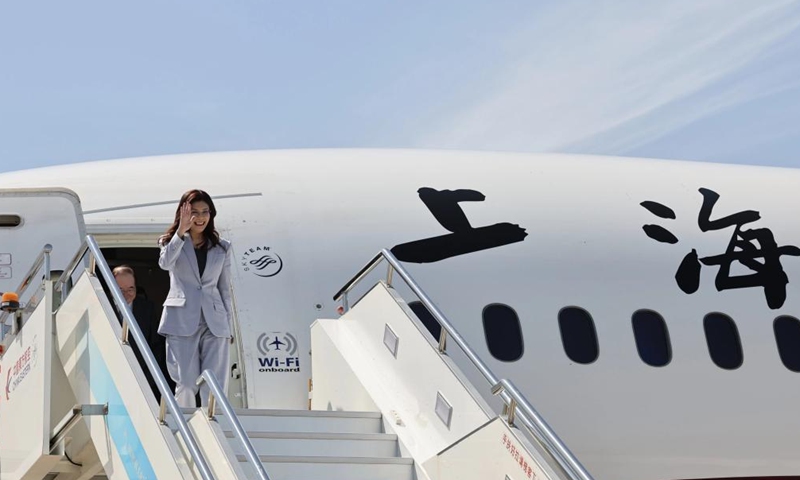
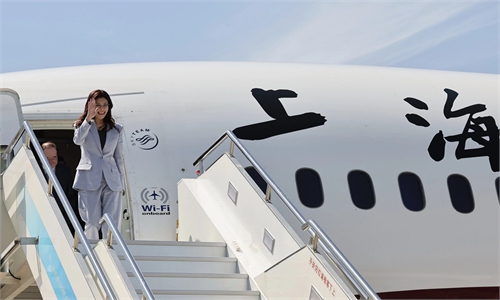
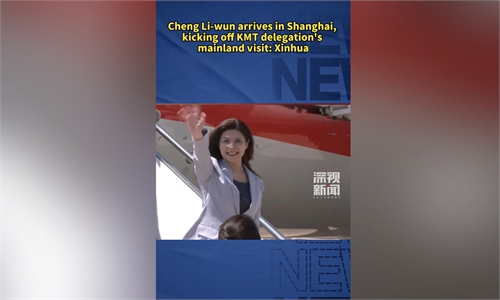
A delegation of the Chinese Kuomintang (KMT) party, led by its chairwoman Cheng Li-wun for a mainland visit, arrives at Shanghai Hongqiao International Airport, in Shanghai, east China, April 7, 2026. The delegation arrived here on Tuesday for a mainland visit that will run through Sunday. (Xinhua/Xing Guangli)
At the invitation of the Communist Party of China (CPC) Central Committee and Xi Jinping, general secretary of the CPC Central Committee, Cheng Li-wun, chairperson of the Chinese Kuomintang (KMT) party, led a delegation to Nanjing on Tuesday after first arriving in Shanghai, beginning a six-day visit to the mainland. This is the first time in nearly a decade that the chairperson of the KMT has led a delegation to visit the mainland, which has garnered intense attention from media across the Straits and internationally. No sooner had news of the delegation's arrival in Shanghai been released than expressions of the sentiment that "the two sides of the Straits are one family" began flooding the internet. This clearly demonstrates that strengthening cross-Straits exchanges and cooperation, and safeguarding the overarching framework of peace and development across the Taiwan Straits, are the common voice and mainstream public opinion of both sides of the Straits.
Amid a turbulent international landscape, the welcome extended to Cheng underscores the consistency, continuity, and stability of the central government's policy toward Taiwan. Prior to her departure, the KMT released a list of the 14 delegates comprising the visiting delegation. Accompanying Cheng were Chang Jung-kung, who played a pivotal role in facilitating Lien Chan's visit to the mainland in 2005 and serves as the current KMT vice chairman, as well as Su Chi, who originally coined the term "1992 Consensus." Thus, it isn't coincidental that the "1992 Consensus" has emerged as an important keyword defining Cheng's visit to the mainland.
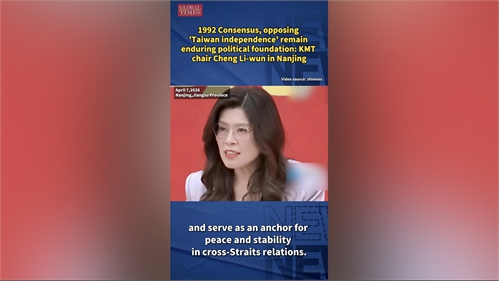
This consensus serves simultaneously as the shared political foundation for strengthening exchanges and dialogue between the mainland and various political parties including the KMT, organizations, and figures from all walks of life in Taiwan. It is an immutable principle and clear bottom line; it constitutes the essential prerequisite for compatriots on both sides of the Taiwan Straits to unite their hearts and join forces for a common cause.
This visit is timely and resonates with the concerns of the Taiwan public. For some time now, the DPP authorities have stubbornly clung to a separatist stance advocating "Taiwan independence," refusing to acknowledge the "1992 Consensus," which embodies the one-China principle. They have continuously colluded with external forces to engage in provocative acts aimed at "independence," wantonly undermining the foundations of cross-Straits exchange and cooperation. This has resulted in tension and instability across the Taiwan Straits, casting a pall of military peril and conflict over the region, and gravely threatening the safety, property, and vital interests of Taiwan residents. The residents of Taiwan have suffered deeply from this situation and yearn for a peaceful and stable living environment, unimpeded cross-Straits exchanges, and economic prospects that allow for secure and steady development. Cheng's ongoing visit, themed the "2026 Journey of Peace," clearly upholds the "1992 Consensus" and opposes "Taiwan independence," thereby conveying the authentic public sentiment prevailing on the island. The communication and dialogue between the KMT and the CPC will curb separatist activities aimed at "Taiwan independence," counter external interference, and steer cross-Straits relations back onto the correct path of peaceful development.
Cheng's visit is an important part of the exchanges between the KMT party and the CPC under the new circumstances. Since former KMT chairman Lien Chan's "ice-breaking visit" in 2005, then-KMT chairpersons including Wu Po-hsiung, Eric Chu, and Hung Hsiu-chu have all visited the mainland on the political basis of recognizing the "1992 Consensus," actively promoting peaceful cross-Straits exchanges and cooperative development. This time, Cheng led a delegation to the mainland despite the shadow of "green terror" on the island, responding to public concerns and aligning with the course of history through concrete actions. Her courage and sense of responsibility deserve recognition.
Since assuming the role of the chairperson of the KMT, Cheng has repeatedly expressed her desire to visit the mainland. The shared bloodline, cultural bond, and historical identity between people across the Straits cannot be severed. As seen in the continued popularity of mainland TV dramas in Taiwan - from My Fair Princess more than 20 years ago to today's Swords Into Plowshares - Chinese culture remains the common root and spiritual home of people on both sides of the Straits. Even the countercurrent of "Taiwan independence" cannot stop the growing momentum of closer ties and exchanges between people on both sides of the Straits. Last year, residents from Taiwan made 4.8918 million visits to the mainland, a year-on-year increase of 21.6 percent; meanwhile, mainland residents made 557,700 visits to Taiwan, a year-on-year increase of 47.4 percent.
Peace, development, exchange, and cooperation have consistently been the mainstream public opinion on the island. In recent years, the steady growth of cross-Straits economic and trade ties has completely undermined the separatist narrative and information cocoon promoted by "Taiwan independence" advocates. Last year, total trade between the mainland and Taiwan reached $314.33 billion, with mainland exports to Taiwan growing by 11.2 percent and imports from Taiwan increasing by 6 percent. From January to October last year, 6,423 new Taiwan-funded enterprises were established on the mainland, with actual utilized Taiwan investment reaching $1.75 billion, up 53 percent year on year. These figures clearly demonstrate that despite heightened global economic volatility, cross-Straits economic cooperation remains highly resilient and full of potential.
People on both sides of the Straits are one family. The Taiwan question, in essence, is China's internal affair and should be resolved through consultation among family members. The strengthening of exchanges and dialogues between the KMT and the CPC meets the needs of the development of cross-Straits relations, aligns with the shared aspirations of people on both sides, and serves the fundamental interests of the Chinese nation. It reflects the responsibility of both parties to seek peace across the Taiwan Straits, to improve people's well-being, and to advance national rejuvenation. We welcome Cheng's visit to the mainland and hope it will add positive momentum to safeguarding peace and stability in the Taiwan Straits and enhancing the well-being of people on both sides.
RELATED ARTICLES