Chinese automakers post record exports in March; higher global oil prices boost EV demand: expert
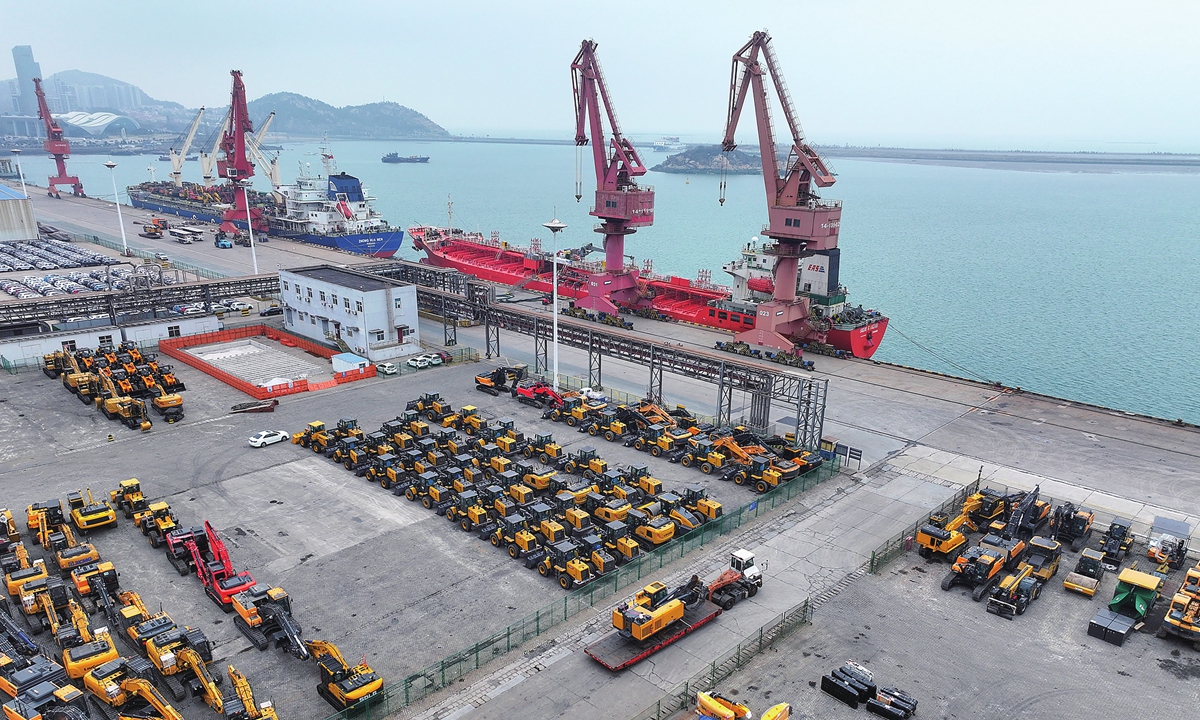
Cargo ships berth at Lianyungang Port in East China's Jiangsu Province, loading construction vehicles and machinery for export on March 15, 2026. Photo: VCG
Several major Chinese automakers have released their March sales results, delivering record-high exports that underscore the rising global competitiveness of China's domestic automotive brands.
BYD exported 119,591 passenger cars and pickups in March, up 65.2 percent year‑on‑year, the company said in a release on its official website.
Chery Group exported nearly 150,000 vehicles in March, the 11th consecutive month of exports exceeding 100,000 units, according to the Xinhua News Agency. New-energy vehicles (NEVs) have become the key driver of Chery's expansion into Europe's high-end market. Chery has a presence in 18 European countries. Of every five Chery NEVs that are exported, one is destined for Europe, Xinhua reported.
Geely Auto, Changan Automobile, Guangzhou Automobile Group Co (GAC) and other prominent domestic brands also set export records in March, reflecting a broad‑based increase in China's auto exports, China Media Group (CMG) reported on Wednesday.
The robust export performance in March was not a short‑term spike, but a continuation of the strong growth seen in the first two months of the year, when exports surged roughly 60 percent year-on-year, Cui Dongshu, secretary-general of the China Passenger Car Association (CPCA), told the Global Times on Wednesday.
According to CPCA data, Chinese carmakers exported 1.55 million vehicles in January and February, a year-on-year increase of 61 percent. NEVs performed exceptionally well, with total exports of 670,000 units, surging 88 percent year-on-year and becoming the primary driver of export growth, with their share continuing to increase.
Cui said that electrification is a core source of competitiveness for Chinese automakers. Backed by a comprehensive and world-leading NEV supply chain, Chinese electric vehicles (EVs) deliver lower operating costs and superior driving experiences compared with traditional fuel-powered cars.
Elevated international oil prices have further stimulated global demand for EVs, while China's strong shipping and logistics capabilities provide reliable supply chain and transportation support to meet surging overseas demand, Cui added.
Chinese automakers are also strategically shifting from pure product exports to broader global integration. Leading firms have established localized overseas operations and management centers to oversee sales networks and after-sales services, steadily improving brand reputation in foreign markets.
Zhang Shengshan, executive deputy general manager of Chery International, told CMG that Chery's production project in Spain involves not only local assembly but also integrated local research and development (R&D), production, supply chain development and marketing, which offer significant strategic value.
Driven by strong overseas demand, nearly 100 percent of Chery's exports to Europe so far this year have been NEVs. In 2025, NEVs accounted for about 30 percent of Chery's total exports of 1.34 million units, and the company expects this share to exceed 70 percent in 2026, Zhang said.
Beyond electrification, intelligent technologies such as smart cockpits and advanced driver‑assistance systems (ADAS) have become key differentiators for Chinese brands.
Rapid technological iteration and sustained investment in R&D enable Chinese carmakers to closely follow global consumer trends and deliver innovative products, Cui added.
On March 12, Geely Auto Group's ADAS, the Qianli Haohan G-ASD, officially obtained UN R171 certification jointly issued by the China Automotive Technology & Research Center and IDIADA, the Global Times learned from Geely Auto Group on Wednesday.
The UN R171 regulation serves as the EU's unified standard for Driver Control Assistance Systems, establishing a unified framework for intelligent mobility across Europe.
It's the first time that a Chinese-developed ADAS has passed this certification, a milestone in the global expansion of China's intelligent driving technology. The first vehicle featuring the certified G-ASD system will hit European roads in June 2026, according to the Geely Auto Group.
Chinese auto brands have accumulated rich experience in overseas markets, expanded their sales networks, improved after-sales services, and built a strong reputation among consumers. In terms of intelligent connectivity, Chinese automakers are overtaking in some areas previously led by American brands, such as autonomous driving and digital cockpits, Zhang Xiang, secretary-general of the International Intelligent Vehicle Engineering Association, told the Global Times on Wednesday.
With continuous technological innovation, rising overseas market share and growing brand recognition, Chinese automakers have gained broad recognition overseas, and positive word-of-mouth among overseas users has encouraged more consumers to choose Chinese brands, Zhang said.
China's auto exports remained resilient in 2025. Exports of NEVs in particular doubled year-on-year to 2.615 million, according to Xinhua.
RELATED ARTICLES