ARTS / CULTURE & LEISURE
Chinese novel unveils rural revitalization and the spirit of new farmers
Drums of revival
By Published: Apr 08, 2026 08:32 PM

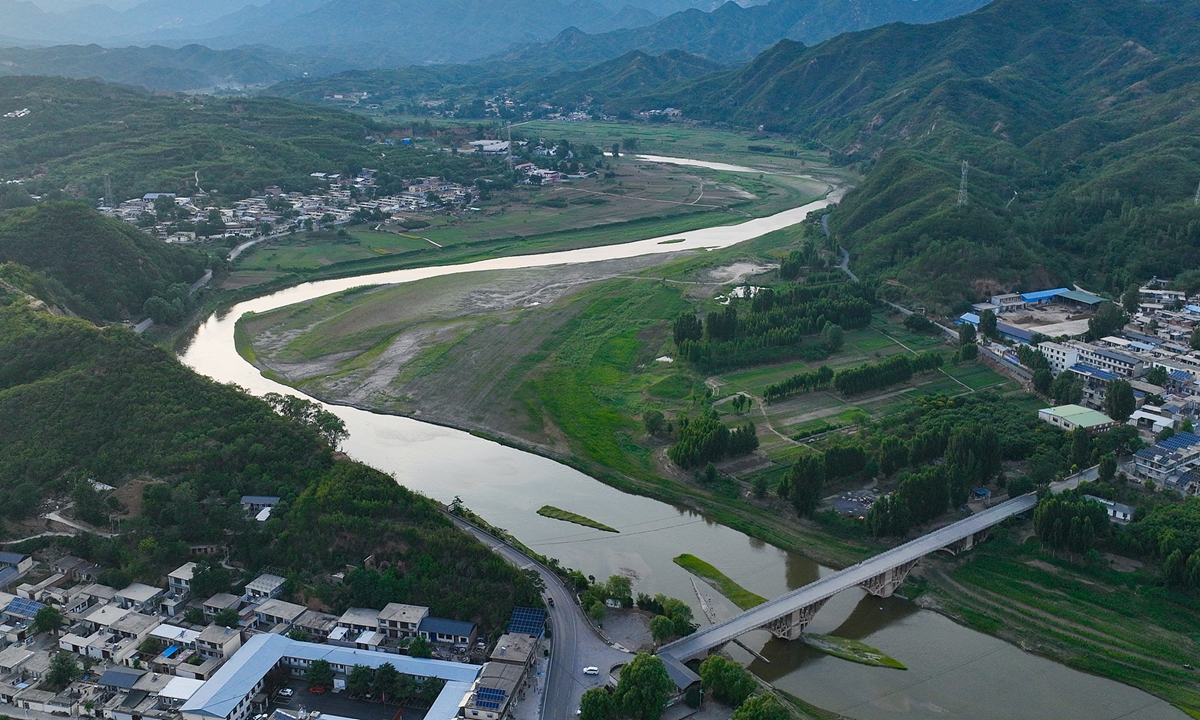
An aerial view of part of the Hutuo River and the villages on both banks in North China's Hebei Province in June 2025. Photo: VCG
In 1948, Chinese writer Ding Ling published The Sun Shines Over the Sanggan River, a novel that reflects the land reform movement and gives voice to Chinese farmers. The book won the Stalin Prize and became a landmark of socialist literature.Now, more than seven decades later, another Chinese novelist from North China's Hebei Province has taken up the same literary lineage. Guan Renshan's latest novel, The Sun Kisses the Hutuo River, released in March, pushes forward into an era of rural revitalization, high-tech agriculture and a new kind of farmer who is not merely surviving, but "growing strong."
Guan told the Global Times in an exclusive interview that the main character arc is deliberate. He traces a clear literary lineage: Ding Ling's The Sun Shines Over the Sanggan River (1948) portrayed the lives of farmers during the land reform. Liu Qing's The Builders (1959) showed them "uniting" under collectivization. Lu Yao's Ordinary World (1986) portrayed the hard-won struggle to "get rich" in the reform era.
What has been missing, Guan argues, is a hero for the age of rural revitalization - a farmer who is confident, resilient and forward-looking.
"I hope readers can see how Chinese farmers in the new era have come this far," he said.
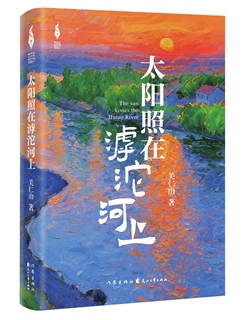
The Sun Kisses the Hutuo River by Guan Renshan Photo: Courtesy of The Writers Publishing House
Image of the 'strong farmer'
Set in Yuanta village, a semi-suburban village on the banks of the Hutuo River in Hebei Province, the novel spans four decades from the early 1980s to the present day.
The real-life inspiration, Zhengding county's Tayuanzhuang village, was once a struggling community hit by drought and poverty.
Today, according to Guan, it boasts an annual collective income of nearly 40 million yuan ($5.83 million). Villagers live in high-rises, receive free eggs and vegetables daily, and enjoy collective support for education and elderly care. The local enterprise now sells its steamed buns in supermarkets across Shanghai, Beijing and Guangdong.
But Guan, a Lu Xun Literary Prize winner, is after something deeper than statistics. The novel's protagonist, Hong Mancang, is a composite figure drawn from the village's real-life entrepreneurs.
Hong's story is anything but a smooth rise. He takes over a failing flour mill, battles obsolete machinery, scrapes together cash to hire engineers, and then, in a moment of legal naivety, is convicted of "speculation" and sent to prison. After release, he starts again, eventually leading his village to shared prosperity.
"He is not arrogant when he succeeds, nor despairing when he fails," Guan told the Global Times. "He has a market vision and ecological awareness that sets him apart from the traditional peasant stereotype."
That hero carries the DNA of his region. Zhengding is the hometown of Zhao Zilong, the legendary Three Kingdoms-era general known for his courage and loyalty. Hong's grit, Guan says, is a modern echo of that ancient spirit.
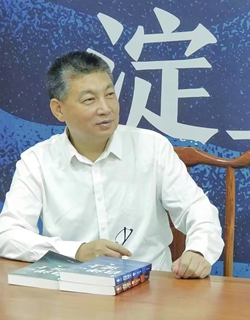
Guan Renshan Photo: Courtesy of The Writers Publishing House
Call of the drums
Perhaps the most distinctive thread in the novel is the Changshan war drum, a national-level intangible cultural heritage native to Zhengding county. Local folklore tells that Zhao directed his soldiers to beat drums to boost morale on the battlefield and succeeded in frightening their enemies away.
In 1990, neighboring villages' drum troupes performed at the Asian Games opening ceremony. But the tradition nearly died out during the early years of market reform, as villagers turned their attention to making money.
In The Sun Kisses the Hutuo River, the drum is not mere decoration. It becomes Hong's spiritual anchor.
At a moment of crisis when his flour mill is on the verge of collapse, his father beats a rhythm that unlocks a breakthrough idea. Guan then pulls the drum back into the realm of the symbolic.
"The drum has become a spiritual need. It becomes part of life," Guan explained.
In the novel's climax, Hong Mancang's son proposes fusing the war drum with modern instruments - saxophone, suona - to attract younger audiences. The old man resists at first, then accepts. It is a quiet but powerful metaphor for how tradition and innovation can coexist, each enriching the other.
Guan is careful not to sugarcoat the realities of rural transformation. The novel does not shy away from the problems of society.
"The deep struggles beneath the surface are no less intense than those during land reform," he said.
Different interests, including the leading enterprises, village collectives, and smallholders, engage in constant negotiation, sometimes conflict, but also mutual nourishment.
What emerges is what Guan calls the "Tayuanzhuang model": a system of secondary distribution where villagers receive daily benefits like eggs and vegetables rather than lump-sum payouts that might fuel gambling or waste. It is designed to create sustained well-being rather than sudden windfalls.
"To strengthen the nation, we must strengthen agriculture," Guan said.
"On the banks of the Hutuo River, a new kind of farmer has been born - one whose story intertwines individual struggle, village governance, economic reform and a search for a spiritual home."
RELATED ARTICLES