IN-DEPTH / IN-DEPTH
Where have US’ China Hands gone? Shortage of China experts leads US to be ill-informed and disoriented in formulating its China policy, experts warned
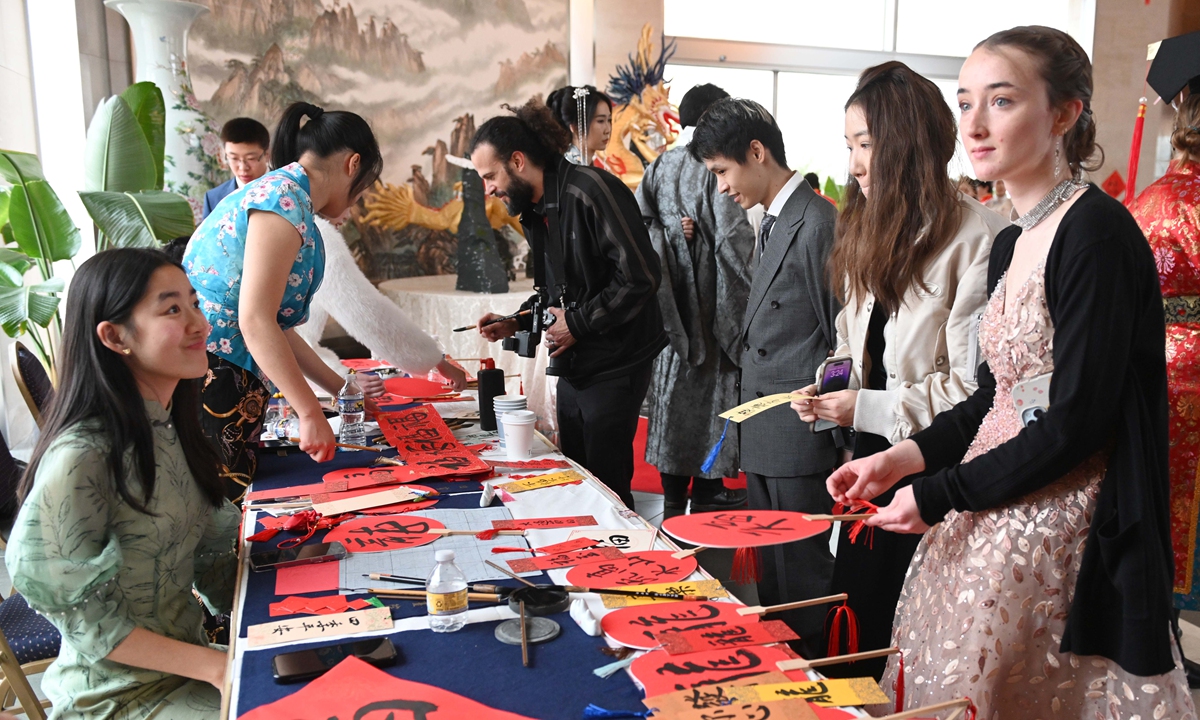
Chinese and American youths attend an event to celebrate the 45th anniversary of the China-US student exchanges held by the Chinese Embassy in the US on January 28, 2024. Photo: VCG
America's ability to understand and manage its most consequential strategic relationship is eroding. Fewer than 2,000 Americans per year are currently estimated to be studying in China compared to 11,000 in 2019, according to a latest report released by the Washington-based non-profit US-China Education Trust (USCET).
If this pattern persists, the critical shortage will become a reality "as today's specialists with deep in-country experience retire without replacement," David M. Lampton, 80 years old, chair of the working group of the report and a renowned "China Hand" in the US, said in the foreword of the report.
At the launching ceremony of the report on March 20, Nicholas Burns, the US ambassador to China under President Joe Biden, said it would be "a national security imperative," referring to American students studying in China, according to The South China Morning Post.
Not only in the research sphere, in the politics circle, the US is also witnessing a downward trend in the number of officials with practical experiences in dealing with China. "US leaders need to see what's happening in China," read the title of an opinion article published by The New York Times on March 22.
If these trends continue, the US will get ill-informed and disoriented in formulating its China policy, putting the entire American China studies system - which the US itself built after World War II - at risk of generational collapse, warned Mei Yang, an expert in China-US defense and security affairs from The Institute for International Affairs, The Chinese University of Hong Kong (Shenzhen).
Declining China experts
China experts in the US refer to American specialists in overseas China studies with a focus primarily on political science, strategic studies and international relations, and are mainly devoted to research on contemporary and practical issues concerning China, according to Mei.
Among them, some actively participated in the two sides' exchanges and exerted influence in the US' China policies, for example, Henry Kissinger, the eminent US diplomat and strategist who played a pivotal role in shaping China-US relations as he spearheaded the historic normalization process. This group is also dubbed China Hands.
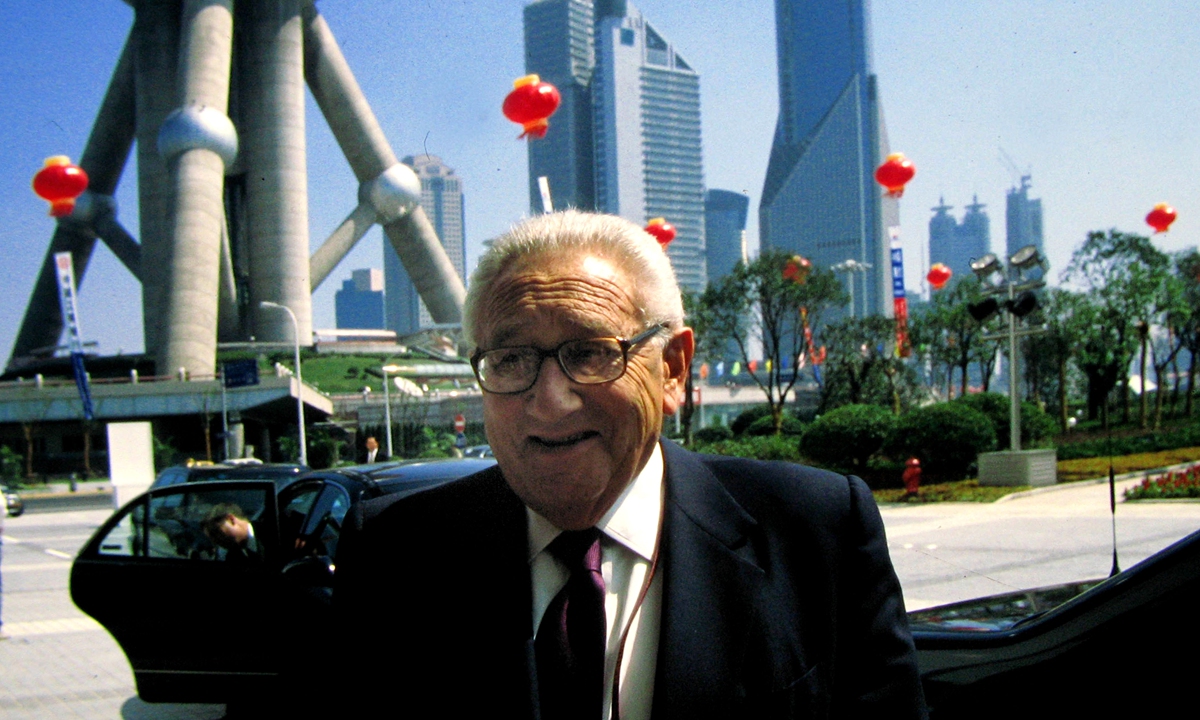
Picture shows former US Secretary of State Henry Kissinger in Shanghai in October 1999. Photo: VCG
Veteran China Hands like Kissinger usually maintained close connections with various sectors of Chinese society, possessed a solid command of Chinese and conducted regular field research in China. This allowed them to develop a relatively profound understanding of Chinese culture and realities. Even when they held personal differing views, these were rooted in on-the-ground observations of China, with Robert D. Barnett, an affiliate of the Lau China Institute at King's College of London, being one such example, Mei explained.
Other renowned American China Hands include Kenneth Lieberthal, Professor Emeritus at the University of Michigan, and Thomas Christensen, Director of the China and the World Program at Columbia University.
Many veteran China Hands began studying China in the 1960s and 1970s. They saw their research coincide with the gradual normalization of China US relations, as well as China's shift from isolation to reform and opening up and from underdevelopment to progress. Thus, they generally held optimistic and favorable views toward China, Da Wei, director of Center for International Security and Strategy at Tsinghua University, told the Global Times.
However, the group of veteran China Hands is facing a risk of a generational gap with no adequate successors to take over. "If we take 1975 as the dividing line, or classify middle-aged and young experts from senior ones by the age of 50, the US has already encountered a serious generational gap among veteran China Hands. Scholars under 50 are few while most scholars over 50 are generally over 70 and facing retirement," Mei told the Global Times.
In 2015, China Foreign Affairs University released a list of influential China Hands in the US, based on their impact on US policy-making, academic influence and social influence. Lampton topped the list, followed by David Shambaugh, the founding Director of the China Policy Program in the Elliott School of International Affairs at George Washington University, and Avery Goldstein, the Inaugural Director of the Center for the Study of Contemporary China at the University of Pennsylvania. The Global Times found that all 10 candidates on the list were born no later than 1975, and eight of them were aged over 70 as of 2026.
The youngest among the top 10 was M. Taylor Fravel, director of MIT Security Studies Program who focuses on international security, China, and East Asia, according to an introduction of him on MIT website. He was reportedly born in 1971.
Beyond general gap risk, veteran China Hands in the US have increasingly returned to academic research at universities, with their students similarly gravitating toward higher education. Consequently, the discourse power over China policy has gradually shifted to think tanks. A growing divide has thus emerged in US' China studies between the university-based "academic camp" and the think tank-led "policy camp," with policy-oriented research from think tanks increasingly gaining the upper hand, Mei said.
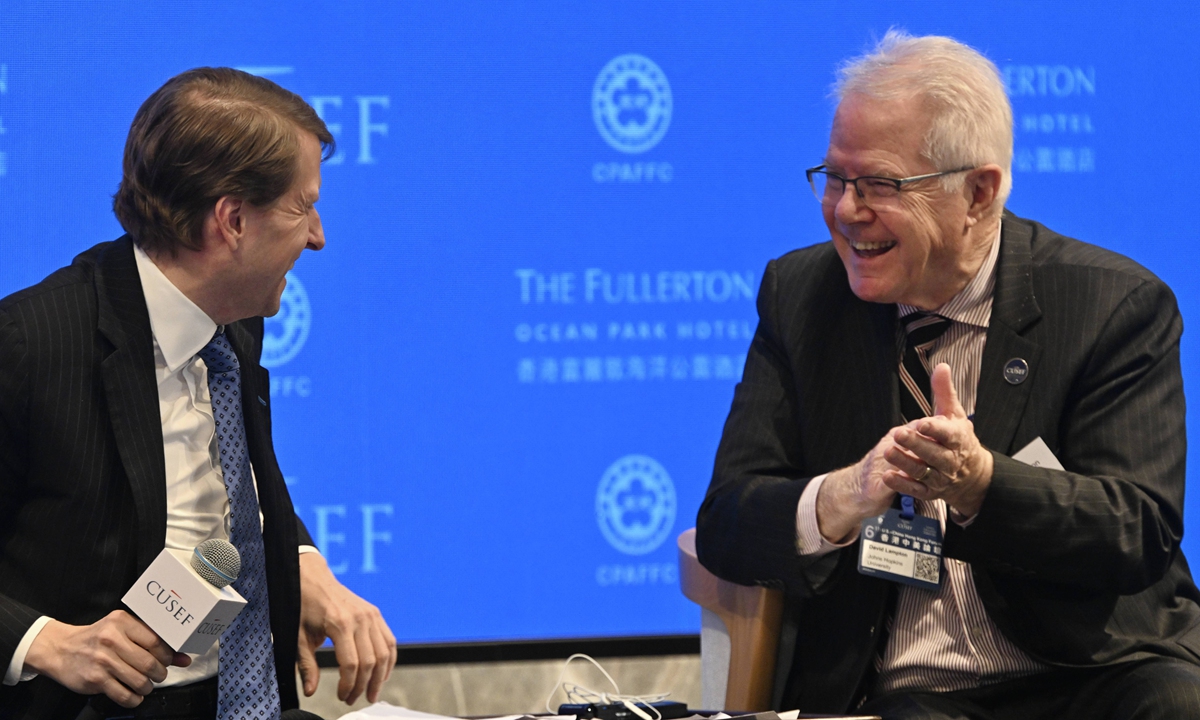
David Lampton (right) attends the US-China Hong Kong Forum on November 17, 2025, in Hong Kong, China. Photo: VCG
According to Mei, the younger generation China experts also present a notable shift in research interest toward military and security issues.
This not only underscores the growing adversarial dynamics in future China-US relations, but also suggests that the new generation of China Hands who will shape the bilateral relationship over an extended period may adopt a more objective, and even detached, attitude toward China. They treat China as a country for calm, dispassionate analysis, rather than a field for in-depth exploration of its historical and cultural connotations, infused with personal sentiment and academic idealism. Against this backdrop, many China Hands are no longer broadly knowledgeable about China; instead, they focus narrowly on specific issues concerning the country, he analyzed.
In this point, Michael S. Chase, former US deputy assistant secretary of defense for China, whose expertise lies in China's maritime security and military modernization, serves as a typical example.
"While well researched on military reforms and naval capabilities, Chase shows little interest in other dimensions of China. This shows a sharp contrast to his mentor Lampton, who grasps China holistically and practices empathetic understanding. Chase maintains an objective and distant stance," Mei said.
Chilling effect
Apart from the internal elements, the toxic political environment and intensified policies play a more vital role in the declining of America's China experts. "Undoubtedly, a 'chilling effect' has emerged in the US regarding engagement with China. China-US people-to-people and cultural exchanges have been significantly 'securitized,'" Zhao Minghao, an expert at the Institute of International Studies, Fudan University, told the Global Times.
According to the USCET report, in the US, federal funding for China-focused study has declined sharply, and many longstanding exchange programs have been suspended. Heightened US university research security rules and new state-level restrictions on university engagement with China have further reduced opportunities for academic travel.
Since the US adopted the "great-power competition" strategy toward China in 2017, the US government has imposed a host of restrictive measures on people-to-people exchanges between the two countries, particularly educational interaction. During that period, the US Department of Justice launched the "China Initiative," and agencies including the Federal Bureau of Investigation targeted Chinese American scientists with ties to China, Zhao said.
During the Biden administration, while Washington formally scrapped the China Initiative in name, it has continued to restrict China-related cooperation at US universities and research institutions. Under this circumstance, many US colleges and universities have suspended partnerships with Chinese institutions, even explicitly restricting faculty and staff travel to China, and warning American students that visiting or studying in China carries security risks such as "wrongful detention," according to Zhao.
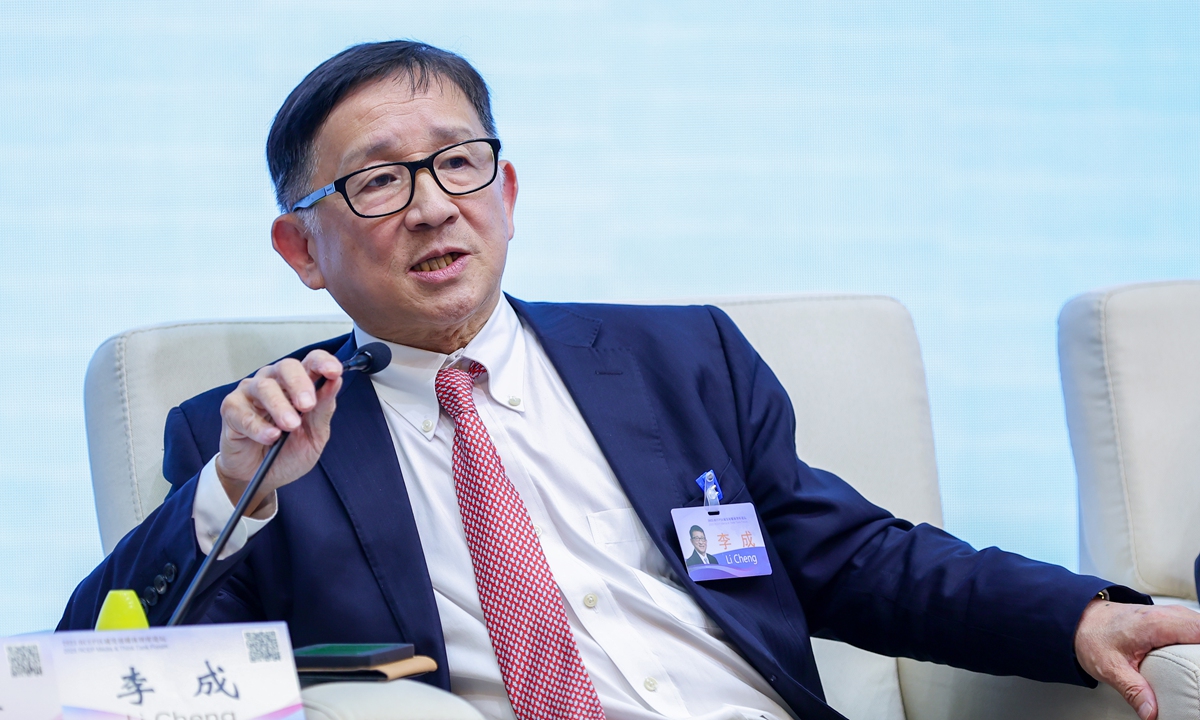
Li Cheng speaks at a forum held on May 24, 2025, in Haikou, capital of South China's Hainan Province. Photo: VCG
Li Cheng, a Chinese American political science expert and a China Hand listed on the abovementioned list, returned to China in 2023 after living in the US for nearly 40 years. He is now a professor of political science and founding director of the Centre on Contemporary China and the World at the University of Hong Kong.
In an interview with the Lianhe Zaobao in July 2023, Li said that life in the US has grown more uncomfortable for Chinese Americans. He said that he is increasingly asked to clarify which side he represents during public speeches. "When I say 'we,' people ask: Who exactly do you mean by 'we'?" Li was quoted as saying by the newspaper.
The "decoupling" from China pushed by the US government in recent years has effectively weakened Americans' access to professional knowledge about China in the name of national security. Any American scholar whose research agenda involves China may face investigations by the federal government, or be denounced by the US officials on social media for assisting China's development. This has further reduced the number of young people coming to China to study the Chinese language and culture, Mei said.
As the USCET report noted, today, American students and scholars are deterred from studying in China because of a widespread perception that such experience will prevent them from obtaining a security clearance for a US government job in the future.
Mei deemed the Trump administration's two terms in office were eight years that witnessed the declining of America's China Hands. He noted that some hardline China experts, such as Miles Yu and Michael Pillsbury (who emphasized the "China threat" rhetoric, claiming that China seeks expansion and to surpass the US), were hired during the Trump administration's first term. However, now, in its second term, even hardline China experts have been excluded from the government's decision-making circle.
Exchanges needed
In the eyes of Da, China is developing and updating its concepts at a rapid pace, yet the current generation of American China Hands lacks on-the-ground experience and is unable to develop a nuanced and accurate understanding of the country.
Universities and institutes in the US have been aware of this crisis and are making sincere efforts to restore bilateral exchanges, including the National Committee on US-China Relations, the Asia Society, and the Institute for America, China, and the Future of Global Affairs at Johns Hopkins University. Former US Ambassador to China Max Baucus, a native of Montana, has in recent years personally led student delegations from the state on visits to China on multiple occasions, Zhao noted.
The launch of the initiative to invite 50,000 young Americans to China for exchange and study programs over a five-year period has also helped to boost educational and cultural exchanges between the two countries. As of January 2026, over 40,000 US youth have actively participated in the initiative, according to the Chinese Foreign Ministry.
Da called for more favorable policies to make it easier for American students to study and work in China. "Over time, these students will grow into a new generation of China Hands."
This year is a vital year for the China-US relationship with a series of planned interactions between the two sides. We also hope that renewed engagement in the field of education between the two sides will achieve fresh progress as this represents a major and positive development serving the long-term interests of both countries, Zhao said.
RELATED ARTICLES