Illustration: Chen Xia/GT
With Oracle reportedly cutting thousands of jobs and becoming the latest US technology giant to announce massive layoffs while ramping up artificial intelligence (AI) investment, the debate over AI's impact on jobs is again in the spotlight. The pressing questions remain: Is the rise of AI destined to bring about massive job losses? Will the "AI-related layoffs" model embraced by US tech giants become the global industry's standard response to the AI era?To answer these questions, it is necessary to look back at a similar period of technological change for a more rational perspective based on industrial reality. Over the past decades, automation has become a critical tool for boosting productivity, and robot density - the number of industrial robots per 10,000 employees - is a key indicator of each economy's performance in the global automation race.
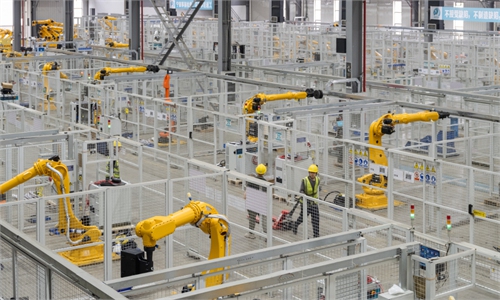
Years ago, when industrial robots began to enter factories on a large scale and replace some manual labor, there were worries about a wave of mass unemployment as workers would face the risk of being replaced. However, the answer given by reality has dispelled this anxiety. China, with a robot density of 470 robots - far above the global average - did not experience mass unemployment. Instead, the widespread use of robots significantly improved automation levels, production efficiency, and product quality, strengthening the competitiveness of Chinese manufacturing.
At the same time, the automation process has led to a host of new jobs in robot research and development (R&D), manufacturing, maintenance, and system integration. Past experience clearly shows that technological progress itself is not equivalent to job losses. Its essence is the optimization and upgrading of production methods, which ultimately drives industrial iteration and creates new jobs.
The same logic applies to AI. As a core driving force of the new technological revolution and industrial transformation, AI's forward momentum is irreversible. Just like industrial robots in the past, AI will inevitably affect some traditional jobs. The wave of layoffs at US tech giants - Oracle, Amazon, Microsoft and others - is a direct manifestation of this impact. To gain a competitive edge, these companies are betting on efficiency gains from AI, which allows them to cut jobs in certain traditional roles. However, it must be made clear that "AI-related layoffs" are not the only path for AI development, nor should they be seen as the "standard answer."
Economies around the world are actively developing their AI industries. Given differences in national conditions, industrial structures, and policy orientations, the outcomes of AI development are bound to be diverse. Take China as an example: the deep integration of AI with various industries has given rise to new sectors such as intelligent healthcare, smart transportation, and smart agriculture. These not only drive the prosperity of related industrial chains but also create new jobs. In recent years, a wide range of AI-related new professions has emerged in China, spanning technological R&D, data services, product applications, and content creation.
In this sense, some US tech giants' "layoffs" script is not the only answer to AI development. The application of robots from the industrial automation era has shown that the ultimate goal of technological progress is to empower people and drive social progress - not to fuel anxiety over job losses. Different economies will likely give different answers to AI's employment impact.
Faced with AI-driven changes, each economy needs to refer to its own national conditions and explore a path that balances innovation and stability, so as to promote AI development while actively fostering new job growth, thus making AI a true driver of high-quality development and improved public well-being.
RELATED ARTICLES