Countdown to China’s zero-tariff policy for African exports
Move to strengthen BRI cooperation, help continent move up the value chain
By Published: Apr 09, 2026 09:03 PM

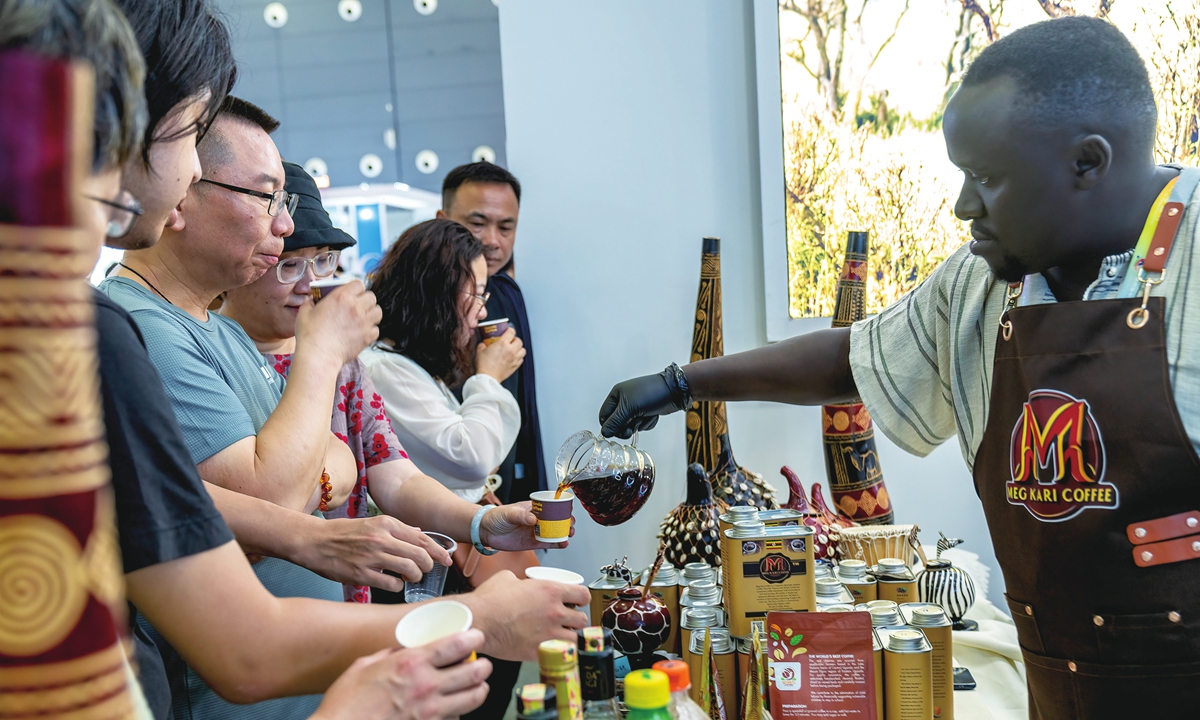
Ethiopian coffee attracts large crowds of local visitors for tastings at the fourth China-Africa Economic and Trade Expo in Changsha, Central China's Hunan Province, on June 14, 2025. Photo: VCG
Wu Yankun, chairman of Kunshan Zhongka Agricultural Products Trading Co, has just returned from a visit to Kenya organized by the China Council for the Promotion of International Trade (CCPIT).
"It was a very fruitful visit," Wu told the Global Times on Thursday, as the company has initiated a procurement plan for 1,000 tons of Kenyan coffee beans. During the visit, the company also established links with 10 Kenya-based coffee enterprises on site, with four agreeing to send samples and pursue deeper cooperation, and two planning to visit Kunshan, East China's Jiangsu Province in the near future.
Wu also held in-depth discussions with the CEO of the Kenya Coffee Board and multiple relevant departments on specialized topics, including the joint establishment of a Kenyan coffee tasting center, the promotion of coffee trade, and industrial chain cooperation. These engagements aim to drive the formation of practical and tangible cooperation outcomes, Wu added.
Wu is one of a delegation of Chinese entrepreneurs organized by CCPIT to Kenya and South Africa in late March.
Taking advantage of China's forthcoming implementation of zero tariffs on 100 percent of tariff lines for African products, the visit aims to promote practical economic and trade cooperation between China and South Africa, and to "turn China's vast market into major opportunities for Africa," the Global Times learned from CCPIT.
Effective May 1, China will implement zero tariffs on 100 percent of tariff lines for products from 53 African countries with diplomatic ties. This policy covers all product categories, with no quota restrictions or additional political conditions, according to China's Foreign Ministry.
The new policy also marks a further expansion of the existing tariff arrangement, under which China, since December 1, 2024, has granted zero-tariff treatment to 100 percent of tariff lines for products from 33 least developed African countries with diplomatic ties to China.
Observers say the move will strengthen China-Africa economic cooperation under the Belt and Road Initiative (BRI), helping Africa shift exports from raw materials toward high value-added products. Such a win-win cooperation model also offers the world a paradigm of equality, mutual benefit, and common development, they said.
Unlocking the Chinese market
Shang Xiangmin, co-founder and vice president of Chagee Holdings Limited, is also among a Chinese business delegation visiting Africa in recent days. The Global Times learned that the company, well known for its fresh milk tea products, has carried out field research on local tea varieties, processing techniques, prices, and production capacity during the visit.
During the visit, the Chinese retailer held discussions with five tea factories, whose main products are black tea, with some also producing white and oolong tea. The Chinese company will continue to follow up on these opportunities.
Likewise, more African agricultural products are now bracing for new opportunities in the vast Chinese market - driven by the zero-tariff arrangement, the country's rising middle-income group and a consumption upgrade trend.
On March 23, the first export consignment under the zero-tariff arrangement was officially flagged off at the Standard Gauge Railway Terminus in Nairobi, Kenya. The consignment contained fresh avocados, avocado oil, hides and skins, coffee, and green beans, according to a statement on the website of Kenya's Ministry of Investments, Trade and Industry.
North African country Morocco will launch the "Morocco Pavilion" in Chinese e-commerce platform JD.com in June, aiming to establish an official online destination for Moroccan products, a consultant at the Moroccan Embassy in Beijing told the Global Times on Thursday. The pavilion mainly sells cosmetic products, clothing such as leather bags and shoes, as well as processed sardines and exotic fruit products, and will introduce more specialty products of Morocco such as wine in the future.
Toumert AI, former general secretary of the China-Morocco Friendship Association and secretary general to the Morocco-China alliance of innovation, told the Global Times on Thursday that under the zero-tariff policy, Africa's export expansion to China will likely move beyond raw materials toward high-potential and high-value-added categories.
For example, in line with China's growing middle-income demand for health, traceability, and authenticity, more African premium agricultural and food products will be exported to China, such as argan oil, olive oil, specialty coffee, cocoa derivatives, fish and processed foods, according to Toumert. He also cited examples of expanding exports such as semi-processed and value-added industrial goods, "particularly in sectors where Africa can leverage regional industrialization policies."
Diversified, value-added integration
Toumert noted that with the implementation of the zero-tariff policy, he expects the trade and economic relationship between China and Africa to move from "traditional resource-driven exchange" to "diversified, value-added integration," which is aligned with the blueprint of BRI high-quality development.
Yoro Diallo, a 2024 Recipient of the Chinese Government Friendship Award and former first counselor of the Embassy of Mali to Beijing, told the Global Times the further opening of the Chinese market will bring valuable export opportunities for millions of cotton farmers, mining workers, as well as Mali's agricultural and mineral products.
"Mali is a major cotton producer and the third-largest gold producer in Africa. Currently, Malian goods mainly enter the Chinese market through two major hubs of Yiwu, East China's Zhejiang Province and Guangzhou, South China's Guangdong Province. This is a direct result of the deepening cooperation between China and Mali under China's opening-up policy," he noted.
Analysts believe the zero-tariff initiative will act as a two-way opening channel. On the one hand, it enables African countries to expand their export scale and accelerate industrial upgrading and value chain enhancement. On the other hand, more high-quality African products — those with local processing capabilities and brand value — will enter the Chinese market with greater cost-effectiveness, further enriching consumer choices and achieving mutual benefit and win-win outcomes.
The initiative will also resonate with other BRI flagship projects in Africa, including basic infrastructure projects such as roads, railways, bridges and electricity, as well as capacity-building platforms such as the Luban Workshop, analysts pointed out. This synergy will enable Africa not only to better serve its domestic market but also to accommodate and integrate more deeply into the global industrial chain.
RELATED ARTICLES