Four visits in four years – why are China-Spain relations so ‘resilient’?: Global Times editorial
China Spain Photo: VCG
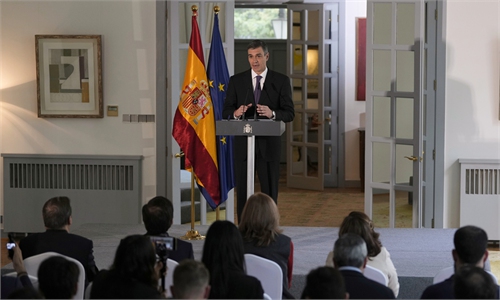
Spanish Prime Minister Pedro Sánchez will pay an official visit to China from April 11 to 15. This marks his fourth visit to China in four years; coming shortly after the visits by both the Spanish King and the prime minister last year, it represents yet another significant high-level exchange between China and Spain within a relatively short timeframe, underscoring the continuity and stability of Spain's policy toward China. At a time when the global landscape is undergoing profound changes and China-Europe relations face complex challenges, China and Spain - guided by political resolve and strategic foresight - vividly exemplify the true meaning of a "resilient partnership."
Prime Minister Sánchez has stated that a visit to China should be an annual undertaking. Underlying this stance is the Spanish government's profound commitment to China-Spain relations and a testament to the political mutual trust between the two sides. The two nations engage in continuous high-level strategic dialogue, ensuring that they can conduct in-depth and direct exchanges on major international and bilateral issues.
From the frequent meetings held between their heads of state and government to the signing of the Action Plan for Strengthening the Comprehensive Strategic Partnership between the People's Republic of China and the Kingdom of Spain (2025-2028), the China-Spain comprehensive strategic partnership continues to advance steadily in the right direction.
Active and pragmatic cooperation serves as the "ballast" of China-Spain relations. In 2025, the bilateral trade volume in goods between China and Spain exceeded $55 billion - a year-on-year increase of 9.8 percent - firmly cementing China's position as Spain's largest trading partner outside the European Union. This cooperation has moved beyond the traditional complementarity of agricultural products, extending into fields of "new quality productive forces," such as green energy, electric vehicles, and the digital economy. Iconic projects, such as the battery plant jointly built by CATL and Stellantis in the Aragon region of Spain and Chery's new-energy vehicle production line in Barcelona, stand as prime examples of Chinese technology "going global," while also representing Spain's strategic choice to realize its own green industrial transformation.
During his visit to China accompanying the King, Spain's Minister of Economy, Trade and Business Carlos Cuerpo stated unequivocally that China is an undeniable priority for Spain. This pragmatic policy is, in essence, a responsible approach toward the development of the nation's industries and the well-being of its people. Experience has proven that cooperation with China is by no means a so-called "risk," but rather an opportunity to foster economic growth and safeguard employment.
While some countries still waver between "de-risking" and cooperation in terms of their China policy, Spain demonstrates foresight that goes beyond short-term fluctuations. This stability is rooted in the two countries' mutual respect for sovereignty and territorial integrity, as well as their shared commitment to multilateralism and international law. Spain's international outlook of opposing bullying and seeking cooperation aligns closely with China's. At a time marked by frequent regional conflicts and heightened geopolitical tensions, Spain, together with China, has upheld the purposes of the UN Charter, injecting much-needed positive energy into a turbulent world.
The stability and deepening of China-Spain relations have long surpassed the bilateral scope, increasingly serving as a model for China-EU relations. Spain tends to view China's development as an opportunity rather than a challenge. On sensitive issues such as the EU's "anti-subsidy investigation" into Chinese electric vehicles, Spain has consistently played a "lubricating" role between Brussels and Beijing, easing tensions and seeking consensus.
Against the backdrop of diverging voices within the EU on China policy and a rising trend of protectionism, Spain's attitude and action toward rational cooperation with China is particularly valuable.
A recent commentary in Spain's El País highlighted a key point: Prime Minister Sánchez is the first Spanish prime minister to visit China so frequently, but this is not particularly unusual in Europe.
In recent months especially, Western leaders have made frequent visits to China, making cooperation with China a common diplomatic priority amid global turbulence. El País noted that former German chancellor Angela Merkel visited China 12 times; French President Emmanuel Macron made his fourth official visit last December; and in January this year, UK Prime Minister Keir Starmer became the first British leader in eight years to visit China. From this perspective, Sánchez's four visits in four years are far from exceptional. His upcoming visit reflects a trend among Western countries to strengthen engagement with China and pursue mutually beneficial cooperation.
An ever accumulating public support provides the deeper driving force behind the steady and long-term development of China-Spain relations. Data from an authoritative Spanish polling institution show that over 74 percent of Spanish respondents hold a positive view of bilateral ties. How to align with the high-quality development of China during its 15th Five-Year Plan period (2026-30) to support the upgrading of Spain's key industries has become a recurring topic in Spanish media. In 2025, the number of Chinese tourists visiting Spain approached 800,000, while business travel from Spain to China has also grown rapidly. These growing people-to-people exchanges are converging into a powerful current of public support against "decoupling" and supply chain fragmentation.
More than two decades of comprehensive strategic partnership between China and Spain have demonstrated that countries with different histories, cultures, and social systems can coexist amicably and pursue common development on the basis of mutual respect and equality. We look forward to and appreciate Spain continuing to serve as a rational force within the EU, using strategic autonomy and pragmatic cooperation as a "warm breeze" to dispel the shadows of geopolitical rivalry, and to translate the stability of China-Spain relations into greater certainty for China-EU relations.
RELATED ARTICLES