Spanish PM Sanchez reportedly to visit China in April; Spain-China coordination a natural move amid stable ties, growing policy autonomy: expert
By and Li Yu Published: Mar 24, 2026 08:50 PM

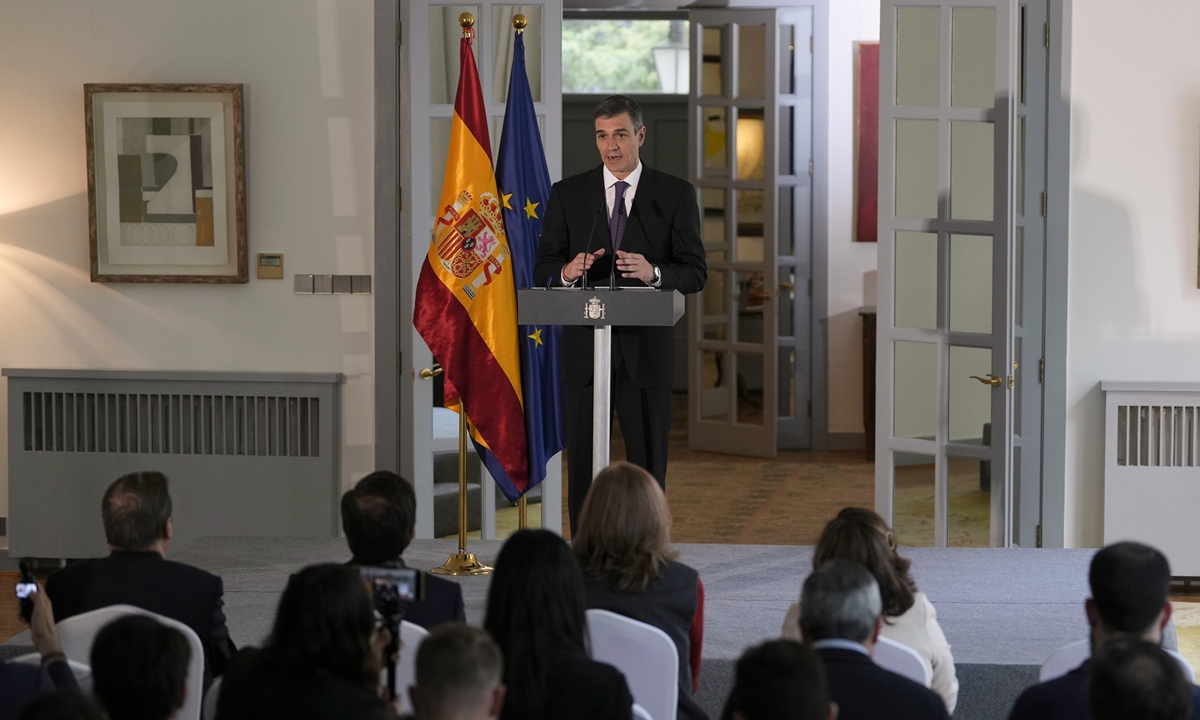
Spain's Prime Minister Pedro Sanchez speaks during a press conference at the Spanish Embassy in Beijing on April 11, 2025. Photo: VCG
Spanish Prime Minister Pedro Sanchez will travel to China from April 13 to 15 for an official visit, his office said on Monday, without giving further details of his schedule, according to AFP. A Chinese expert said that given the stable foundation of China-Spain relations and the growing autonomy of Spain's foreign policy, it is only natural for the two sides to strengthen coordination and dialogue if the visit goes ahead.China and Spain are comprehensive strategic partners. In recent years, bilateral relations have maintained sound momentum. On the visit that you mentioned, I have no information to share at the moment. Please stay tuned, Chinese Foreign Ministry spokesperson Lin Jian said in response to a media inquiry on whether China could confirm or comment on Sanchez's reported official visit to China from April 13 to 15, which his office announced on Monday, and what is China's expectations for the visit.
As of press time on Tuesday, no announcement about the visit had been posted on the Spanish government's website.
News of Sanchez's scheduled visit to China was also reported by the information websites "Spain in English" and "The Diplomat in Spain." While in February, a Bloomberg report citing a person familiar with the preparations as saying that Sanchez is "planning to travel to China in mid-April." El País, one of Spain's leading national newspapers, reported in February that Sanchez would visit China from April 13 to 15, describing it as "his fourth consecutive visit in just over three years" and "an unprecedented move by a Spanish government in terms of its closeness to Beijing."
Sanchez had visited China in April 2025, September 2024 and March 2023, according to the Xinhua News Agency. King Felipe VI of Spain, also paid a state visit to China in November 2025. It marks King Felipe VI's first state visit to the country after his enthronement, and the first visit by a Spanish monarch to China in 18 years, Xinhua reported.
A notable feature of China-Spain relations in recent years has been their stability. Sanchez's frequent visits to China are a clear example. If this trip goes ahead as reported, it will be his fourth visit in four consecutive years, underscoring the important guiding role of leader-level exchanges in bilateral relations, Cui Hongjian, a professor at the Academy of Regional and Global Governance at Beijing Foreign Studies University, told the Global Times on Tuesday.
Spain has stood out in recent years for the stability of its government and the continuity of its foreign policy. Backed by Sanchez's years in office, that stability has allowed Spain to maintain sustained, high-level engagement with China, said Cui.
Cui also noted that as one of the few major European countries where a left-wing government has remained relatively stable, Spain has also shown a stronger preference for international cooperation and dialogue. This is closely tied to Sanchez's role as a prominent figure on the European left and to his government's policy orientation. At a time when Europe is grappling for greater autonomy in its approach to the US, Spain has been one of the most outspoken voices against US policies seen as harming European interests, Cui said.
The AFP report noted that this visit is "Sanchez's fourth trip to China in as many years, comes in the wake of the Spanish leader's fervent criticism of US President Donald Trump over the war against Iran." The report said that the Socialist premier has doubled down on his refrain of "no to the war" and refused Washington's requests to use Madrid's military bases against Iran, despite Trump's threat to sever trade with Spain as a result.
On the foreign policy front, Sanchez has sought to help Spanish companies break into new markets and find new investors for the eurozone's fourth-largest economy, according to the AFP report.
Given the stable foundation of China-Spain relations and the growing autonomy of Spain's foreign policy, it is only natural for the two sides to strengthen coordination and dialogue through a visit to China at this time, Cui said, adding that stepping up coordination during major developments to seek common ground and solutions should also be the norm in China-EU relations.
While as Spain seeks greater autonomy in its US policy, it also faces pressure and a growing need for diplomatic balance. Stronger communication with China and other major countries would help expand its room for maneuver. For Spain, the current situation presents both pressure and opportunity. If handled properly, it could help broaden Spain's diplomatic space and steadily enhance its influence in Europe and beyond, said Cui.
If Sanchez's visit to China materializes, it should also be viewed as part of the broader wave of European leaders visiting China since the second half of last year, reflecting the continuity of Europe's ongoing recalibration of its China policy, Cui said.
Several European leaders have visited China since the beginning of 2026, including Irish Taoiseach Micheal Martin, Finnish Prime Minister Petteri Orpo, British Prime Minister Keir Starmer and German Chancellor Friedrich Merz.
As US policy toward Europe undergoes further change, the greatest pressure facing Europe now comes increasingly from the US itself. In response, many European countries have been adjusting their policies, and more are expected to do the same. The direction of this shift is essentially one of rebalancing: reasserting the importance of economic ties with China and seeking more dialogue with Beijing as a way to cope with pressure from Washington. From Europe's perspective, this is the only way to maintain a more balanced and advantageous diplomatic position, said Cui.
RELATED ARTICLES