FM says China, US to maintain communication as Trump delays China visit; China adopts highly responsible, constructive and strategic approach in managing ties with US: expert
By Published: Mar 18, 2026 11:42 PM

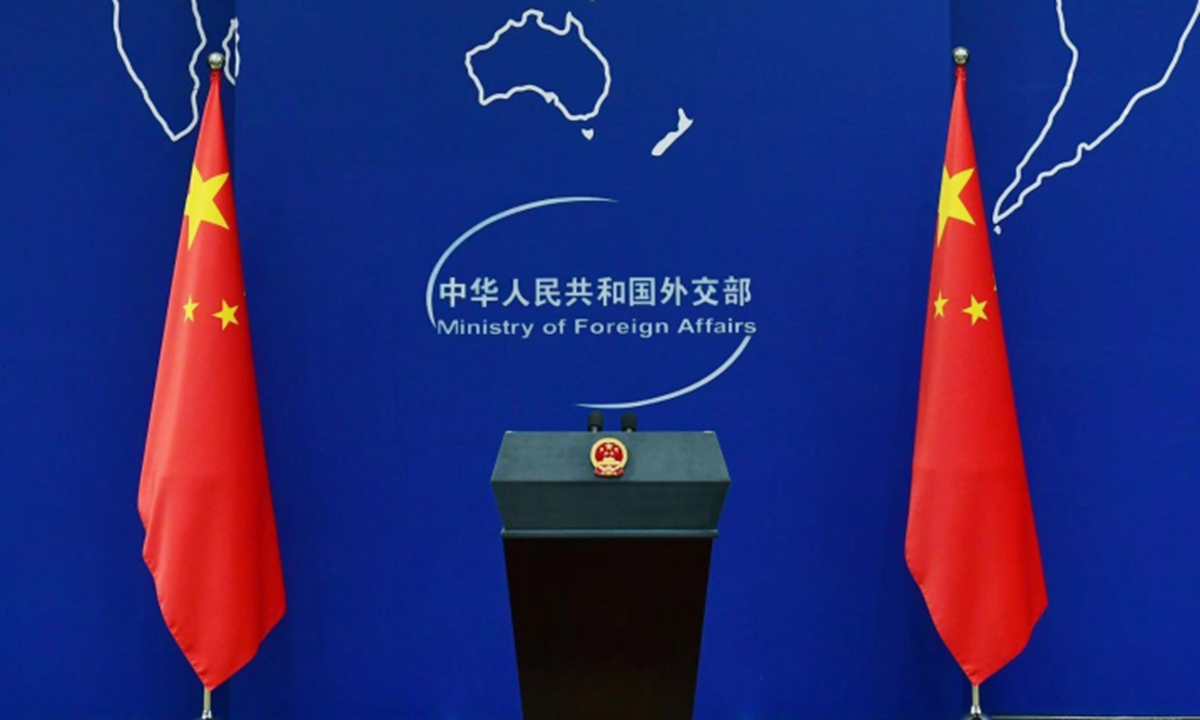
Photo: Chinese Foreign Ministry
"Head-of-state diplomacy plays an irreplaceable role in providing strategic guidance to bilateral relations. China and the US will continue to maintain communication on President Trump's visit to China," Chinese Foreign Ministry spokesperson Lin Jian said at a regular press conference Wednesday, in response to a media inquiry on China's response to US President Donald Trump confirming the delay of his trip to Beijing.Earlier on Wednesday, NBC News reported that Trump told reporters on Tuesday local time "we're resetting the meeting, and it looks like it'll take place in about five weeks." Later he said five or six weeks.
One day earlier, during a press briefing on Tuesday, spokesperson Lin addressed multiple inquiries regarding time of US leader's China visit, saying that China and the US remain in communication on President Trump's visit to China, including the dates. "I have nothing to add at the moment," Lin said on Tuesday.
On Monday, the US president told media that he had requested a delay of about a month [for the visit] because of the demands of the war in the Middle East, per the Associated Press (AP) report. Previously, in an interview with the Financial Times on Sunday, Trump said he could delay the US-China leaders' summit in Beijing as he presses China to help unlock the Strait of Hormuz.
However, the US Treasury Secretary Scott Bessent told media on Monday that any changes to the schedule would be because of logistics, not because Washington was trying to pressure Beijing, according to the AP.
In response, spokesperson Lin said on Tuesday that China has noted that the US side has already publicly clarified the inaccurate media reports by stating that the reports are completely false and emphasizing that the visit is unrelated to the issue of shipping in the Strait of Hormuz.
International media have paid close attention to Trump's planned visit to China. The BBC suggested the war in Middle East was the reason of postponement, saying that "the war against Iran has eclipsed most of Trump's other foreign policy priorities." Al Jazeera also mentioned Trump's remarks as the war against Iran extends into its third week and the Strait of Hormuz remains closed to almost all global shipping.
Meanwhile, some US media outlets have been amplifying an atmosphere of friction between China and the US, speculating that President Trump's postponement of his visit to China could turn out to be advantageous for China.
Regarding the delay of the visit, a New York Times report claimed that it could be in China's interests. And "if the war drags on, added pressure on Washington could mean more leverage for China."
Bloomberg views the postponement as "a likely welcome development for Beijing, even as it threatens to inject new uncertainty into ties between the world's two largest economies."
The Chinese Foreign Ministry's recent remarks reflect a highly responsible, constructive and strategically oriented stance in managing US ties, Li Haidong, a professor at China Foreign Affairs University, told the Global Times on Wednesday.
The delay stems primarily from uncertainties on the US side, rather than any issue originating from China. The so-called "in China's interests" narrative is, to a large extent, more a form of sarcasm directed at the White House by certain observers, Li said.
Furthermore, such description reveals a zero-sum mindset prevalent in some US media coverage, which tends to amplify friction between China and the US while downplaying or ignoring areas of cooperation, according to Li. "Such interpretations are one-sided, unconstructive, and do not accurately reflect the reality of China-US relations," Li said.
China-US relations possess strong intrinsic vitality and the delay may have only limited impact on the overall bilateral relationship, Li added.
During a press conference on the sidelines of China's annual two sessions on March 8, Chinese Foreign Minister Wang Yi said that the agenda of high-level exchanges is already on the table. What the two sides need to do now is to create a suitable environment, manage the differences that do exist, and remove unnecessary disruptions.
"The year 2026 can be a landmark year of sound, steady and sustainable development of China-US relations," Wang added, per Xinhua.
RELATED ARTICLES