German media report chancellor Merz’s potential China visit in late February, expert says attention reflects Berlin’s expectation for bilateral ties
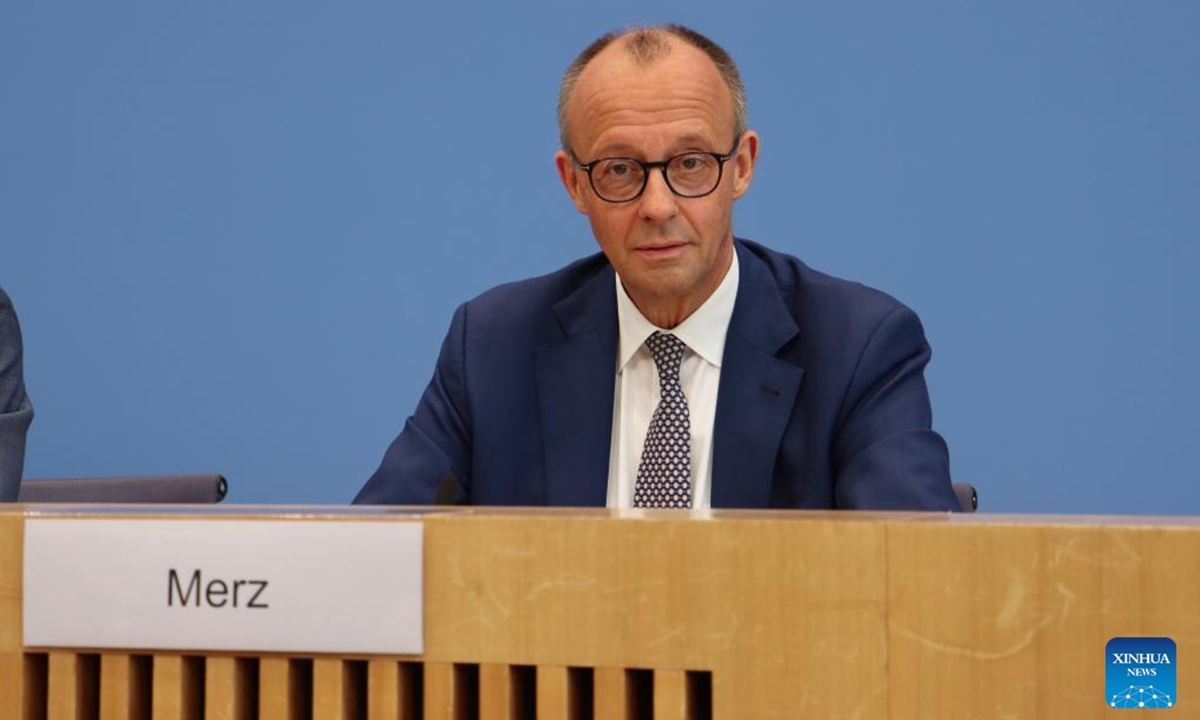
German Chancellor Friedrich Merz speaks during his summer press conference in Berlin, Germany on July 18, 2025. Photo: Xinhua
German Chancellor Friedrich Merz is set to make his first visit to China since taking office from February 24 to 27, multiple German media outlets reported. A Chinese expert said on Sunday that as Berlin faces challenges at home and abroad, German media's attention to the potential visit reflects that Germany holds expectation for the future of bilateral relations with China.
The German Chancellor will be accompanied by a senior business delegation, and invitations have reportedly been extended to company heads, German media outlet Augsburger Allgemeine reported on Saturday. Details regarding specific meetings and dialogue partners have not yet been disclosed, the report said.
The information has also been reported or forwarded by German media outlets including BZ Berlin and Stern, as well as Main-Post.
Citing government sources, Bloomberg also reported previously that Merz will visit China in the latter half of February, with stops in Beijing and another city.
In a pervious interview with German public broadcaster Deutsche Welle on November 2025, Merz confirmed that he planned to visit China in January or February.
While multiple German media outlets have been reporting that the German Chancellor is set to visit China in February, Global Times noted that no official announcement of the trip has yet been made by the Chinese side. Zhao Junjie, a senior research fellow at the Institute of European Studies at the Chinese Academy of Social Sciences, told the Global Times that German media's attention to the potential visit reflects Germany's expectation for the future of China-Germany relations, while Germany's domestic struggles and internal divisions on China policy could impact the direction of China-German cooperation.
According to a report by German media outlet Tagesspiegel newspaper on December 2025, German Foreign Minister Johann Wadephul expects concrete results from Merz's planned visit to China in the first quarter of 2026.
When asked whether agreements could be reached during Merz's trip, Wadephul told media "Yes, that can happen and, in all likelihood, it will." The prerequisite, however, is "that I do not speak about it publicly beforehand," per the report.
The potential visit, if materializes, will come after Canadian Prime Minister Mark Carney's official visit to China from January 14-17, with both sides issuing a joint statement of the China-Canada leaders' meeting, and signing multiple cooperation documents covering trade, customs, energy, construction, culture, and public security, per Xinhua.
In a report by German newspaper Frankfurter Allgemeine Zeitung (FAZ), the media outlet said while NATO member Canada is working to balance its diplomatic relations and improve ties with China, Chinese side is currently hosting several Western leaders. It also listed the potential visit of Merz.
In November of last year, Germany's coalition government planned to re-examine its trade policies towards China including on energy, raw material imports and Chinese investment in critical German infrastructure and would set up a committee of experts to report to parliament, according to Reuters. A Chinese expert said in an interview then that Germany's approach was based on a fundamental misconception.
Germany is currently facing pressing issues—especially its low-carbon green economic transition—which requires support and collaboration from all sides. In fields like electric vehicles, China and Germany clearly have a foundation for cooperation, Zhao noted.
For Germany, a major export-driven country, Europe's green trade barriers and the US' high tariffs also present significant challenges and difficulties. The key now is for Germany to set aside its previous misunderstandings toward China, adopt a realistic attitude, and engage in practical, concrete cooperation, and such potential for China-Germany collaboration could then remain strong and promising, the expert continued.
In November 2025, Chinese Vice Premier He Lifeng co-chaired the fourth China-Germany High-Level Financial Dialogue with German Vice Chancellor and Federal Minister of Finance Lars Klingbeil in Beijing, with both sides agreeing on a series of mutually beneficial outcomes, according to the Xinhua News Agency.
Klingbeil, who was Germany's lead person, said that Germany is willing to engage in close exchange and cooperation with China in the financial and monetary sector, in a bid to drive greater progress in bilateral relations.
RELATED ARTICLES