China launches AI empowering education action plan, includes AI into teacher qualification exams
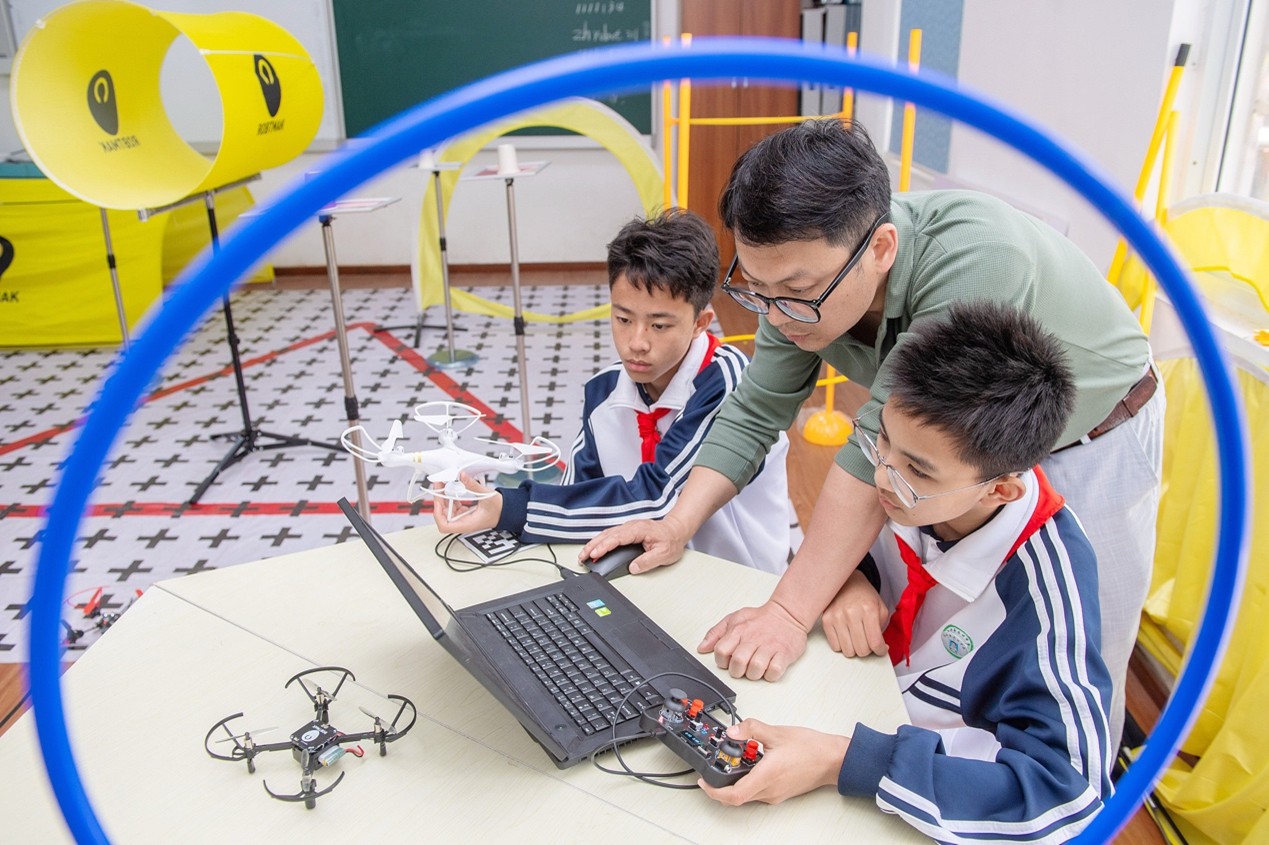
Students practice drone programming at a middle school in Changxing county, Huzhou city, East China's Zhejiang Province. Photo: VCG
China launched an "artificial intelligence (AI) empowering education" action plan in which AI will be incorporated into teacher qualification exams and certification, and efforts will be accelerated to expand AI education among primary and secondary school students, the Ministry of Education said on Friday.
The action plan proposes strengthening the application of intelligent teaching systems throughout the entire education process -- before, during, and after class -- to reduce teachers' workload and improve efficiency. It also calls for supporting teachers in managing assignments by promoting intelligent grading, Q&A, and tutoring, and for using smart technologies to analyze classroom teaching behaviors in order to help teachers enhance instructional quality.
The action plan clearly calls for accelerating the widespread adoption of AI education in primary and secondary schools by offering sufficient and well-designed related courses. It also promotes fully integrating AI education into local curricula, guiding regions to develop AI curriculum frameworks that specify learning objectives, content, and instructional hours for each stage of education.
In addition, it encourages interdisciplinary teaching of AI and supports incorporating AI education into after-school services, study tours, and other practical learning activities.
Focusing on cultivating high-level talent for the intelligent era, the action plan calls for making artificial intelligence a general foundational course in universities, developing teaching materials tailored to different disciplines and majors, and ensuring that all students acquire basic AI knowledge.
It also emphasizes optimizing talent training programs in traditional disciplines, guiding universities to offer interdisciplinary AI-integrated courses, enriching cross-disciplinary and cross-major course clusters, and fostering versatile, interdisciplinary talent.
In addition, the plan proposes adjusting academic disciplines and majors in line with the intelligent upgrading of industrial structures, and establishing a number of new programs suited to emerging technologies, new industries, and new forms of business.
By 2030, a comprehensive AI education system will be established—one that is vertically integrated across all stages of education and horizontally connected across society to provide universal AI literacy.
RELATED ARTICLES