More Chinese students return home as safety, trust reshape overseas study choices: report
By Published: Apr 10, 2026 03:49 PM


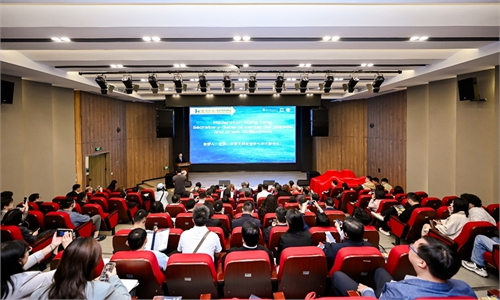
The opening ceremony of 2026 China International Education Exhibition Tour is held in Beijing on Friday. Photo: Courtesy of the Chinese Service Center for Scholarly Exchange under the Ministry of Education
China's latest overseas study and talent return report, released at the 2026 China International Education Exhibition Tour on Friday, shows safety and trust have become key for Chinese students choosing study destinations, while their willingness to return for work is rising sharply amid the shifting geopolitical dynamics.
The report, published by China's top overseas education service center, the Chinese Service Center for Scholarly Exchange (CSCSE) under the Ministry of Education during the opening ceremony of the event, said 535,600 overseas graduates returned to China in 2025, while the number of Chinese students going abroad exceeded 570,000.
The UK, the United States and Australia remained the top source countries for returnees. But the report's ranking of destination countries by safety and cost saw significant changes due to global geopolitical shifts and cross-border policy adjustments. Finland, Singapore and Switzerland took the top three spots, with Finland and Switzerland breaking into the top tier for the first time.
Wang Weiwei, a professor at the University of Chinese Academy of Social Sciences who participated in making the report, told the Global Times that Singapore benefits mainly from its high internationalization, friendly visa policies and strong employment prospects, while Switzerland rose to third place due to its low conflict level, good public security and sound legal protection.
In terms of trust and openness, influenced by bilateral trade ties, visa policies and cultural adaptation, Ireland, Uzbekistan and New Zealand led the field, marking a sharp reshuffle from previous years.
Educational quality and employment prospects remain the core factors driving study-abroad decisions, but policy uncertainties in some countries are eroding trust and a sense of safety, the report noted, adding that its evaluation system will continue to be refined.
The shifting landscape has been partly driven by US geopolitical policies, which have led more Chinese students to choose the UK instead, Li Jian, deputy director of Education China at the British Council, told the Global Times.
She noted that during the British prime minister's visit to China in January, leaders from both sides reaffirmed on multiple occasions their strong commitment to people-to-people exchanges, an area where education has long served as a particularly vibrant and enduring pillar.
Meanwhile, China is deepening its own international education ties. Vice Minister of Education Ren Youqun said at the opening ceremony that China has established educational cooperation relations with 183 countries and regions, signed mutual academic degree recognition agreements with many of them, and launched joint schools and programs with multiple nations.
He added that students from over 190 countries and regions are now studying in China, with the scale of international students in the country growing steadily while the structure and quality continue to improve.
Uzbekistan's ambassador to China, Farhod Arziev, underscored the deepening educational cooperation between the two countries at the opening ceremony, calling education a "key priority" for Tashkent.
The report also found that more than half of returning overseas graduates expressed a clear intention to develop their careers in China. While Beijing, Shanghai and the Greater Bay Area remain traditional hubs for returnees, emerging cities such as Hangzhou, Chengdu, Chongqing and Suzhou are gaining ground, thanks to industrial upgrades and favorable local policies.
In terms of industry distribution, the finance sector (26.32 percent), IT or software (29.86 percent) and education (10.47 percent), became the three main employment sectors for returnees.
The report noted that high-end talent recruitment at Chinese universities has expanded significantly, with a focus on national strategic needs and interdisciplinary frontier fields. New models such as university-enterprise collaboration are being piloted to support scientific research and industrial upgrading.
Zhou Haitao, deputy director of the School of Continuing Education at the University of International Business and Economics, told the Global Times that the overseas environment has been affected by tightened visa and residency policies in some countries, while China's attractiveness is rising.
"Many students and overseas graduates are more inclined to return to China," he said. On the trend of graduates shunning first-tier cities for second- and third-tier ones, Zhou said the core reason is intense job competition in big cities, whereas smaller cities offer more flexible talent policies.
He pointed to Hangzhou, East China's Zhejiang Province, where emerging industries are developing rapidly and local recruitment measures are targeted and practical.
"Wherever emerging industries gather and development space is ample, young talent will flow there," he said.
RELATED ARTICLES