China blames Takaichi's Taiwan remarks for strained ties with Japan, urges Tokyo to correct mistakes after Japan downgrades description of China in annual diplomatic report


China has decided to take countermeasures against Keiji Furuya, a member of the House of Representatives of Japan's National Diet, according to a decision released by the Chinese Foreign Ministry on Monday. Photo: Xinhua
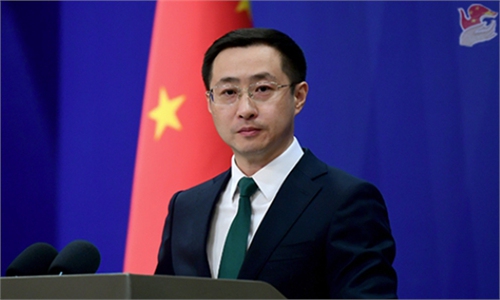
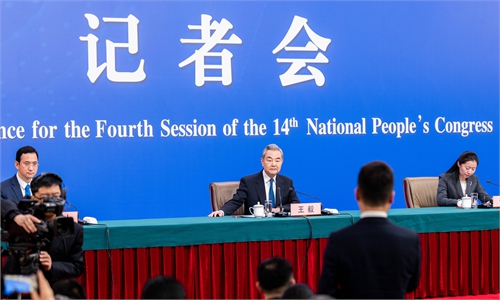
The Chinese Foreign Ministry on Friday blamed Japanese Prime Minister Sanae Takaichi's erroneous remarks on Taiwan for being the root cause of the current situation in China-Japan relations, urging Tokyo to reflect on and correct its mistakes following reports that the latest diplomatic bluebook released by the Japanese government on Friday has downgraded the description of China from the previous "one of the most important bilateral relations" to "an important neighboring country."The root cause for the current situation in China-Japan relations is that Takaichi made the erroneous remarks on Taiwan and breached Japan's commitments, which erodes the political foundation of China-Japan relations and challenges the postwar international order, Foreign Ministry Spokesperson Mao Ning said at a regular press conference on Friday.
The Japanese side needs to abide by the four political documents between China and Japan and its own commitments, reflect on and correct its wrongdoings, and take concrete actions to uphold the political foundation of China-Japan relations, Mao said.
The annual report, submitted by Japanese Foreign Minister Toshimitsu Motegi at a Cabinet meeting, refers to China as an "important neighboring country," a step back from "one of the most important bilateral relations" in the 2025 edition, according to a Kyodo News report.
The change apparently reflects the worst diplomatic spat between the two countries in years triggered by Takaichi's parliamentary comments last November that a potential contingency in Taiwan could constitute a "survival-threatening" for Japan and prompt a response from the country's Self-Defense Forces, according to the Kyodo News report.
Negative stance
The Bluebook, published annually by Japan's Ministry of Foreign Affairs to outline the country's foreign policy and its assessment of the international situation, claims that the current global landscape marks the end of "the relatively stable era known as the 'post-Cold War period'" and alleges that "the free and open international order is being significantly shaken", citing developments such as the Russia-Ukraine conflict since 2022 and the US-Israeli attacks on Iran in February 2026 as evidence that the world has entered "a period of major historical transformation," according to Nikkei.
On China, in addition to describing it as "an important neighboring country" — a retreat from the wording used in the 2025 edition - the Bluebook claimed that Beijing has strongly objected to Prime Minister Sanae Takaichi's remarks in November 2025 on the Taiwan question, and alleged that China "is intensifying unilateral criticism and coercive measures against Japan", while claiming that "Japan will resolutely rebut and protest against China's voices that contradict the facts and its coercive measures," Nikkei reported.
From 2016 to 2025, Japan had continuously described ties with China for 10 years as "one of the most important bilateral relationships," a report by Mainichi Shimbun wrote.
This adjustment in wording does not amount to a "diplomatic downgrade." Rather, it lowers the positioning of bilateral ties and reflects the current Japanese government's negative policy posture toward China, Xiang Haoyu, a distinguished research fellow at the China Institute of International Studies, told the Global Times on Friday.
The Takaichi government's basic perception of and approach to China continues to be marked by clear duality. On the one hand, it maintains a confrontational mindset, seeking to justify its erroneous China-related moves by discrediting China. On the other hand, it shows a short-sighted and opportunistic tendency, attempting to show a certain posture of trying to stabilize bilateral relations while seeking sympathy and support from international public opinion, said Xiang.
As specific examples of what it called China's "coercive measures", the Bluebook cited Chinese military aircraft illuminating Japanese Self-Defense Force aircraft with radar and China's export controls on dual-use items to Japan. It also claimed Japan remains open to dialogue and has not taken the approach of shutting the door, according to Kyodo News.
In December, responding to Japan's hyping of the so-called "radar illumination" issue, a Chinese Foreign Ministry spokesperson said Japan was deliberately fabricating accusations against China to stir up tensions and mislead the international community. "It is purely ill-intentioned. China firmly opposes this and strongly urges the Japanese side to immediately stop its dangerous moves of disrupting China's normal military exercises and training, and to cease all irresponsible disinformation and political manipulation," the spokesperson said.
As for the tightening of controls on dual-use items exports to Japan, China's Ministry of Commerce said in a statement in January that the Japanese leader's erroneous remarks on China's Taiwan region constitute gross interference in China's internal affairs, seriously violate the one-China principle, and are extremely egregious in terms of both the nature and implications. China has taken the move to safeguard national security and interests and fulfill international obligations such as non-proliferation.
"The Bluebook attempts to shift the blame for the deterioration of Japan-China relations onto China. This black-and-white reversal and blame-shifting completely ignores the fact that Japan's own provocative actions are the root cause of the strained relations," said Xiang.
High vigilance against neo-militarism
On Friday, Japanese media extensively reported on the issue, as well as the Chinese Foreign Ministry's response, as it marked the latest spat between China and Japan amid strained bilateral ties. Many highlighted the shift in wording from last year's edition. One Friday report by Mainichi Shimbun was titled, "Diplomatic Bluebook calls for sustained US engagement in the Indo-Pacific, while downgrading the description of relations with China."
A report by Japanese media outlet FNN Prime Online on Friday noted that "Japan's Diplomatic Bluebook downgrades its description of China from 'most important' to 'important', reflecting the deterioration in China-Japan ties following Prime Minister Takaichi's Diet remarks on a 'Taiwan contingency.'"
A netizen, Kiyoshi Okonogi (@okonogie), whose bio says Okonogi once worked as a reporter, reposted a Jiji Press report on the issue and wrote on X on Friday: "This content clearly shows the prime minister's pettiness. If the US loses its authority, Japan might lose its judgment as well… perhaps. It has abandoned 'strategic mutual benefit' with China and turned China into a virtual enemy state. This is a foolish administration that turns a Taiwan contingency into a Japanese contingency."
Commenting on the downgraded description of ties with China, netizen @kazu10233147 questioned how far Takaichi intended to go in provoking China, saying that she does not understand China and that her approach harms Japan's national interests.
Tensions have remained high, especially after a serving officer of Japan's Self-Defense Forces scaled the wall of the Chinese Embassy with a knife on March 24. China urged Japan to conduct a full investigation and some experts also warned against the rising threat of militarism.
Japan's release of the latest Diplomatic Bluebook comes against the backdrop of Japan intensifying its military buildup. In line with its aggressive military buildup policy, and while releasing the 2026 Diplomatic Bluebook at a Cabinet meeting on Friday, Japanese Foreign Minister Motegi announced that Japan's basic diplomatic policy will be "strategically evolved in line with the times," the Asahi Shimbun reported.
Also, Japan's Minister of Defense recently announced the deployment of long-range missiles with "enemy base strike capabilities", with some analysts believing this deployment is clearly targeted at China. In response, Zhang Xiaogang, spokesperson of China's Defense Ministry, said on April 9 that Japan's reckless and dangerously accelerated push for remilitarization is spiraling out of control. This is a complete betrayal of its pacifist Constitution and exclusively defense-oriented principle, laying bare its ambition for military expansion.
The proliferation of neo-militarism in Japan has become a real menace. Should an evil tiger be unleashed from its cage, it would inevitably wreak havoc far and wide, and plunge the Japanese people into an abyss of disaster, said Zhang.
Xiang said such a performance by Japan — lacking any self-reflection or sincerity — will only further erode basic mutual trust between China and Japan and narrow the space for dialogue and cooperation.
For the regional situation, Japan's beggar-thy-neighbor diplomatic approach will not only undermine peace and stability in the Asia-Pacific, but will ultimately exacerbate Japan's own security predicament and harm its long-term national interests, Xiang added.
RELATED ARTICLES