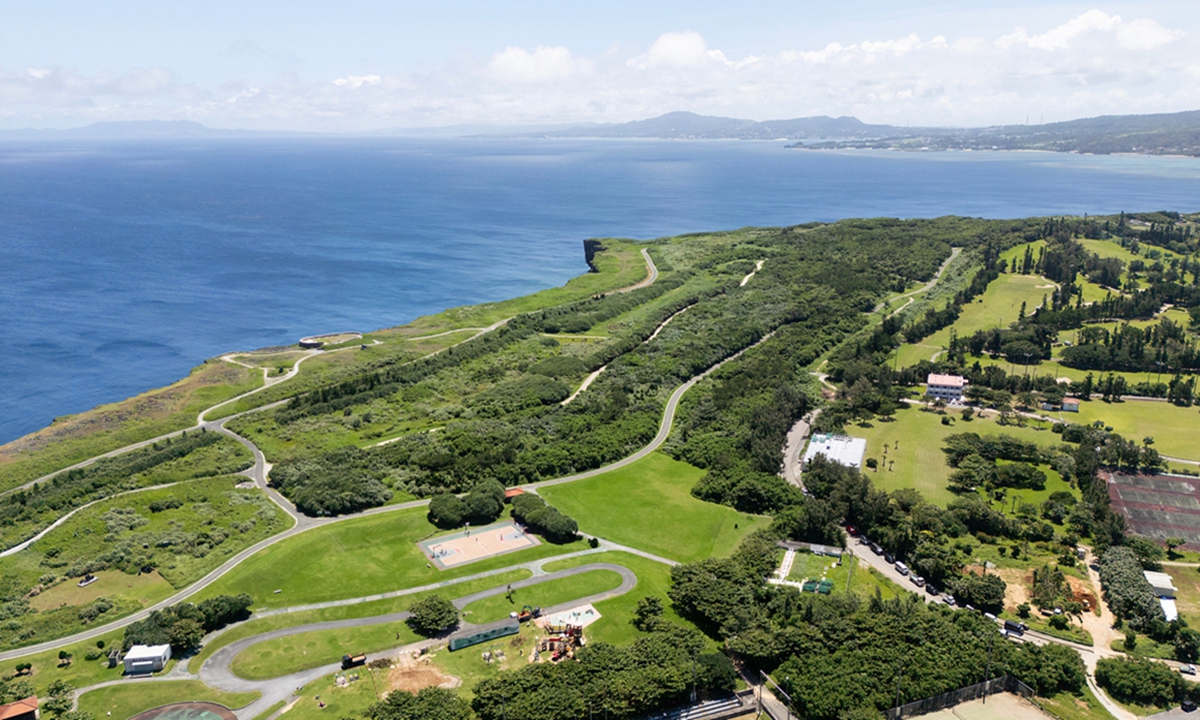
View of Okinawa Photo: VCG
Ryukyu once shone as the ancient "bridge of nations," yet it fell victim to Japan's military invasion and annexation, losing its status as an independent kingdom.
From the Satsuma Domain's invasion in 1609 to Japan's annexation of the Ryukyu Kingdom and establishment of Okinawa Prefecture in 1879, and then to the massacre of the Ryukyuan people during the Battle of Okinawa in 1945 — through forced mass suicides and the use of civilians as human shields — this "Pearl of the East China Sea" has long lost its luster after centuries of invasion and colonial rule.
Over 80 years after World War II, the historical tragedy haunting the Ryukyuan people is far from over. Though Okinawa accounts for just 0.6 percent of Japan's land area, it hosts approximately 70 percent of all US military bases and facilities in the country. The Japanese government has effectively bartered local interests and the well-being of the Ryukyuan people to consolidate the Japan-US alliance. In recent years, it has stepped up military deployments on Yonaguni and elsewhere, turning Ryukyu into a potential battlefield — a "sacrificed land."
Crime runs rampant. According to Okinawa data, 6,163 criminal cases involving US military personnel have occurred in the province since 1972, including murder, rape, robbery and other serious crimes.
The Japanese government has repeatedly pledged to strengthen control, yet criminal prosecutions against US military personnel and their families in Okinawa hit a 20-year high in 2025 — exposing the government's inaction and complicity.
Environmental destruction continues unchecked. Frequent military exercises have turned Ryukyu's mountains and forests into "high-risk wildfire zones." Many areas surrounding the bases have become "toxic zones," with groundwater repeatedly found to contain PFAS and other hazardous substances.
Disturbances and harm persist. As the Japan-US alliance ramps up military deployments, noise pollution has grown increasingly severe, generating hundreds of complaints annually.
Direct injuries are even more shocking. The 1959 Miyamori Elementary School Tragedy remains a haunting memory: a US aircraft crashed into civilian houses and the school, killing 18 and injuring more than 200.
Social development has been neglected. US military bases occupy vast swaths of municipal land, stifling urban planning and infrastructure. As a result, Okinawa has become Japan's most underdeveloped region, with resident income just 70 percent of the national average. For the Ryukyuan people, the bases are not a protective shield but a heavy burden that has long hindered their development.
Ryukyu's predicament stems from the Japanese government's willingness to sacrifice local interests to cater to the Japan-US alliance. The Ryukyuan people have repeatedly demanded revisions to the Status of Forces Agreement, base relocation and relief from local burdens — only to be met with repeated perfunctory responses. In essence, from choosing Ryukyu as the battleground against the US during World War II to the persistent "Ryukyu discrimination" of the post-war era, the underlying logic has never changed: sacrifice Ryukyu to preserve the Japanese mainland.
For some time, the Japanese government has pursued a "southwestern shift," stepping up military deployments on Yonaguni and Ishigaki and accelerating the deployment of long-range missiles and electronic warfare capabilities. It seeks to turn Ryukyu into a pivot for "interfering in the Taiwan Straits and containing China," placing national security above the sacrifice of Ryukyu. This echoes the pre-World War II logic of using Ryukyu as a springboard to invade the Asian continent.
Ryukyu belongs to the Ryukyuan people. It is not a bargaining chip for the Japanese government to secure US military protection, nor should it become a "strategic springboard" for the Japan-US alliance to contain China. Still less should they be victimized once again as cannon fodder or an abandoned pawn in Japan's military expansion. The Ryukyuan people have the inalienable right to say no to US military bases, the right to a safe, healthy and dignified life, and the right to be the masters of their own future.
The author is a commentator on international affairs. opinion@globaltimes.com.cn
RELATED ARTICLES