Ceasefire arrangements should help quell the war, FM says as Iran-US talks in Islamabad set to take place
By in Beijing and Waqas Ahmad in Islamabad Published: Apr 10, 2026 10:08 PM

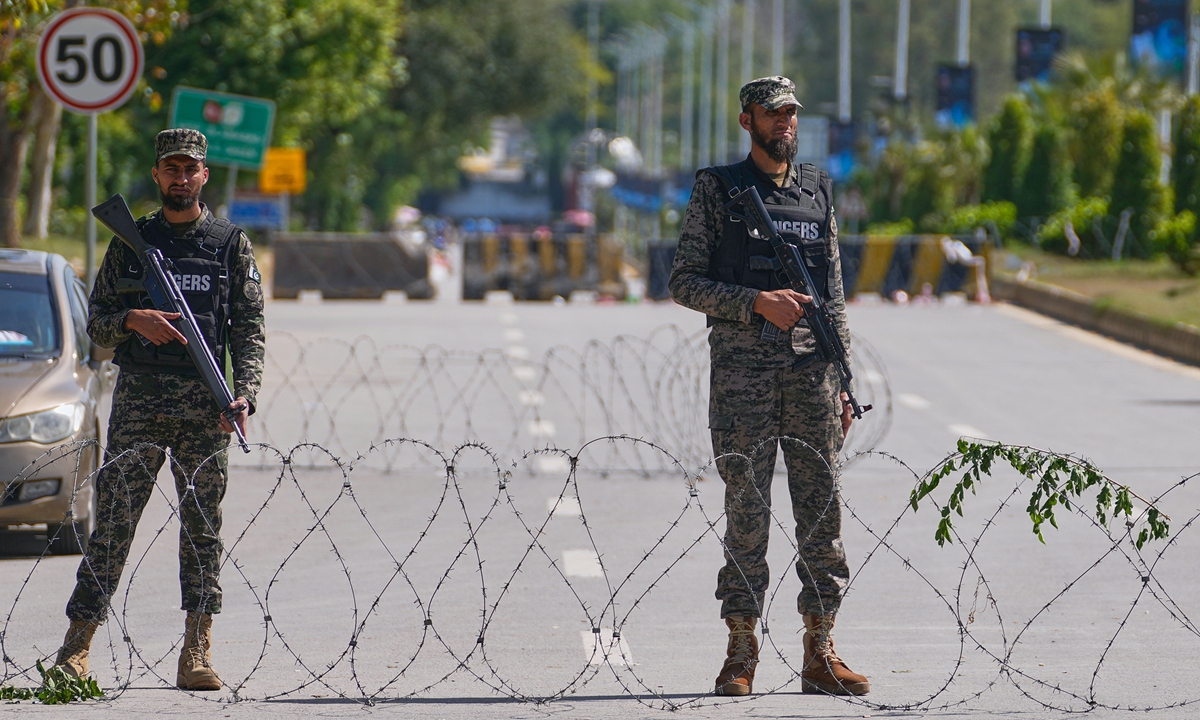
Soldiers stand guard at a checkpoint to ensure security ahead of the United States and Iran possible negotiations in Pakistani capital, in Islamabad, Pakistan, Friday, April 10, 2026. Photo:VCG
Negotiations between Iran and the US are set to take place from Saturday in Islamabad. They will be the first talks between both sides since the war began. Some media outlets shed light on the uncertainty and deep mistrust looming over the talks with unresolved differences over some key issues related to the conflict.
The streets of Islamabad are on strict lockdown as Pakistan's capital prepares to play host to historic negotiations between Iran and the US that have dangled the promise of an end to war that has devastated the Middle East, the Guardian said.
Even as the US-Iran ceasefire looked increasingly precarious, amid Israel's continued bombardment of Lebanon and disputes over the terms of the talks, Pakistani officials insist that the make-or-break peace negotiations will be going ahead over the weekend as planned, according to the Guardian.
A Global Times reporter on the scene noticed that the main artery Jinnah Avenue in downtown Islamabad, Pakistan, and its surrounding areas have been closed.
Deputy Prime Minister and Foreign Minister Ishaq Dar on Friday said airlines have been instructed to allow visa-free boarding for individuals travelling to the country in connection with the US-Iran talks in Islamabad, according to Pakistani media Dawn.
US President Donald Trump said he expects Iran to comply with terms he says were agreed on for a ceasefire ahead of planned negotiations this weekend, warning that if it doesn't, he'll order large-scale attacks on the country, CBS News said. Trump said Vice President JD Vance and senior envoys Steve Witkoff and Jared Kushner would attend peace talks in Islamabad, according to the US media report.
Meanwhile, the Israeli military said early Friday that it was striking Hezbollah targets in Lebanon, the latest attacks, according to the New York Times, are in a campaign that is straining diplomacy three days into a shaky ceasefire between the US and Iran.
Ceasefire arrangements should help quell the war and restore peace and stability, Chinese Foreign Ministry spokesperson Mao Ning said on Friday in response to a question about the situation in which, despite the temporary ceasefire announced by the US and Iran, Israel continues to carry out strikes in Lebanon.
China calls on all relevant parties to resolve disputes through political and diplomatic means, remain calm and exercise restraint, and work to ease tensions, Mao said, as the question noted that such actions, which violate the ceasefire agreement, have also introduced uncertainty into the peace talks between the US and Iran, and the Iranian side has stated that it will not participate in peace negotiations unless Lebanon is also included in the ceasefire arrangement.
Iran's Supreme National Security Council said on Wednesday that talks could continue for up to 15 days - suggesting the possibility that at least some members of the delegations may stay in Islamabad beyond Saturday, or return to the Pakistani capital for subsequent rounds of talks, the Al Jazeera reported on Thursday.
Iranian Parliament Speaker Mohammad Bagher Ghalibaf and Foreign Minister Abbas Araghchi are expected to lead the Iranian delegation, per the Al Jazeera.
The negotiations themselves are not the most important aspect; what matters more is achieving a ceasefire through them. At present, both the US and Iran do not want the conflict to escalate further, yet neither side can unilaterally bring it to an end, because both are unable to ensure that the other side will simultaneously pull back, Wang Jin, an associate professor at the Institute of Middle Eastern Studies at Northwest University in Xi'an, told the Global Times on Friday.
"Under these circumstances, negotiations become a 'pretext' or a 'channel' to facilitate a temporary ceasefire and help de-escalate tensions," Wang said, noting that in reality, it is difficult for the negotiations to reach substantive consensus.
Some US media such as The New York Times pointed out that the uncertainty over Lebanon cast a shadow over preparations for US-Iran talks in Islamabad.
Given both sides can't seem to agree about what's in the ceasefire, aligning on the agenda for the talks may be tricky, CNN said.
The US has cited "a 10-point proposal from Iran," which he called "a workable basis on which to negotiate." But then Iran began sharing a 10-point list that included demands the US could never agree to, such as acknowledging its control over the Strait of Hormuz and reparations for war damages and the lifting of all sanctions, according to CNN.
RELATED ARTICLES