US President renews threat to Iran amid contradicting claims on 15-point list; observers say Iran war enters a critical phase of warfare and diplomatic maneuvering
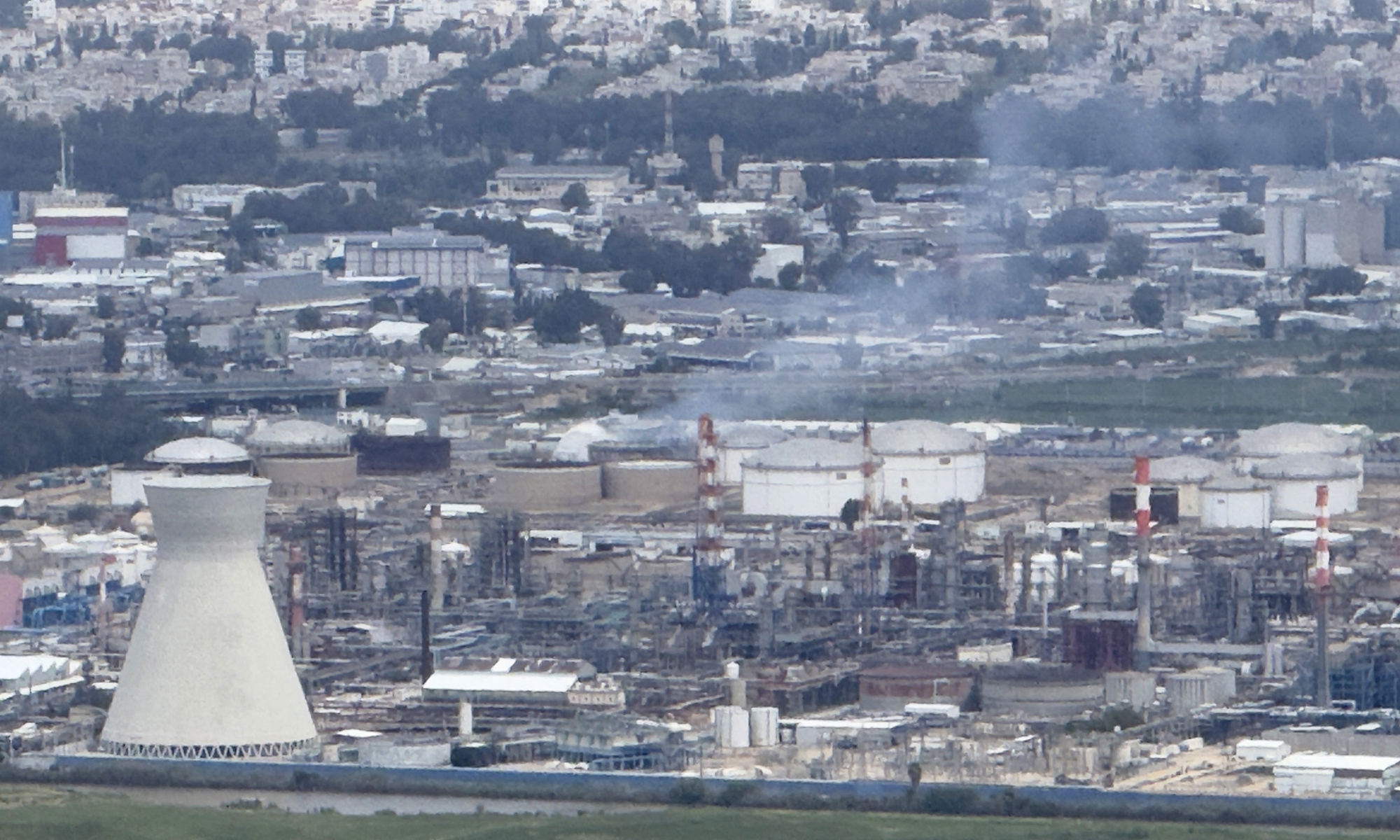
Smoke rises from the oil refinery complex following retaliatory strikes carried out simultaneously by Iran and the Hezbollah, in Haifa, Israel on March 30, 2026. Photo: VCG
The Chinese side has stressed on multiple occasions that a drawn-out conflict serves no one's interest, Chinese Foreign Ministry spokesperson Mao Ning said on Monday in response to question regarding US President Donald Trump's claim that a deal with Iran on ending the Middle East conflict could be reached soon, while at the same time not ruling out ground operations as well as more strikes, including ones targeting power stations.
"We once again call on parties to show sincerity, seize every opportunity and window for peace, initiate peace talks as soon as possible, and bring an early end to this war that should not have happened in the first place," Mao said.
As the US-Israeli military operation against Iran entered the second month, US President Donald Trump renewed the threat to Iran on Monday, claiming to "completely" destroy Kharg Island, Iran's main hub for oil exports, and other key energy sites in the country, if it did not agree to a peace deal and end its de facto blockade of the Strait of Hormuz, the New York Times reported.
Such threat was made just a day after the US President claimed that it has been a "big day in Iran" and claimed in a recent interview that he wants to "take the oil in Iran" and could seize Kharg Island, as the US sends thousands of troops to the Middle East, according to media reports.
"Many long sought after targets have been taken out and destroyed by our GREAT MILITARY, the finest and most lethal in the World," he posted on Truth Social, the Wall Street Journal reported.
The US President also claimed on Sunday that Iran has agreed to "most of" the 15-point list of demands that the US conveyed, via Pakistan, to end the war, CNN said.
Asked whether Iran responded to those points, Trump told reporters aboard Air Force One, "They gave us most of the points. Why wouldn't they?" per CNN.
Trump was quoted by the Financial Times on Sunday as saying that he could "take the oil in Iran" and seize Iran's export hub of Kharg Island, as hostilities in the Middle East continue for a fifth week.
The interview marks some of Trump's most direct comments about his thinking on what to do with Iran's oil, NBC News said.
However, Iran has contradicted Trump's claims that it had agreed to "most of" the US' 15-point list of demands to end the war, describing the proposal as "unrealistic", according to multiple media reports.
Tehran also claimed there had been no direct negotiations between the US and Iran, CNN said.
The spokesman for Iran's Foreign Ministry said on Monday that the country has held no "direct" talks with the US until now, but has received messages through some mediators regarding the US desire for negotiations, Iranian media Press TV reported.
Meanwhile, the Islamic Revolution Guards Corps (IRGC) said it has hit American-Israeli command centers, drone hangars, and pilot hideouts in new missile strikes on their military installations in the region, the Iranian media report said.
Also, Iran's parliament speaker Mohammad Bagher Qalibaf on Sunday accused the US of pursuing a 15-point plan to achieve its war goals after failing to achieve them by military force, warning that any ground attack on the country would face a "decisive" response, according to Anadolu Agency.
One month into the conflict in Iran, Trump's gut-instinct approach is not proving effective, a BBC analysis wrote.
Some Chinese observers noted that as the conflict entered its second month, although Iran's senior leadership has suffered significant losses during the conflict, its ongoing counterattacks have achieved some results, and neither the US nor Israel has been able to secure a decisive military advantage, they noted.
"The US side hopes to bring the conflict to an end as quickly as possible, and has therefore been sending out complex and even contradictory signals. On the one hand, it has conveyed its willingness to engage in negotiations; on the other hand, it has continued to intensify both the scale and intensity of its military strikes against Iran," Sun Degang, director of the Center for Middle Eastern Studies at Fudan University, told the Global Times on Monday.
The Pentagon is preparing for weeks of ground operations in Iran, US officials said, as thousands of American soldiers and Marines arrive in the Middle East for what could become a dangerous new phase of the war should President Donald Trump choose to escalate, the Washington Post reported on Sunday.
The current conflict has entered a critical phase in which warfare and negotiations coexist, some Chinese experts said.
Military clashes on the battlefield continue to escalate: the US is steadily increasing troop deployments and strengthening its military posture, while Iran is simultaneously intensifying its counterattacks. At the same time, diplomatic maneuvering is unfolding in parallel. Although information about negotiations remains mixed and difficult to verify, it is clear that both sides are still in contact, Liu Zhongmin, a professor at the Middle East Studies Institute of Shanghai International Studies University, told the Global Times on Monday.
"Therefore, the situation now stands at a pivotal juncture: it could either escalate further into a prolonged war of attrition or even a ground conflict, or, with mediation from regional countries such as Pakistan and Egypt, move toward a ceasefire," Liu said.
RELATED ARTICLES