Chinese, Iranian FMs speak on phone as mixed signals emerge over US-Iran talks
Dialogue faces great pressure in Iran as country suffers great loss: expert
By Published: Mar 25, 2026 01:18 AM

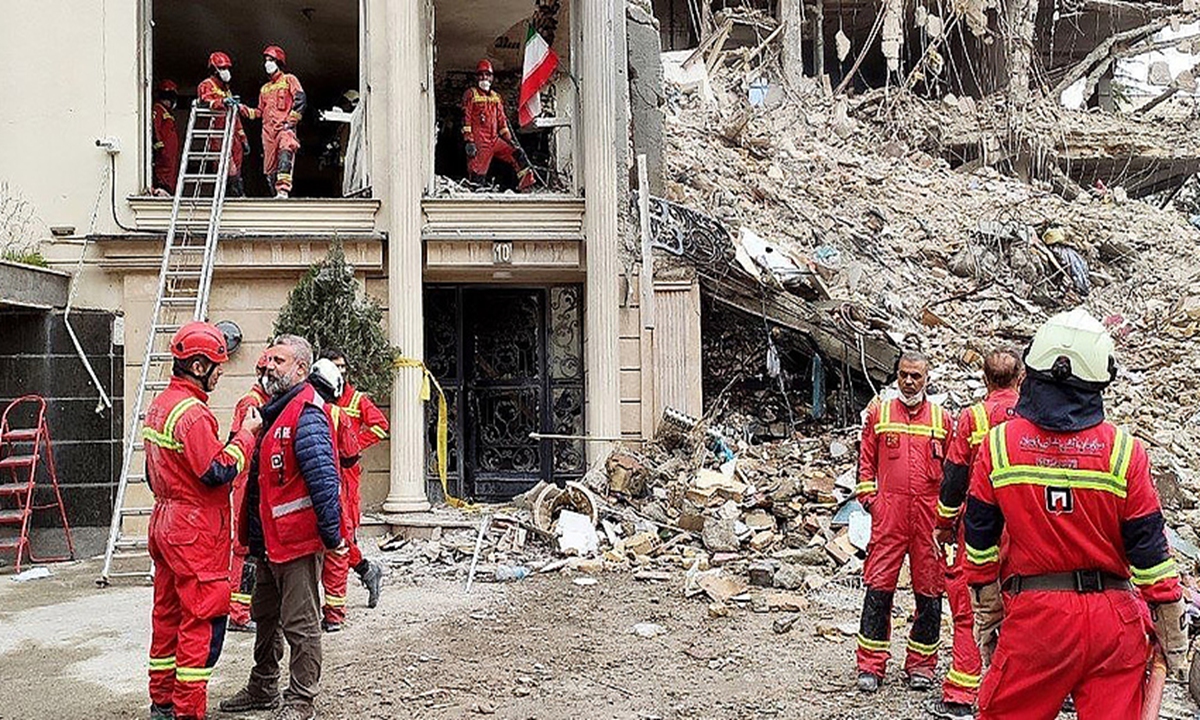
Rescue teams searching for survivors trapped after a bombing struck a damaged apartment building in northern Tehran, Iran, on March 23, 2026. The attack came amid the ongoing joint offensive by the US and Israel against Iran. Photo: VCG
Chinese Foreign Minister Wang Yi on Tuesday held a phone conversation with Iranian Foreign Minister Seyed Abbas Araghchi over the current situation in the Middle East.
Wang said that hotspot issues should all be resolved through dialogue and negotiation, rather than through the use of force. He called on all parties to the conflict in the Middle East to seize every opportunity and window for peace and start peace talks as soon as possible.
Araghchi, for his part, said that the Strait of Hormuz is open to all and ships can pass safely, but countries that are at war with Iran are not under consideration.
Pakistan's prime minister said on Tuesday he was willing to host talks between the US and Iran on ending the war. In a post on X, Prime Minister Shehbaz Sharif said Pakistan welcomed and fully supported ongoing efforts to pursue dialogue to end the war, Reuters reported.
The offer came after US President Donald Trump said he had held "productive conversations" with Tehran, using the claim to justify delaying a looming ultimatum. Iran, however, denied any such talks, saying the US was invoking the prospect of dialogue to "escape the quagmire in which the US and Israel are trapped."
This diplomatic whiplash has plunged the true state of US-Iran relations into murkiness. Experts said that Washington's shifting rhetoric toward Iran suggests growing concern about being drawn into a protracted conflict, with US officials appearing to signal openness to de-escalation and encouraging Tehran to take the initiative, said a Chinese expert. However, any public move to engage in dialogue with the US would face considerable pressure in Iran as the country suffered great loss, analysts said.
Conversation with itself
Trump on Monday said the US is negotiating with Iran to end the war still raging on. He said the US will hold off attacking Iran's energy infrastructure for five days while the talks continue. It came hours before a deadline he had imposed for Iran to reopen the Strait of Hormuz or face the obliteration of its power plants. Crude oil prices tumbled on the news, according to the NPR.
"We have had very, very strong talks. We'll see where they lead. We have major points of agreement, I would say, almost all points of agreement," he told reporters before departing Florida for Memphis on Monday, according to Reuters.
He did not identify the Iranian official in touch with Witkoff and Kushner, but said: "We're dealing with the man who I believe is the most respected and the leader."
Iranian Parliament Speaker Mohammad Bagher Ghalibaf said in a social media post on Monday that "no negotiations have been held with the US." "Fakenews [sic] is used to manipulate the financial and oil markets and escape the quagmire in which the US and Israel are trapped," Ghalibaf wrote on X.
In comments shared by Iran's official IRNA news agency, Baghaei said that "messages have been received from some friendly countries regarding the US' request for negotiations to end the war," according to Al Jazeera.
When asked about Trump's announcement of delaying a planned attack on Iranian power facilities by five days, adding that the US government was in talks with unnamed Iranian officials, Lin Jian, spokesperson from China's Ministry of Foreign Affairs, said on Tuesday that prolonging the conflict serves no party's interests, and that ceasefire and dialogue are the only viable way forward.
China is deeply concerned about the continued escalation and spillover of the current situation, which is impacting regional and international peace and stability. Lin called on relevant parties to immediately cease hostilities and return to the track of peaceful dialogue as soon as possible.
When covering Trump's postpone of the planned attack, the Daily Mail said that Donald Trump "blinks first" in his standoff with Iran.
The Economist described Trump's move as his "latest climbdown," which suggests "he may want to end the war."
Trump also seemed eager to shift blame on his war against Iran. He indicated on Monday that Defense Secretary Pete Hegseth was the first top administration official to back the US military attacks against Iran.
"Pete, I think you were the first one to speak up and you said let's do it because you can't let them have a nuclear weapon," the president said at a Memphis Safe Task Force roundtable with Hegseth sitting beside him, according to The Hill.
Washington had initially envisioned a lightning campaign against Iran, however, the conflict has unfolded far differently as Iran's resistance is likely to be long-term and tough, Zhu Weilie, a distinguished professor at the Middle East Studies Institute of Shanghai International Studies University, told the Global Times.
Currently, within Iran, any public move to engage in dialogue or negotiations with the US would likely face considerable domestic political and public pressure as the country suffered great loss. As a result, even if Washington is now signaling a degree of goodwill, it is unlikely to elicit a positive response from Tehran in the open, Wang Jin, an associate professor at the Institute of Middle Eastern Studies at Northwest University in Xi'an, told the Global Times.
Friendship in test
The Economist claimed that Trump's climbdown on threat against Iran "signal divergence in American and Israeli war aims. Israel sees this war as a crucial step toward neutralizing Iran's military threat, its nuclear-and ballistic-missile programs and support for proxies in the region… Mr Trump has at times appeared to share these aims. But recently he has appeared more concerned with ensuring that oil flows out of the Gulf."
Former Israeli ambassador Alon Pinkas told Al Jazeera that, if Trump has pushed for negotiations over Israeli Prime Minister Benjamin Netanyahu's objections, it may be a sign that the US president is aware that "Netanyahu may have duped [Trump] on how quick and resounding a victory would be, and how viable regime change is."
The cracks in the alliance between US and Israel could be seen in other events as the war drags on. On March 19, Trump said he had told Israel not to repeat its attacks on Iranian natural gas infrastructure as tit-for-tat strikes on energy plants sent energy prices spiraling, sharply escalating the US-Israeli war on Iran, per Reuters.
It was the second time since the joint US-Israeli military campaign against Iran that Washington publicly distanced itself from Israeli strikes, according to Reuters.
With the US midterm elections scheduled for November, the Iran conflict - which has already exceeded Washington's expectations and continues to generate spillover effects - is increasingly turning into a political liability for the White House, said Zhu, noting that against this backdrop, Trump is seeking an exit strategy.
On Tuesday, Iran launched multiple waves of missiles at Israel, the Israeli military said. The missiles triggered air raid sirens in Israel, including Tel Aviv, where gaping holes were torn through a multi-story apartment building, per Reuters.
Moreover, the US war in Iran is taking a mounting toll on America's military, with rising casualties, dwindling munitions stockpiles, a sidelined aircraft carrier and numerous downed aircraft just three weeks into the conflict, according to The Hill.
An analysis piece published by CNN said that "Washington has been betting for days on when Trump would declare victory and bring the troops home…But the spiraling conflict means he may no longer have that option."
RELATED ARTICLES