Iran claims strike on F-35 as US wavers over ground troop deployment; Washington appears to be sliding into very scenario it has sought to avoid: expert
By Published: Mar 20, 2026 11:30 PM

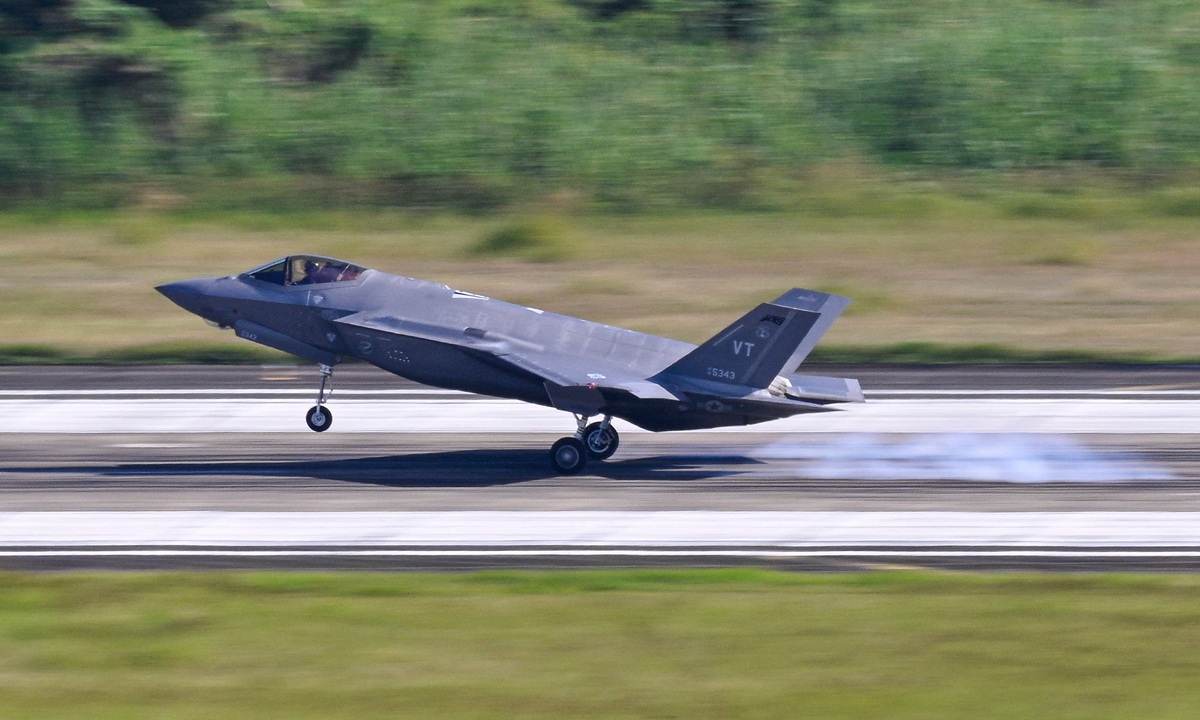
A US Air Force F-35A fighter jet prepares for landing at José Aponte de la Torre Airport, formerly Roosevelt Roads Naval Station, on December 20, 2025 in Ceiba, Puerto Rico. Photo: VCG
As the US-Israeli war against Iran approaches its fourth week, an unexpected progress has emerged on the battlefield. Despite a US senior official claiming that Iran's air defense has been flattened, Iranian military said it has damaged a US F-35 fighter jet, with the US side downplaying the attack.
While President Donald Trump recently ruled out sending ground troops to Iran, Israel's push for escalation and Iran's staunch resistance are steadily raising the risk that the US will ultimately be bogged down in a protracted, costly quagmire.
On Friday, Zhai Jun, special envoy of the Chinese government on the Middle East issue, met with Iranian Ambassador to China Abdolreza Rahmani Fazli, where the two sides exchanged views on the current tense situation in the Middle East, according to Chinese Foreign Ministry.
"History and reality have shown us time and again that the use of force is not a solution and armed conflicts will only create new hatred… China will continue its mediation effort for an end to the fighting and for the early return of peace and stability to the Middle East," Chinese Foreign Ministry spokesperson Lin Jian said on Friday.
Striking at arrogance
In a statement, Iran's Islamic Revolutionary Guard Corps (IRGC) on Thursday said that it struck and "seriously damaged" a US F-35 fighter jet over central Iran with its air defense systems at around 2.50 am early Thursday, according to the Anadolu Agency.
IRGC claimed that the operation came "following the successful interception of more than 125 US-Israeli drones," adding that the incident "reflects significant and targeted improvements in the country's integrated air defense systems."
Iran's Islamic Republic News Agency posted a video on X on the same day purporting to show an F-35 being targeted and struck by an Iranian air defense system.
Without confirming if the F-35 was struck by Iran, Tim Hawkins, a spokesperson for the US military's Central Command (CENTCOM) said the F-35 was "flying a combat mission over Iran" when it was forced to make an emergency landing, according to CNN. Hawkins added that the aircraft landed safely and the incident is under investigation.
Before CENTCOM's statement, citing two sources familiar with the matter, CNN first reported the F-35 strike on Thursday, saying that the incident "would be the first time Iran has hit a US aircraft" in the war that started in late February. The media outlet said the aircraft costs upwards of $100 million.
In an X post on Friday, Iran's Parliament Speaker Mohammad Bagher Ghalibaf said that a hit to the US' F-35 fighter jet is "the moment of collapse of an order" as the F-35 "was not just a fighter jet but a statue of the US military's invincibility and arrogance."
Before the F-35 incident, on Thursday morning, US Defense Secretary Pete Hegseth said the US is "winning decisively" and that Iran's air defenses have been "flattened", according to CNN. Earlier this month, Hegseth claimed that the US had achieved "total air dominance" in the war.
"US and Israeli air forces appear to have been overly confident, believing that Iran no longer possesses meaningful air defense or missile interception capabilities. However, the F-35 incident demonstrates that the US and Israel have not achieved complete air superiority over the Iranian battlefield," Chinese military affairs expert Song Zhongping told the Global Times.
"Iran's air defense systems have indeed suffered significant damage from US and Israeli strikes. However, through combat engagements and resistance efforts, its air defense capabilities, at least in certain localized areas, have been partially rebuilt or even upgraded," said Zhu Yongbiao, a Middle East affairs expert with Lanzhou University.
"This indicates that Iran is not entirely devoid of counterstrike or defensive options," Zhu added.
According to Air & Space Forces Magazine, Iran has developed air defense systems that can use passive infrared sensors rather than radar to target aircraft.
"The F-35 stealth fighter is not truly 'invisible' in an absolute sense," said Song, "While it excels at evading radar detection, it remains vulnerable to other detection methods, such as electro-optical and infrared-guided sensor systems."
Iran already possesses anti-stealth capabilities, including weapons and sensors equipped with infrared and electro-optical detection technologies, which can effectively detect and counter the F-35 fighter jet, Song noted.
At least 16 US military aircraft have been lost since the start of the war, including 10 Reaper strike drones hit by Iranian fire and a half-dozen other planes badly damaged in attacks or accidents, Bloomberg reported on Thursday.
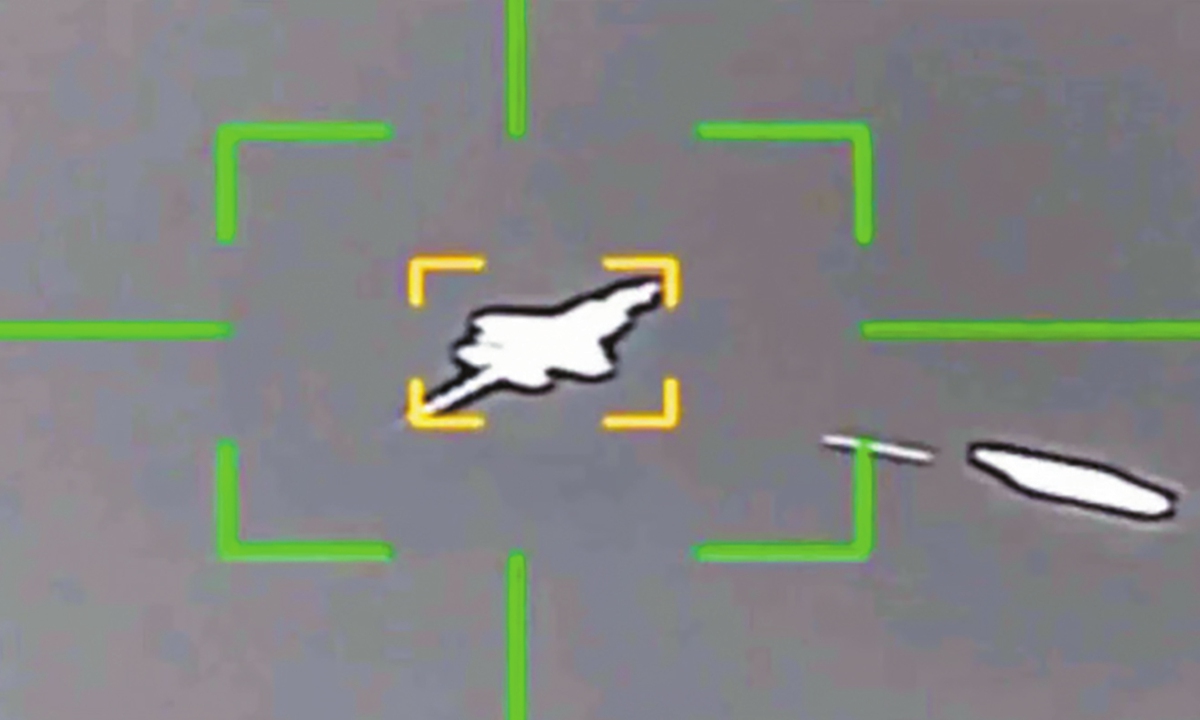
Photo: Screenshot from a video released by Iran's Islamic Republic News Agency on X purporting to show an F-35 being targeted and struck by an Iranian air defense system.
Wavering on ground troopsThe latest F-35 incident came amid concerns of further escalation as the war's intensity grows.
On Friday, IRGC announced the execution of the 67th wave of its retaliatory Operation True Promise 4, according to Iran's Mehr News Agency. IRGC stated that it struck key US positions, including the Ali al-Salem base, which houses drone and airspace command centers, aircraft maintenance facilities, and the US-led coalition's operations center. The strike also targeted early-warning radar systems and missile defense installations at the Al-Wafa base.
IRGC on Friday confirmed that spokesperson General Ali Mohammad Naeini has been killed in an Israeli-US missile attack. IRGC warns that the war will continue until the "enemy is completely exhausted," per Al Jazeera.
The death of the IRGC spokesperson came after the killing of Iran's top security chief Ali Larijani and Intelligence Minister Esmaeil Khatib earlier this week, which is making a political resolution to the conflict increasingly difficult.
Meanwhile, the White House is showing a wavering attitude over the issue of troop deployment.
Sources told Axios on Friday that the Trump administration is considering plans to occupy or blockade Iran's Kharg Island, which processes 90 percent of Iran's crude oil exports, to pressure the country to reopen the Strait of Hormuz. But the media outlet also warned that the operation could "put US troops more directly in the line of fire."
However, Trump on Thursday claimed that he had no plans to commit ground forces, according to the NYT, after sources told Reuters on Wednesday that the US administration is considering deploying thousands of US troops to reinforce its operation in the Middle East.
"I'm not putting troops anywhere," Trump told media, "If I were, I certainly wouldn't tell you."
Hours after Trump's remarks, Israeli Prime Minister Benjamin Netanyahu said that Iran is being "decimated", adding that meaningful regime change will require a "ground component", according to CNBC.
According to Song, Kharg Island is easy to attack but difficult to defend, and it lacks the feasibility for thorough occupation and control. "Any attempt to seize and occupy Kharg Island would trigger fierce retaliatory strikes from Iran, resulting in heavy losses for US forces," Song noted.
On Thursday, the Pentagon asked for $200 billion, almost a quarter of the US' entire annual defense budget, in funding for the war, the New York Times said, citing US officials.
"As Israel continues to pull the US deeper into the conflict and Iran sustains its fierce and prolonged resistance, the prospect of the US deploying ground troops is becoming increasingly likely," Zhu said.
"However, any decision to commit ground forces would sharply elevate the risk of the war descending into a protracted, resource-draining quagmire, while driving military casualties and financial expenditures to dramatically higher levels," Zhu added, "The US seems to be gradually sliding into the very situation it had tried to avoid."
RELATED ARTICLES