IN-DEPTH / IN-DEPTH
International polls find climbing approval of China; boosted by tangible perception via real experiences: experts
Knowing a real China
By Zhang Han, and Leng Shumei Published: Apr 10, 2026 11:10 PM

In a recent Gallup global poll, China surpassed the US in global approval ratings in 2025, with a median of 36 percent approving of China's leadership, compared with 31 percent for the US, and the five-percentage-point advantage over the US in terms of the global median approval rate is the widest Gallup has recorded in China's favor in nearly 20 years, the Xinhua News Agency reported.
Survey results by the Washington, DC-based multinational analytic and advisory company align with a trend suggested by multiple international polls, including the Pew and Morning Consult, and observed by some international relations experts - China's global image is becoming more appealing and China's leadership is gaining wider international recognition.
Meanwhile, from the craze of "China travel" to the viral trend known as "Chinamaxxing," more and more young people in the West are gaining a comprehensive, tangible and lively perception of China through their encounters with China.

China taking the lead
According to the Gallup poll released on April 3, median approval of US leadership fell from 39 percent in 2024 to 31 percent in 2025, returning to earlier lows, while China's approval rose from 32 percent to 36 percent.
The latest results, which Gallup described as "China Edges Past US in Global Approval Ratings," are based on Gallup surveys conducted in 2025 in more than 130 countries, with around 1,000 respondents in each country. They do not account for recent US foreign policy moves since the beginning of 2026, including its attack on Iran and its withdrawal from 66 international organizations.
China has all along been a builder of world peace, a contributor to global development and a defender of the international order. The poll reflects the international community's firsthand perceptions of the performance of China amid the current world of turmoil and intertwined changes. China's actions and contributions to the world have been widely recognized, Li Haidong, a professor at the China Foreign Affairs University, told the Global Times.
However, Li noted that the result should not be simply viewed as a "shift in momentum" between China and the US with China's global approval rising and the other declining. He said that the two countries have behaved differently in international affairs, leading to divergent levels of recognition from the international community.
"It should be made clear that China's advantages are not highlighted simply because of the poor performance of the US. In fact, China's international acceptance has been rising steadily even if the US performs well. Some analyses of the changing recognition of China and the US remain trapped in a zero-sum logic of 'you lose, I win,' which is inconsistent with objective reality," Li explained.
For China, the changing global mood presents an opening to project itself as a steadier and more dependable partner internationally, read a report by Pakistan Today published on April 5. Citing the Gallup survey, the report noted that China has worked to widen its diplomatic and economic reach through infrastructure investment, trade ties and multilateral engagement, particularly across the Global South.
Wang Yiwei, an international affairs expert at the Renmin University of China, told the Global Times that traditionally Gallup has not been friendly toward China, so the 36 percent approval rating is already quite remarkable.
Approval of US leadership declined by 10 points or more in 44 countries between 2024 and 2025, while it increased by a similar amount in only seven. The declines were concentrated among US allies, including many of its NATO partners. Germany led the world in declines, as its approval of US leadership fell by 39 points, followed closely by Portugal (down 38 points). Several other long-standing US partners - including Canada, the UK and Italy - also showed substantial decreases.
According to Wang, behind this result lies more of a reflection of the dissatisfaction among the Western pro-establishment camp with the US government, delivered in the format of public opinions.
The Gallup poll also contains an index suggesting the polled country's alignment. Last year, 8 percent of countries were strongly aligned with China, compared with 5 percent strongly aligned with the US; 30 percent of countries have no clear alignment; among another 40 percent weakly aligned to either power, 32 percent leaned to China and 8 percent to the US.
According to the Gallup report, the poll results also highlighted that the shifting perceptions of US leadership over the past two decades reflect a world that has moved toward a more multipolar order. Many countries, particularly US allies, may be open to balancing relationships across major powers than aligning clearly with one.
The results reflect a broader geopolitical moment in which many countries are reassessing their alignment in an increasingly fragmented and multipolar world. Perceptions of American leadership have been dented by a combination of foreign policy decisions, economic uncertainty and political polarization at home, according to a report of Indian media The Tribune published on April 5.
Gallup is not the only institute that noted this trend of rising recognition of China. A survey by US-based Pew Research Center released in July 2025, showed that the share of people with a favorable view of China has increased since 2024 in 15 of the 25 countries.
Polling organization Nira Data's Democracy Perception Index (DPI) found in 2025 that far more countries hold a favorable view of China than of the US - 76 out of the 96 nations surveyed had a preferable view of China compared to the US. China was viewed more positively across all continents, enjoying the largest levels of support in the Middle East and North Africa (MENA) region and Sub-Saharan Africa, Newsweek reported.
A poll on 41 countries, including major economies in North America, Europe, Asia and Latin America, found that by late May 2025, China's net favorability reached +8.8, while the US was at -1.5. China improved in 34 of 41 markets, Axios reported, citing data provided by Morning Consult, a US business intelligence company.
These poll results should be seen as a structural shift in global political psychology, rather than a simple "win-lose" outcome between China and the US, Chen Hong, director of the Australian Studies Centre of East China Normal University, told the Global Times.
The US' unilateralism and exceptionalism - its frequently externalizing its domestic political conflicts onto international relations - have dealt a blow to its image in the global community, eroding trust even among many of its traditional allies, Chen pointed out.
Casting aside this comparative lens and focusing on China, the "Global Survey on Impression and Understanding of China" released by the Global Times Institute in December 2025, covering 46 countries and about 51,700 respondents, shows that 69 percent of foreign respondents have a favorable impression of China, up 6 percentage points from 2024.
Favorability toward China exceeds 70 percent in Middle Eastern countries and ASEAN member states, and approaches or exceeds 80 percent in BRICS and African countries. The proportion of respondents holding a "good" overall impression of China (64 percent) and the Chinese people (66 percent) showed an increase of 5 and 10 percentage points, respectively, compared to 2024, according to the survey.
Chen noted that in a volatile global landscape, China's growing attention is precisely because it offers a stable, practical path of cooperation and development. As China's international influence grows, the global community is developing higher expectations for China, hoping it will play a more stable and constructive role in global governance.
Both developed and developing countries across the world are calling for stability and growth.
As a pillar of global growth, China's stability and prosperity has delivered real opportunities to the world, contributing over 30 percent of global economic expansion for many consecutive years. Given the sheer size of the Chinese economy, it is remarkable to realize such growth momentum despite the impact of various risks and challenges, the People's Daily reported in July 2025, citing chairman of the National Development and Reform Commission Zheng Shanjie.
Meanwhile, China has articulated its vision for a better world through its four global initiatives, mediated regional flashpoints and championed fairness and justice in crises. China is earning the support of more people across the globe, by its deeds as much as its words, experts said.
Tangible appeal
While the cold numbers of the polls tell only part of the story, the craze for "China travel" and the viral appeal of "Chinamaxxing" - young people, especially in the West, are playfully "maxing out" on Chinese lifestyle habits, wellness routines, and cultural aesthetics - add a human, relatable layer, as people around the world are not just reading about China in the headlines, but trying on its rhythms for size and finding something worth keeping.
Though "China travel" has trended for years, the just concluded Qingming Festival holiday turned in notable records. In the three-day holiday, Chinese border inspection agencies handled 843,000 cross-border trips made by foreigners, up 20.9 percent compared with the same period in 2025; among them, 319,000 inbound foreigners entered under visa-exemption policies, a year-on-year increase of 30.7, the National Immigration Administration said on Tuesday.
In many foreign travelers' social media posts, the diverse snack stands during safe night walks, accessible medical care at community clinics, the unique cultural hue in ethnic villages, the futuristic robot dogs patrolling the streets… these firsthand experiences have not only impressed the visitors, but also helped expand how their family and friends see and understand China.
For Nepali influencer Garima Ghimire, who has considered Chengdu in Southwest China's Sichuan Province her "second hometown" for over a year, China's safety is a tangible part of daily life - one that reshaped her understanding of public security. "Before coming, I only knew China as a neighboring country with some cultural overlaps," she recalled. "I never expected its culture, food, and especially public security, to be so rich and reliable."
"Convenient, efficient, and professional" are the words British vlogger "Simon in China" most frequently uses to describe China's public healthcare system.
Simon recalled that a medical visit to the Qingpu branch of Zhongshan Hospital in Shanghai, affiliated with Fudan University, took him just two hours from the arrival to the hospital to the completion of the visit. "In the UK, honestly, this could take two months," he told the Global Times previously.
In early 2026, the phrase "Very Chinese Time" went viral on global social media platforms. Content centered around China's everyday life has been widely viewed and discussed, bringing the Chinese experience into the international public sphere in an extremely down-to-earth way. For example, drinking warm water instead of iced beverages, practicing Baduanjin (an ancient Chinese wellness exercise), exploring traditional Chinese medicine, preparing basic Chinese dishes, as well as reshaping diet, sleep and work routines to achieve a more balanced daily rhythm.
This phenomenon goes beyond mere online popularity - it is unfolding amid the ongoing reshaping of the global order and the accumulation of anxiety in Western societies. A deeper transformation is emerging, as China's lifestyle, pop culture and technological practices are increasingly recognized, discussed, and used as references around the world, according to Li Haidong.
It is through such cultural exchanges that China is increasingly perceived by global youth as tangible and lovable rather than a tag of "super power" or "second largest economy," he said.
Survey results by the Washington, DC-based multinational analytic and advisory company align with a trend suggested by multiple international polls, including the Pew and Morning Consult, and observed by some international relations experts - China's global image is becoming more appealing and China's leadership is gaining wider international recognition.
Meanwhile, from the craze of "China travel" to the viral trend known as "Chinamaxxing," more and more young people in the West are gaining a comprehensive, tangible and lively perception of China through their encounters with China.
Foreign students pose for photos among blooming flower fields in Jurong, East China's Jiangsu Province on April 10, 2026.
China taking the lead
According to the Gallup poll released on April 3, median approval of US leadership fell from 39 percent in 2024 to 31 percent in 2025, returning to earlier lows, while China's approval rose from 32 percent to 36 percent.
The latest results, which Gallup described as "China Edges Past US in Global Approval Ratings," are based on Gallup surveys conducted in 2025 in more than 130 countries, with around 1,000 respondents in each country. They do not account for recent US foreign policy moves since the beginning of 2026, including its attack on Iran and its withdrawal from 66 international organizations.
China has all along been a builder of world peace, a contributor to global development and a defender of the international order. The poll reflects the international community's firsthand perceptions of the performance of China amid the current world of turmoil and intertwined changes. China's actions and contributions to the world have been widely recognized, Li Haidong, a professor at the China Foreign Affairs University, told the Global Times.
However, Li noted that the result should not be simply viewed as a "shift in momentum" between China and the US with China's global approval rising and the other declining. He said that the two countries have behaved differently in international affairs, leading to divergent levels of recognition from the international community.
"It should be made clear that China's advantages are not highlighted simply because of the poor performance of the US. In fact, China's international acceptance has been rising steadily even if the US performs well. Some analyses of the changing recognition of China and the US remain trapped in a zero-sum logic of 'you lose, I win,' which is inconsistent with objective reality," Li explained.
For China, the changing global mood presents an opening to project itself as a steadier and more dependable partner internationally, read a report by Pakistan Today published on April 5. Citing the Gallup survey, the report noted that China has worked to widen its diplomatic and economic reach through infrastructure investment, trade ties and multilateral engagement, particularly across the Global South.
Wang Yiwei, an international affairs expert at the Renmin University of China, told the Global Times that traditionally Gallup has not been friendly toward China, so the 36 percent approval rating is already quite remarkable.
Approval of US leadership declined by 10 points or more in 44 countries between 2024 and 2025, while it increased by a similar amount in only seven. The declines were concentrated among US allies, including many of its NATO partners. Germany led the world in declines, as its approval of US leadership fell by 39 points, followed closely by Portugal (down 38 points). Several other long-standing US partners - including Canada, the UK and Italy - also showed substantial decreases.
According to Wang, behind this result lies more of a reflection of the dissatisfaction among the Western pro-establishment camp with the US government, delivered in the format of public opinions.
The Gallup poll also contains an index suggesting the polled country's alignment. Last year, 8 percent of countries were strongly aligned with China, compared with 5 percent strongly aligned with the US; 30 percent of countries have no clear alignment; among another 40 percent weakly aligned to either power, 32 percent leaned to China and 8 percent to the US.
According to the Gallup report, the poll results also highlighted that the shifting perceptions of US leadership over the past two decades reflect a world that has moved toward a more multipolar order. Many countries, particularly US allies, may be open to balancing relationships across major powers than aligning clearly with one.
The results reflect a broader geopolitical moment in which many countries are reassessing their alignment in an increasingly fragmented and multipolar world. Perceptions of American leadership have been dented by a combination of foreign policy decisions, economic uncertainty and political polarization at home, according to a report of Indian media The Tribune published on April 5.
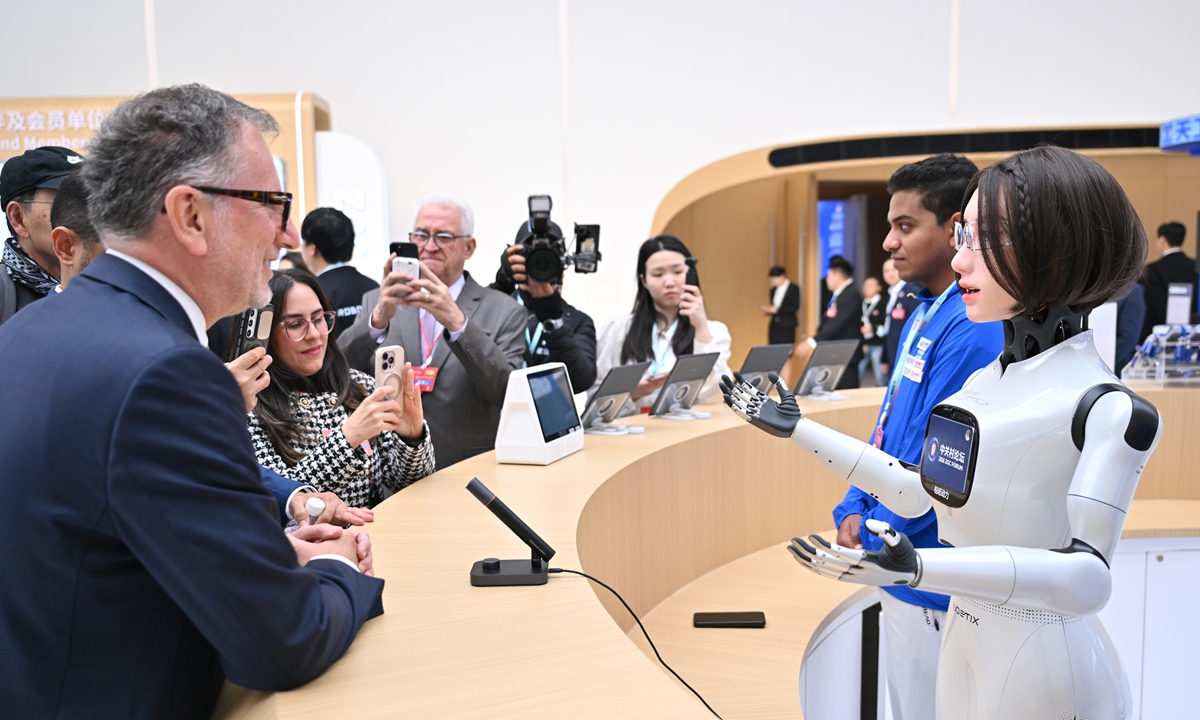
A foreign guest interacts with a Chinese-developed robot at the 2026 Zhongguancun Forum on March 25, 2026. Photo: VCG
An observed trendGallup is not the only institute that noted this trend of rising recognition of China. A survey by US-based Pew Research Center released in July 2025, showed that the share of people with a favorable view of China has increased since 2024 in 15 of the 25 countries.
Polling organization Nira Data's Democracy Perception Index (DPI) found in 2025 that far more countries hold a favorable view of China than of the US - 76 out of the 96 nations surveyed had a preferable view of China compared to the US. China was viewed more positively across all continents, enjoying the largest levels of support in the Middle East and North Africa (MENA) region and Sub-Saharan Africa, Newsweek reported.
A poll on 41 countries, including major economies in North America, Europe, Asia and Latin America, found that by late May 2025, China's net favorability reached +8.8, while the US was at -1.5. China improved in 34 of 41 markets, Axios reported, citing data provided by Morning Consult, a US business intelligence company.
These poll results should be seen as a structural shift in global political psychology, rather than a simple "win-lose" outcome between China and the US, Chen Hong, director of the Australian Studies Centre of East China Normal University, told the Global Times.
The US' unilateralism and exceptionalism - its frequently externalizing its domestic political conflicts onto international relations - have dealt a blow to its image in the global community, eroding trust even among many of its traditional allies, Chen pointed out.
Casting aside this comparative lens and focusing on China, the "Global Survey on Impression and Understanding of China" released by the Global Times Institute in December 2025, covering 46 countries and about 51,700 respondents, shows that 69 percent of foreign respondents have a favorable impression of China, up 6 percentage points from 2024.
Favorability toward China exceeds 70 percent in Middle Eastern countries and ASEAN member states, and approaches or exceeds 80 percent in BRICS and African countries. The proportion of respondents holding a "good" overall impression of China (64 percent) and the Chinese people (66 percent) showed an increase of 5 and 10 percentage points, respectively, compared to 2024, according to the survey.
Chen noted that in a volatile global landscape, China's growing attention is precisely because it offers a stable, practical path of cooperation and development. As China's international influence grows, the global community is developing higher expectations for China, hoping it will play a more stable and constructive role in global governance.
Both developed and developing countries across the world are calling for stability and growth.
As a pillar of global growth, China's stability and prosperity has delivered real opportunities to the world, contributing over 30 percent of global economic expansion for many consecutive years. Given the sheer size of the Chinese economy, it is remarkable to realize such growth momentum despite the impact of various risks and challenges, the People's Daily reported in July 2025, citing chairman of the National Development and Reform Commission Zheng Shanjie.
Meanwhile, China has articulated its vision for a better world through its four global initiatives, mediated regional flashpoints and championed fairness and justice in crises. China is earning the support of more people across the globe, by its deeds as much as its words, experts said.
Tangible appeal
While the cold numbers of the polls tell only part of the story, the craze for "China travel" and the viral appeal of "Chinamaxxing" - young people, especially in the West, are playfully "maxing out" on Chinese lifestyle habits, wellness routines, and cultural aesthetics - add a human, relatable layer, as people around the world are not just reading about China in the headlines, but trying on its rhythms for size and finding something worth keeping.
Though "China travel" has trended for years, the just concluded Qingming Festival holiday turned in notable records. In the three-day holiday, Chinese border inspection agencies handled 843,000 cross-border trips made by foreigners, up 20.9 percent compared with the same period in 2025; among them, 319,000 inbound foreigners entered under visa-exemption policies, a year-on-year increase of 30.7, the National Immigration Administration said on Tuesday.
In many foreign travelers' social media posts, the diverse snack stands during safe night walks, accessible medical care at community clinics, the unique cultural hue in ethnic villages, the futuristic robot dogs patrolling the streets… these firsthand experiences have not only impressed the visitors, but also helped expand how their family and friends see and understand China.
For Nepali influencer Garima Ghimire, who has considered Chengdu in Southwest China's Sichuan Province her "second hometown" for over a year, China's safety is a tangible part of daily life - one that reshaped her understanding of public security. "Before coming, I only knew China as a neighboring country with some cultural overlaps," she recalled. "I never expected its culture, food, and especially public security, to be so rich and reliable."
"Convenient, efficient, and professional" are the words British vlogger "Simon in China" most frequently uses to describe China's public healthcare system.
Simon recalled that a medical visit to the Qingpu branch of Zhongshan Hospital in Shanghai, affiliated with Fudan University, took him just two hours from the arrival to the hospital to the completion of the visit. "In the UK, honestly, this could take two months," he told the Global Times previously.
In early 2026, the phrase "Very Chinese Time" went viral on global social media platforms. Content centered around China's everyday life has been widely viewed and discussed, bringing the Chinese experience into the international public sphere in an extremely down-to-earth way. For example, drinking warm water instead of iced beverages, practicing Baduanjin (an ancient Chinese wellness exercise), exploring traditional Chinese medicine, preparing basic Chinese dishes, as well as reshaping diet, sleep and work routines to achieve a more balanced daily rhythm.
This phenomenon goes beyond mere online popularity - it is unfolding amid the ongoing reshaping of the global order and the accumulation of anxiety in Western societies. A deeper transformation is emerging, as China's lifestyle, pop culture and technological practices are increasingly recognized, discussed, and used as references around the world, according to Li Haidong.
It is through such cultural exchanges that China is increasingly perceived by global youth as tangible and lovable rather than a tag of "super power" or "second largest economy," he said.
RELATED ARTICLES