Xi meets KMT leader, urges joint efforts to promote cross-Straits peace, oppose ‘Taiwan independence’ secession
Cross-Straits meeting helps accumulate goodwill, rebuild mutual trust: expert


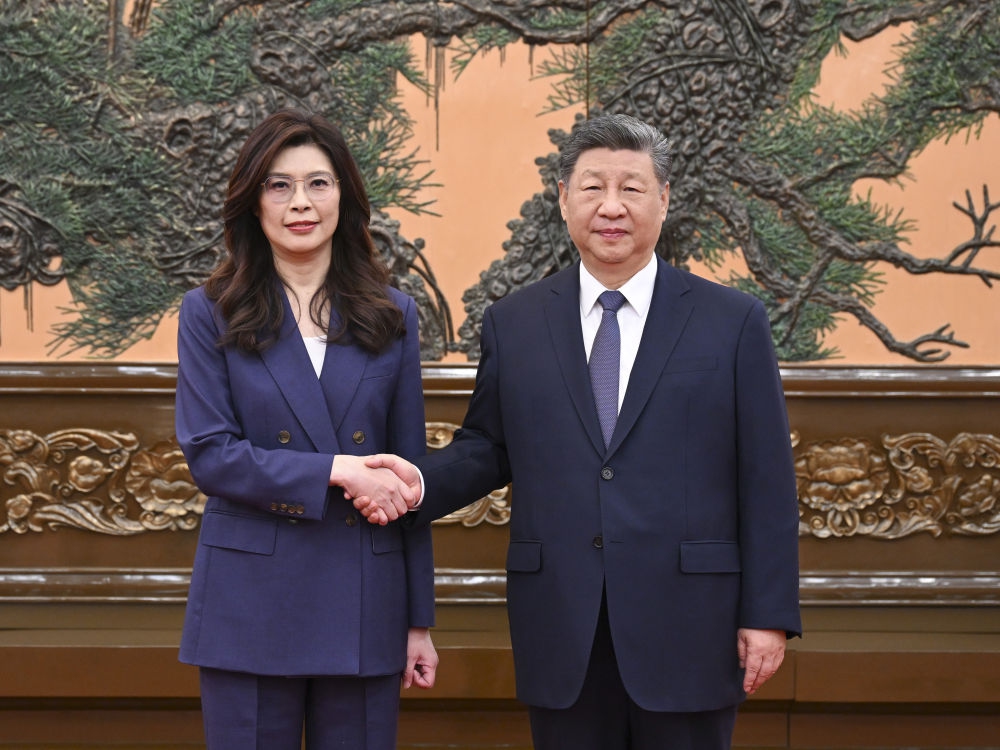
Xi Jinping, general secretary of the Communist Party of China (CPC) Central Committee, meets with Cheng Li-wun, chairwoman of the Chinese Kuomintang (KMT) party in Beijing, April 10, 2026. Photo: Xinhua
Xi Jinping, general secretary of the Communist Party of China (CPC) Central Committee, on Friday morning met with Cheng Li-wun, chairwoman of the Chinese Kuomintang (KMT) party, in Beijing, the Xinhua News Agency reported on Friday.
Invited by the CPC Central Committee and Xi, Cheng is the first KMT chairperson to have led a delegation to the Chinese mainland in the past decade. The delegation had visited Jiangsu Province and Shanghai before coming to Beijing.
Xi said this meeting between the CPC and KMT leaders after 10 years is of great significance for developing relations between the two parties and across the Taiwan Straits.
Xi stressed that no matter how the international landscape and the situation across the Taiwan Straits may evolve, the overarching trend toward the great rejuvenation of the Chinese nation will not change, and the prevailing momentum for the Chinese on both sides of the Straits to come together will not change, according to Xinhua.
He expressed the willingness to work with all political parties in Taiwan, including the KMT, as well as groups and people from all sectors, to strengthen exchanges and dialogue, promote peace across the Taiwan Straits, improve the well-being of the people and advance national rejuvenation, on the basis of the common political foundation of adhering to the 1992 Consensus and opposing "Taiwan independence."
Cheng said that people on both sides of the Taiwan Straits are Chinese and belong to one family, according to Xinhua.
The KMT and the CPC should uphold the common political foundation of adhering to the 1992 Consensus and opposing "Taiwan independence", strengthen mutual political trust, preserve Chinese history, promote Chinese culture, and expand exchanges and cooperation across all fields, Cheng said.
She called for efforts to promote the peaceful development of cross-Straits relations, foster a brighter future for ties across the Straits, and advance the rejuvenation of the Chinese nation.
Forging closer bonds
According to Xinhua, Xi made four points about the development of cross-Straits relations.
He called for forging closer bonds across the Straits by upholding a correct understanding of identity. "Differences in social systems should not be an excuse for secession," Xi said.
Xi called for safeguarding the shared homeland through peaceful development. The core issue for safeguarding the shared homeland lies in recognizing that both sides of the Straits belong to one China, he said.
"We welcome any proposals conducive to the peaceful development of cross-Straits relations and will spare no effort to advance any endeavors that promote such development," Xi said, adding that "Taiwan independence" is the chief culprit undermining peace across the Taiwan Straits. "We should neither condone nor tolerate it."
Xi called for fostering the well-being of the people through exchanges and integration.
Taiwan compatriots are welcome to visit the mainland, Xi said. He encouraged young people in Taiwan to seek development opportunities on the mainland. Taiwan agricultural and fishery products, as well as other high-quality goods, are welcome to enter the mainland market, he added.
Xi also called for joint efforts to achieve national rejuvenation, according to Xinhua.
Zheng Jian, a professor at Xiamen University, told the Global Times that the meeting occurred at a critical moment — with the Chinese nation's rejuvenation accelerating, US strategic competition intensifying, and secessionists on the island rampant. It holds significant importance in reorienting cross-Straits relations toward stability, restoring exchanges, and reducing space for external intervention.
According to the Global Times observation, words like "exchange," "peace," "compatriots" and "Chinese nation" appeared frequently in Xinhua's meeting readout.
The emphasis by the leaders of both parties on shared Chinese identity and history, directly counters DPP efforts to tie Taiwan region to the US and Japan while distorting history and severing the civilizational ties between the two sides of the Straits, Zheng said.
Herman Shuai, a retired Taiwan lieutenant general, told the Global Times that the CPC and KMT, from the top level, discussed relations from the perspective of shared bloodline and cultural heritage — a major positive step for peace, especially amid the mainland's firm opposition against secessionists and some island politicians' "resist Chinese mainland, protect Taiwan" stance.
Shuai noted Cheng clearly stated that peaceful development must be based on the 1992 Consensus with deepened exchanges. Through the latest interaction, the KMT's discourse and policy line will become clearer, with more consensus with the mainland, said Shuai.
Taiwan-based media have paid close attention to this meeting, with CTiTV describing it as "historic" on its YouTube live page.
The vast majority of Taiwan media outlets highlighted the detail of the 14-second handshake between the KMT and CPC leaders.
The BBC described the meeting as a rare one, which saw both sides "stress a desire for cross-Straits peace." Major media including Bloomberg and New York Times also reported the voices advocating peace and anti-external interference by the two parties' leaders in Beijing.
Cai Peihui, a deputy to the 14th National People's Congress from the Taiwan delegation and Chairman of the Board of the Cross-Strait Greater Bay Area Group Limited, said that the latest engagement has demonstrated to the international community that Chinese people on both sides of the Straits possess full wisdom and capability to resolve differences through dialogue and consultation, and jointly safeguard peace.
At a time when "official" communication channels across the Straits are not smooth and the risk of accidental conflict is rising, the high-level communication channel between the CPC and the KMT helps both sides of the Straits gradually accumulate goodwill, rebuild the foundation of mutual trust, and create conditions for the eventual restoration of institutionalized consultations, said Cai.
Choice between war and peace
Cheng Li-wun, during a press briefing, described the meeting as sincere, candid and heartfelt, and it fully demonstrated the shared aspiration of both sides for peaceful development across the Taiwan Straits.
She urged all political parties in the Taiwan region to refrain from using cross-Straits peaceful development as a tool for partisan competition or vote-seeking, stressing it is a choice between peace and war.
While Cheng continued her "journey of peace" in the mainland, Taiwan regional leader Lai Ching-te hyped the "mainland threat" rhetoric on Friday, claiming the island must strengthen its own capabilities, according to udn.com.
On Tuesday, Lai met with a US delegation led by Representative Zach Nunn, vowing to boost defense capabilities. Lai previously announced a $40 billion eight-year special defense budget in November 2025, but it was blocked by opposition legislators multiple times.
Shuai said the DPP has long used the "anti-China" narrative to switch public attention from its corruption and authoritarianism, but the failure of large-scale recall efforts against KMT legislators last year has shown it is losing public support. Further military spending aligned with the US would become an unbearable burden on Taiwan people.
Zheng pointed out that Taiwan is now confronted with a critical choice: whether to follow the path of peace through cross-Straits exchanges and oppose "Taiwan independence" or to defy the trend by adopting "anti-China" confrontation and reliance on the US for secession.
"The KMT led by Cheng has chosen the bright and righteous road," he added.
"We are paving the way and have taken the first step. From now on, the road ahead will only become smoother and broader," Cheng told media on Friday.
RELATED ARTICLES