CALT unveils China's largest composite power cabin for reusable launch vehicles
By Published: Apr 12, 2026 08:40 PM

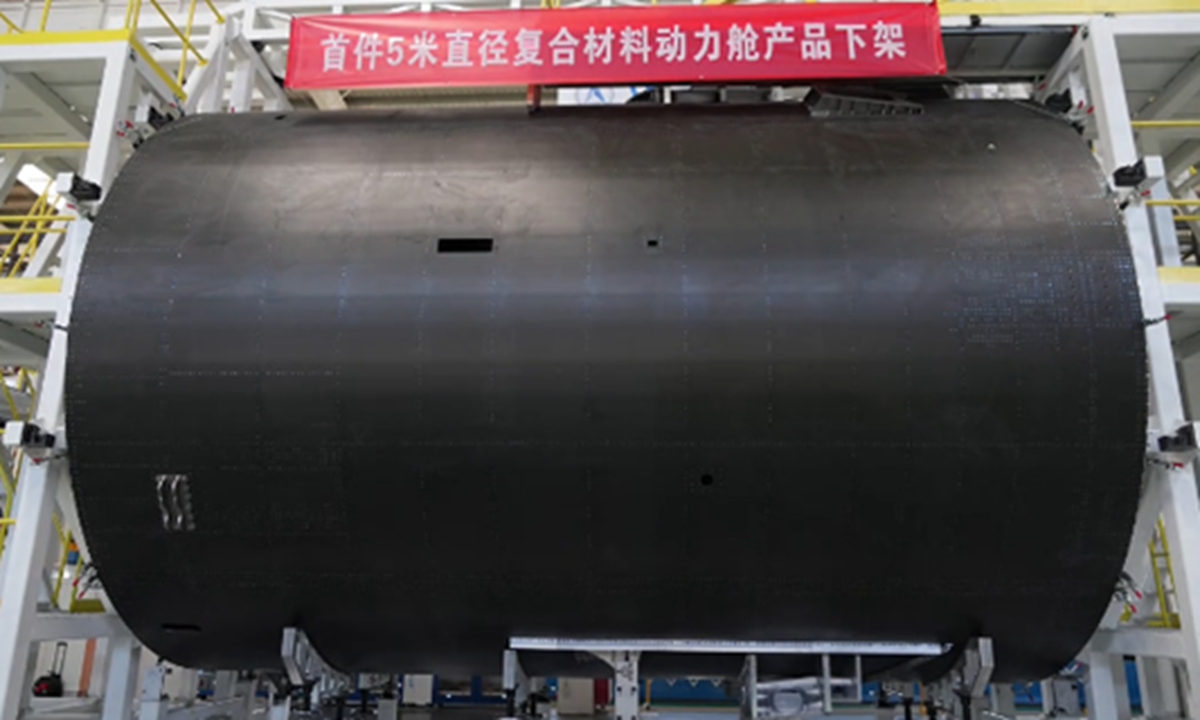
China Academy of Launch Vehicle Technology (CALT) completes the development of its first 5-meter-diameter composite material power cabin product. Photo: Courtesy of the CALT
The Global Times has learned from the China Academy of Launch Vehicle Technology (CALT) on Sunday that the first 5-meter-diameter composite material power cabin product it developed has officially been unveiled. According to a CALT statement, it represents the largest composite material integrated cabin section for reusable launch vehicles in China's aerospace sector, marking a major breakthrough in the country's large-scale aerospace composite material structure manufacturing technology.
The power cabin uses more than 60 percent composite materials. Its wall panels enable a lightweight structure capable of withstanding axial compressive loads of several thousand tons while featuring adaptive adjustment interfaces, it said.
The development team has adopted a highly parallel and collaborative approach during the structural design and manufacturing process. They overcame key technical challenges, including high-precision and high-quality manufacturing of large-scale novel composite integrated structures, as well as complex technical state management under a highly concurrent collaborative model.
The first unit of the product was completed from conceptual design to final delivery within seven months, the CALT disclosed.
According to the European Space Agency (ESA), composite materials like carbon fibre reinforced polymers are increasingly being used in spacecraft structures. They are composed of a polymer matrix, reinforced with layers of carbon or glass fibres. This creates a strong and lightweight material, resistant to corrosion.
Such materials could reduce waste resulting from space missions and would be ideal for reusable launchers, ESA said.
China is currently making efforts to advance the development of reusable launch vehicles, with a particular focus on the first stage as a key development priority, Song Zhongping, a Chinese space affairs observer, told the Global Times. The new generation of reusable launch vehicles requires the first stage to withstand multiple flights and re-entry cycles, which places significantly higher demands on the performance of structural materials.
Advanced materials with excellent high-temperature resistance, corrosion resistance, and fatigue resistance must be adopted. Composite materials are one of the key technologies that can meet these stringent requirements, and their successful application will strongly support the long-term development of China's reusable launch vehicle programs, Song noted.
RELATED ARTICLES