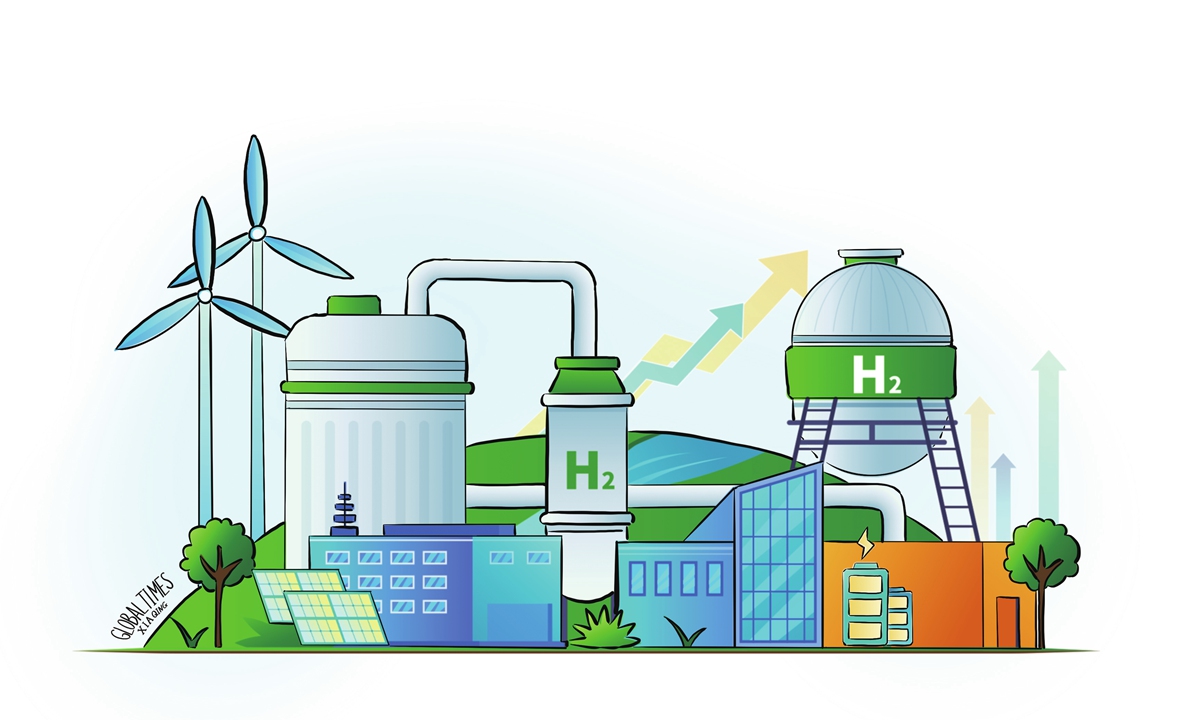
Illustration: Xia Qing/GT
Baicheng, in Northeast China's Jilin Province, is accelerating a full industrial chain linking "wind and solar power generation - green hydrogen production - chemical conversion." As of the end of 2025, its installed new-energy capacity stood at 19.1 gigawatts. With abundant green electricity, the local hydrogen sector is gaining momentum, according to a report by the Economic Daily on Sunday.Baicheng's successful practice in clean energy offers a new lens on China's green and high-quality development. As resource advantages extend downstream industries, the logic of growth is shifting.
For years, resource-rich regions have faced a common issue: power is easy to generate but hard to convert into greater economic gains. Baicheng is moving beyond simply producing electricity. It is turning power into hydrogen, then into chemical products. The longer the industrial chain, the higher the value and the stronger the growth it brings.
The key shift is clear. Once green power becomes cost-competitive, the question is not only "how to connect to the grid," but also "how to convert it." This shift determines whether an economy stays at the level of selling resources or moves up to making products. By linking clean power with advanced chemicals, Baicheng amplifies the value of each unit of electricity through a "power-hydrogen-product" chain.
In essence, this model is a three-step upgrade of the same resource. Compared with selling electricity alone, converting green power into hydrogen, ammonia, or methanol raises its value significantly. More importantly, these products can be stored and transported. As fuels for global shipping, green ammonia and methanol can plug directly into international trade.
What matters is not having all the links, but connecting them. Upstream, 19.1 gigawatts of capacity provide low-cost power. Midstream, hydrogen production links with ammonia and methanol synthesis. Downstream, sectors such as shipping and fine chemicals absorb the output. This deeper structure helps resource-based regions move from raw material suppliers to producers of green products.
The model is making rapid progress. In 2025, two major projects in Baicheng began operation, including a wind-powered green methanol project and an integrated hydrogen-ammonia project. Both are part of China's first batch of pilot programs for green liquid fuels.
The Da'an Wind-Solar-Powered Green Hydrogen to Ammonia Integration Demonstration Project has formed a full "green power-hydrogen-ammonia" loop. It runs entirely on wind and solar power, producing 32,000 tons of green hydrogen and 180,000 tons of green ammonia each year. It cuts carbon emissions by about 650,000 tons annually while creating stable jobs and generating output, according to local official data.
Another example involves products from Shanghai Electric's Taonan green hydrogen-to-methanol plant in Baicheng being used to refuel a methanol dual-fuel container ship of French shipping group CMA CGM at Shanghai's Yangshan Port, according to Baicheng Fabu. This marked its entry into large-scale use in international shipping and showed how local resources can be turned into globally traded products.
CMA CGM's choice is no coincidence. With the International Maritime Organization targeting net-zero emissions by 2050, demand for green fuels is rising fast. By meeting international standards and entering global supply chains, these new-energy products go global and generate economic gains.
Baicheng has an estimated 50 gigawatts of clean energy capacity that can be developed. Local plans aim to produce 300,000 to 400,000 tons of green hydrogen annually by 2030, along with 2 million tons of green ammonia, methanol, and related products. These goals signal a shift from pilot projects to scaled-up development, with growth potential expanding quickly.
This is a microcosm of a broader shift in China's new-energy sector from merely expanding capacity to actually creating value. Baicheng shows that the real competition is no longer about who has more resources, but who can convert them more efficiently. Those who turn electricity into products and embed resources into industrial chains will gain the edge in the next phase of green growth.
At the national level, this shift is beginning to reshape how new energy is developed and used. Instead of relying solely on grid expansion to absorb power, more regions are exploring local conversion models. By linking renewable energy with hydrogen, chemicals, and advanced manufacturing, electricity is no longer an end product but a starting point for higher-value industrial activity.
This process also opens a new pathway for resource-rich inland regions. In the past, distance from major markets limited their growth. Now, by producing tradable green fuels and materials, these regions can connect directly to global supply chains. As more projects scale up, China's new-energy sector is likely to move further toward integrated development, with the "chain extension" model adding more values.
The author is a reporter with the Global Times. bizopinion@globaltimes.com.cn
RELATED ARTICLES