Fresh investment wave by Chinese firms in Brazil with Mixue opening its first store
Trend shows long-term commitment, strong complementarity: experts
By Published: Apr 12, 2026 09:37 PM


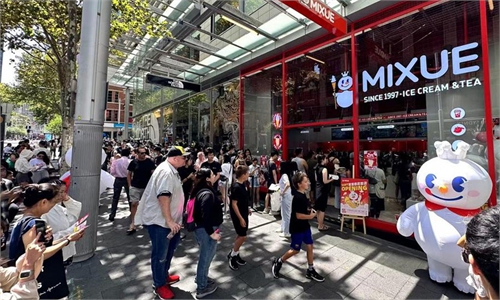
Chinese ice cream and beverage chain Mixue marks its arrival in the Brazilian market with the opening of its first store in Sao Paulo on April 11, 2026. Photo: Courtesy of Mixue Bingcheng
Chinese ice cream and beverage chain Mixue, known for its affordable ice cream and tea-based drinks, marked its arrival in the Brazilian market with the opening of its first store in Sao Paulo on Saturday (local time).
The move by the popular beverage brand came amid an investment tide by Chinese consumer brands in Brazil, demonstrating the strong complementarity enjoyed by the two economies on various sections of the supply chain, a Chinese analyst said.
Through shop openings and investment, Mixue and its partners are expected to bring as many as 25,000 jobs by 2030 to the local community, according to a company statement sent to the Global Times on Sunday, citing a Brazilian official.
The company said that the opening of its first shop in Brazil came after the signing of strategic partnership last year, and it is actively preparing for the opening of a second retail shop and an expanding network that will foster industrial chain integration between the two countries in agriculture and food processing.
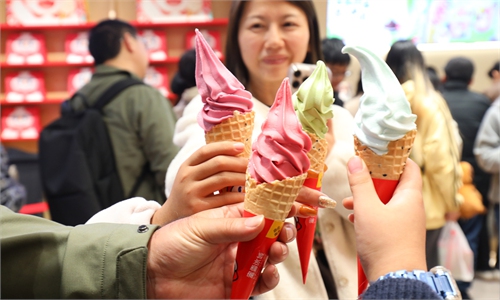
Domestic news portal Jimu News reported on Sunday that the shop drew a crowd on Saturday, with Brazilians and Chinese people living in Brazil trying out the company's offerings, including its ice cream cone.
According to Reuters, the move by Mixue comes as "an array of Chinese businesses are now courting the country's more than 200 million consumers."
China-founded fast-fashion retailer Shein promised to invest $150 million in partnerships to make clothing in 2,000 local factories, creating 100,000 fashion manufacturing jobs in Brazil by 2026, Reuters reported in February.
Chinese automaker GWM opened its first South American plant in Sao Paulo state in 2025.
Chinese direct investment doubled to $4.2 billion in 2024 across 39 projects in Brazil, making it the world's third-largest recipient of Chinese investment, Reuters reported, citing data from the Brazil-China Business Council.
Last May, Mixue signed an agreement with Brazilian authorities to purchase at least 4 billion-yuan ($586 million) worth of materials including coffee beans and fruits from the country in the next three to five years and started to build localized supply chains.
Zhu Danpeng, a veteran food industry analyst, told the Global Times on Sunday that what stands out in these new cooperation deals is the focus on dual-way supply chain cooperation, which highlighted the long-term commitment by and strong complementarity of companies from the two sides.
"The key to supporting new-style tea drinks in moving from 'going global' to taking a foothold in the local market lies precisely in the global layout of supply chains. While products, channels, and marketing strategies can be replicated, and price wars may yield short-term results, building a supply chain is by no means an overnight achievement and needs input over the years," Zhu said.
The deep roots of new Chinese consumer brands in Brazil as well as a rising number of markets in Latin America reflect the complementarity between the Chinese and Latin American economies across various links of industrial and supply chains, a Chinese analyst said.
Yue Yunxia, a deputy director of the Institute of Latin American Studies at the Chinese Academy of Social Sciences, told the Xinhua News Agency earlier this month that these new consumer brands share three common characteristics: targeting young consumers, focusing on cost-effective fast-moving consumer goods and adopting a chain franchising model suited for light entrepreneurship. These features align well with the characteristics of the Latin American market, Yue said.
In the meantime, more Brazilian goods are finding their way to the Chinese market.
Luckin Coffee, a leading Chinese coffee chain, officially opened its first Brazilian coffee-themed store in the Guangdong-Hong Kong-Macao Greater Bay Area in the city of Guangzhou, South China's Guangdong Province, Xinhua reported in September 2025.
Brazilian mining giant Vale said on Friday that it had signed a contract of affreightment for the world's first ethanol/methanol tri-fuel ocean-going vessels with Shandong Shipping Corp, a company in East China's Shandong Province. The first ship should start operating in Vale's service from 2029 and the use of ethanol in vessels can reduce greenhouse gas emissions in maritime transport by about 90 percent, the company said in an email statement sent to the Global Times.
"China-Brazil economic and trade cooperation has evolved from simple import and export of goods to commercial investment, and further to local supply chain deployment. In the future, it holds the feasibility of localized production. The matching and complementarity of supply chains and value chains are very strong," Yue said.
Trade between Brazil and China hit a record $171 billion in 2025, up 8.2 percent year-on-year, the South China Morning Post reported in January, citing data released by the China-Brazil Business Council.
RELATED ARTICLES