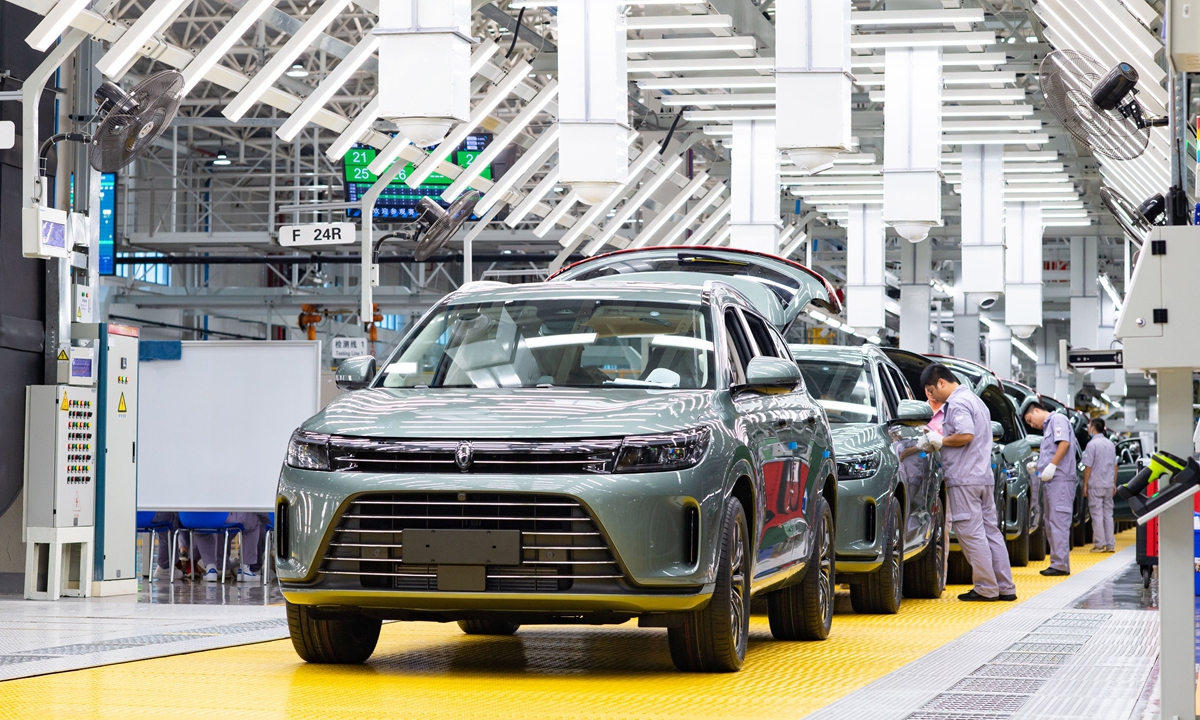
An NEV manufacturing line in Southwest China's Chongqing Municipality Photo: VCG
Wholesale sales of new-energy vehicle (NEV) passenger vehicles by Chinese automakers are projected to grow by 13 percent year-on-year to reach 17.3 million units in 2026, Cui Dongshu, secretary-general of the China Passenger Car Association (CPCA), said at a forum on Sunday, signaling steady growth in China's NEV sector.
Speaking at the 2026 Intelligent Electric Vehicle Development Summit Forum on Sunday, Cui also forecast that total wholesale sales of automobiles in China will reach 34.8 million this year, with year-on-year growth of 1 percent. He confirmed the forecasts with the Global Times on Sunday.
"In March, both fuel-powered and NEV exports by domestic passenger vehicle manufacturers hit record highs for the same month, fully demonstrating the continuous improvement of the international competitiveness of China's automotive industry and sustained robust overseas demand," Cui said.
In the first quarter, China's automobile output reached 7.04 million units and sales totaled 7.05 million units, according to the China Association of Automobile Manufacturers (CAAM).
Between January and March, the country's NEV output came in at 2.97 million units and sales at 2.96 million units, according to the CAAM.
Cui noted that retail sales of automobiles slightly decreased recently following the expiry of purchase tax exemptions, adding that long-term support measures to further tap into the domestic auto market would help effectively unleash consumption potential.
"China's auto market is expected to enter a phase of gradual improvement in the second quarter. Looking ahead to the second half, the auto market is expected to maintain overall stability, ushering in positive growth," Cui said.
Zhang Xiang, a visiting professor in the engineering department of Huanghe Science and Technology University, also predicted stable and sustainable development of China's automobile market.
"A new round of policy support for the trade-in program for consumer goods, along with the large room for the growth of car ownership in China compared with other countries such as the US, Japan and South Korea, mean that the country's auto market will likely maintain strong momentum this year," Zhang told the Global Times on Sunday.
The National Development and Reform Commission (NDRC), the country's top economic planner, said on Friday that it, along with the Ministry of Finance, had recently allocated the second batch of 62.5 billion yuan ($9.15 billion) in ultra-long special treasury bond funds to support the trade-ins of consumer goods for 2026.
In addition, China is accelerating technological breakthroughs in the autonomous-driving sector, with the Ministry of Industry and Information Technology already granting permits for electric sedans to offer Level-3 self-driving functions, Zhang said.
"Once material breakthroughs are made in this aspect, it will definitely give a strong boost to the automobile market," he said.
In this regard, Chinese companies are stepping up efforts to enhance their international competitiveness. For example, Chinese autonomous-driving leader Pony.ai recently launched commercial robotaxi services in Zagreb, Croatia, in partnership with local mobility firm Verne and global ride-hailing platform Uber, becoming Europe's first fully commercial robotaxi service open to the public.
On March 19, Chinese autonomous-driving technology company WeRide announced a national-level strategic partnership with ELEVATE Slovakia, officially launching Slovakia's first autonomous-driving project, the Securities Daily reported.
RELATED ARTICLES