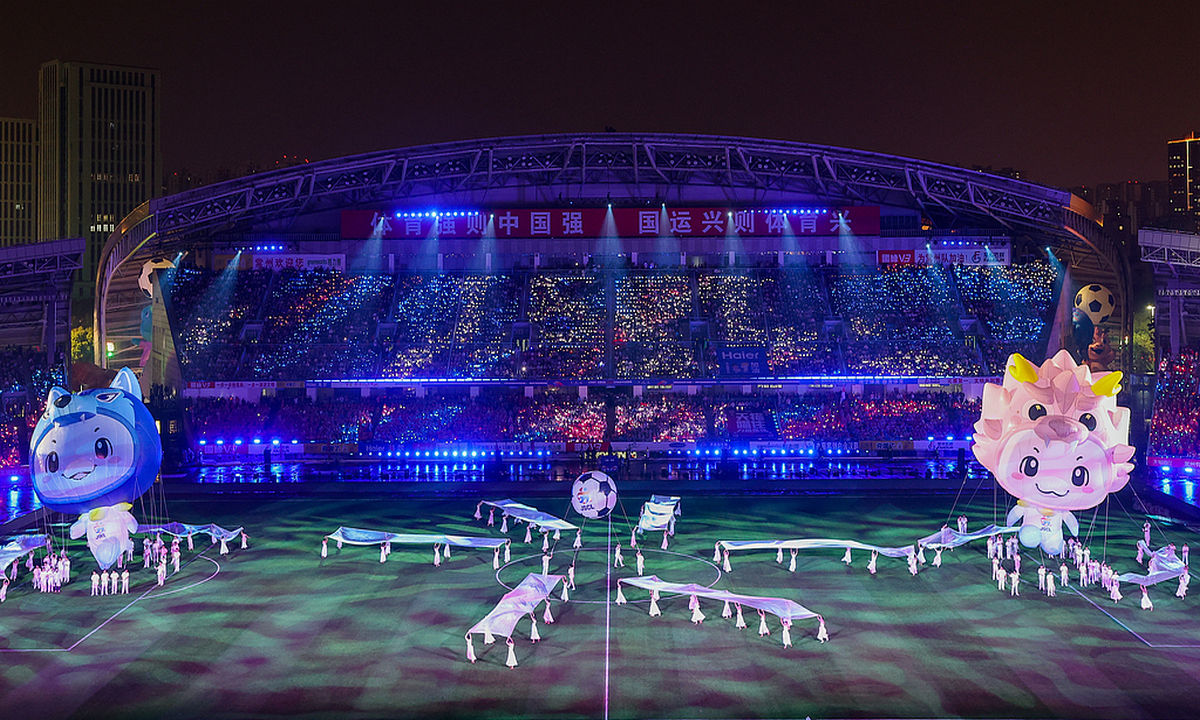
The 2026 Jiangsu Football City League - popularly known as the Su Super League - kicks off in Changzhou, East China's Jiangsu Province, on April 11, 2026. Photo: VCG
The 2026 Jiangsu Football City League - popularly known as the Su Super League - kicked off on Saturday night in Changzhou, East China's Jiangsu Province, with multiple Chinese localities including South China's Guangdong and Central China's Hubei standing ready for their provincial city football leagues this year.
These events not only ignite public enthusiasm and participation, but also explore a new path for grassroots competitions to leverage and boost the local economy, a Chinese expert said, noting that the event economy is increasingly creating fresh consumption scenarios and opening up new avenues for economic growth.
On Saturday evening, the first round of the Su Super League kicked off. Across the four matches on the opening day, a total of 124,264 fans attended in person. The curtain-raiser between Changzhou and Nantong drew 40,833 spectators, with an average attendance of more than 31,000 per match, thepaper.cn reported on Sunday.
This year, all matches are scheduled on Saturdays, with the entire season covering major holidays including May Day, the Dragon Boat Festival, Mid-Autumn Festival, and National Day. The season has also been extended by one month compared with 2025, chinanews.com reported.
From issuing consumption vouchers and digital yuan to the new "ticket stub +" initiatives, Jiangsu's cultural and tourism departments, commercial districts, scenic spots, restaurants, and study tour organizations are all joining forces. Data from Meituan show that the events are driving weekend travel across the Yangtze River Delta, with cities such as Nanjing, Suzhou, Wuxi, and Yangzhou ranking among the hottest destinations, according to the report.
In the previous season, the Su Super League ran for 176 days, drawing more than 2.43 million fans to the stadiums and more than 2.2 billion viewers via online livestreams. Official data showed that every 1 yuan ($0.15) in ticket revenue drove 7.3 yuan in related spending, demonstrating the strong magnet effects of the "ticket stub economy," said the report.
In addition to Jiangsu, the Hubei Football City League began on Sunday and will run until November. A total of 17 city and prefecture-level teams from across the province will participate. Tickets for the league are priced at just 9.9 yuan, with fans able to enjoy a range of perks, including local dining discounts and tournament merchandise deals.
The Guangdong City Football Super League will run from April to November, featuring 21 cities across South China's Guangdong Province. Meanwhile, a total of 16 city teams will compete in the Shandong Qilu Super League, which is to begin on April 18.
Jiang Yiyi, a tourism and sports expert at Beijing Sport University, told the Global Times on Sunday that people are increasingly willing to pay for emotional value. Against this backdrop, the event economy is creating more and more new consumption scenarios and opening up fresh avenues for economic growth.
"The months-long season provides a sustained time window for continuous consumption stimulation. It transforms one-time traffic surges into lasting consumption trends, offers a sustainable timeframe for the deep integration of culture, commerce, tourism, and sports, and seamlessly integrates event-related consumption into people's daily lives," Jiang said.
The General Administration of Sport of China carried out pilot monitoring on event-driven consumption across seven provinces and regions. It monitored 1,947 key events in 2025, which drove 43.13 billion yuan in consumption, with an average consumption impact of 22.15 million yuan per event, according to stcn.com.
"As various regions leverage their unique strengths to develop distinctive sporting events, the event economy is expected to remain a highlight this year, continuously providing strong momentum for upgrading consumption and ensuring steady economic development in China," Wang Peng, an associate researcher at the Beijing Academy of Social Sciences, told the Global Times on Sunday.
RELATED ARTICLES