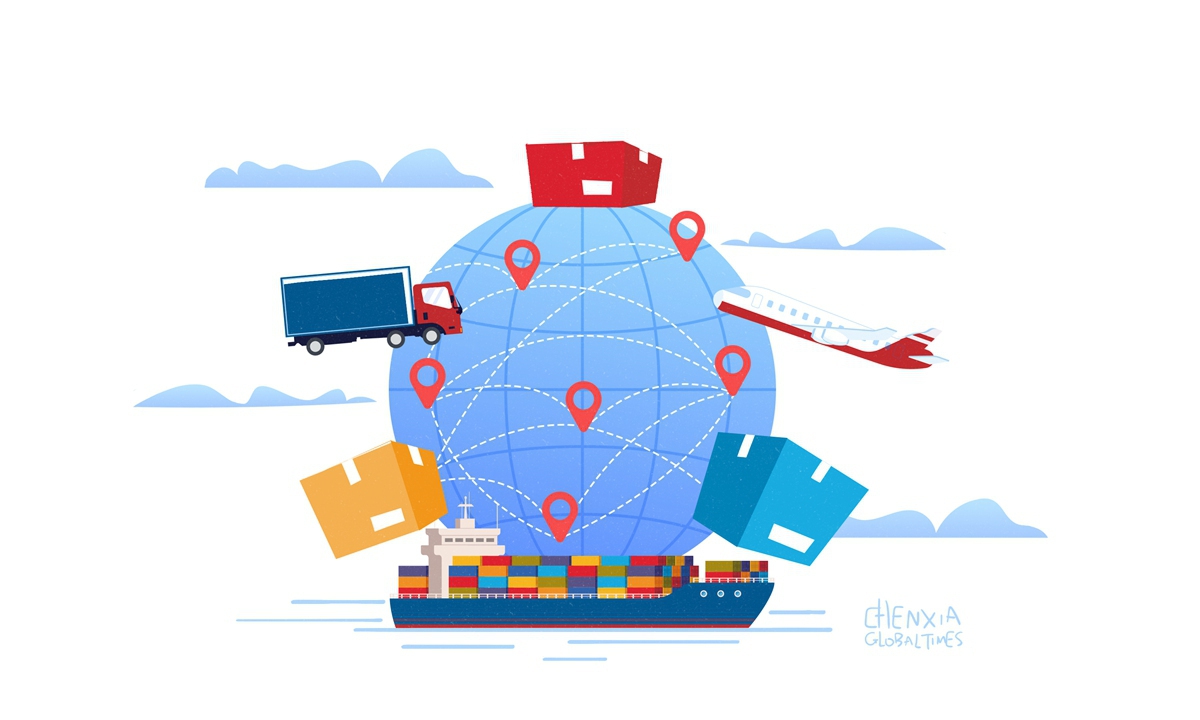
Illustration: Chen Xia/GT
South Korea aims to expand its free trade agreement (FTA) network with emerging markets, such as Latin America and Africa, in its latest effort to diversify supply chains, the Yonhap News Agency reported on Monday, citing South Korean Finance Minister Koo Yun-cheol. This move offers a lens through which to observe the ongoing changes in Asian supply chains, particularly in the context of rising trade protectionism in some Western economies.Western economies have long been important destinations for exports from Asia. However, with growing uncertainties in global trade - driven by factors such as rising protectionism in certain Western countries and softening demand - it is not surprising that some Asian nations, including South Korea, are looking to deepen ties with emerging markets. This trend may further support the ongoing reorganization of Asian supply chains.
Two factors are noteworthy in this context. The first is the increasing potential of consumption within Asia, especially in markets such as China, Southeast Asia countries, and India. These regions, home to many developing economies, are seeing increasing consumer demand, driven by the growth of the middle class. For instance, China, as the world's second-largest consumer and import market, remains an irreplaceable player in regional consumption.
The second factor extends beyond Asia, to emerging economies in regions such as Latin America and Africa. These areas also hold massive growth potential, driven by factors including urbanization, demographic changes, and rising incomes. As Asian economies look to diversify their trade networks, these markets are gaining importance, presenting new opportunities for growth beyond traditional partners.
According to the Global Trade Update published by UN Trade and Development in January, South-South trade - trade among developing countries - has become a major engine of global trade growth. Between 1995 and 2025, South-South merchandise exports surged from about $500 billion to $6.8 trillion. Today, 57 percent of developing-country exports go to other developing economies, up from 38 percent in 1995. The report shows that the surge has been driven largely by Asia's regional value chains, particularly in East and Southeast Asia.
Amid rising trade protectionism in some Western countries, the growth opportunities for trade with developing economies are becoming increasingly prominent. This trend benefits not only developing nations but also developed economies that are integrated into Asia's regional supply chains.
In this context, Yonhap reports that the South Korean government sees a need to continuously expand and strategically upgrade its FTA network. This move reflects broader global trends. Koo, the South Korean finance minister, was quoted as saying that "in the future, we will broaden our FTA map to emerging markets, such as Southeast Asia, Latin America, and Africa, to diversify global supply chains."
Within Asia's supply chains, as well as in its trade ties with developing economies outside the region, several free trade arrangements have been established, and these trade networks continue to evolve. In today's uncertain global trade environment, the growing focus of Asian economies on developing countries presents an opportunity to build upon existing foundations. By effectively integrating these established networks, the potential for mutual benefit could be enhanced.
China, in particular, has built close trade links and supply chain connections with developing economies both within Asia and beyond. For instance, official data show that China's trade with countries participating in the Belt and Road Initiative grew by 20 percent year-on-year in the first two months of 2026. This trade involves a substantial number of developing economies, underscoring China's role in fostering economic ties with emerging markets.
As major Asian economies continue to deepen trade with developing economies, cooperation between countries such as China and South Korea can further strengthen these efforts. The two countries have the opportunity to build on their intertwined FTAs and supply chain networks, reinforcing economic ties that can create valuable synergies in third markets.
While Western markets remain important, the evolution of Asia's supply chains is likely to persist. If these changes result in greater complementarity within the supply chain, new opportunities will emerge, benefiting all economies engaged in the network.
RELATED ARTICLES