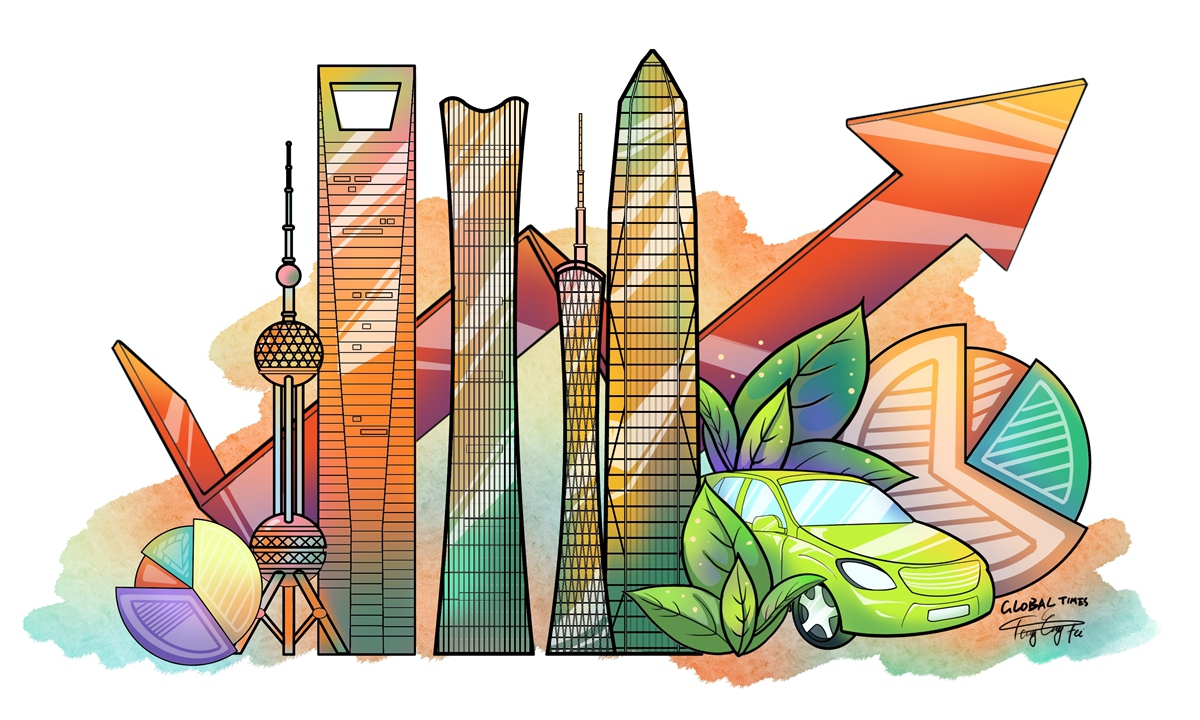
Illustration: Tang Tengfei/GT
Editor's Note:
Currently, China's economy is steadily advancing along the path of high-quality development, even as domestic and international circumstances become increasingly complex. Some Western media, due to misunderstanding or bias, have repeatedly questioned or even distorted China's economic development. Accordingly, the Global Times launches the "Q&A on China's Economy" column to publish opinion pieces to present facts and clarify perceptions.
Some Western media outlets have recently claimed that China's economy is experiencing what they describe as "a tale of fire and ice." According to them, while high-tech industries in China are "on fire," they supposedly represent a "negligible" portion of the overall economy; meanwhile, traditional industries - which still "hold the lion's share" of GDP - are allegedly "stuck in a rut." This ambiguous perspective falls into the trap of mistaking a part for the whole. It is inherently difficult to reach accurate conclusions by dissecting the interconnected and intertwined economic sectors and interpreting them in a fragmented manner.
There are two key questions to address here. First, from an absolute numerical standpoint, is the GDP share of China's high-tech industries truly "negligible," while that of traditional sectors is truly "extremely high"? This impression is likely outdated. With the rapid surge in high-tech sectors, the gap is narrowing fast. In 2024, the added value of China's new industries, new business formats and new business models, dubbed the "three new" economy, rose to 18 percent of GDP. According to Bloomberg estimates, by 2026, the share of high-tech and green industries in China's GDP could climb to around 20 percent, potentially overtaking the real estate sector for the first time. Bloomberg previously predicted that China's high-tech industry has the potential to become a more important driver of growth.
The second question is: Are high-tech and traditional industries in a zero-sum, adversarial relationship? While China is indeed transitioning between old and new growth drivers, this is not a matter of opposition and replacement; rather, it is a process of one growing upward while the other striking deep roots - together, they support the steady growth of the "giant tree" of the Chinese economy.
New industries never emerge from a vacuum. They are built upon a complete industrial system, mature infrastructure, a massive application market and extensive engineering experience. The accelerated breakthroughs in new-energy vehicles would have been impossible without the manufacturing capabilities and supply chain systems accumulated over decades by the traditional auto industry. The wide application of the Industrial Internet is inseparable from the diverse real-world scenarios provided by sectors like steel, machinery, chemicals and textiles. Similarly, the constant iteration of high-end equipment relies on the solid support of a vast array of basic materials, general components and a skilled workforce. The "fire and ice" narrative essentially severs the industrial chain, failing to see the deep-rooted, interdependent relationship that binds them together.
Meanwhile, traditional industries have not lost their significance in the wake of the new technological and industrial revolution. Instead, through green and smart transformations, they are demonstrating the vitality of "old trees sprouting new shoots." From the intelligent upgrading of steel mills to digital design in textiles and the pursuit of green standards and precision in home appliances, building materials, machinery, an increasing number of traditional industries are achieving transformations in quality, efficiency and driving forces through technological upgrades, equipment renewal, process optimization and management improvements. Many seemingly "old faces" in industry have already integrated "new genes" like smart factories, flexible manufacturing, industrial software and green standards. In 2025, energy consumption per unit of added value in major energy-intensive industries - including building materials, steel and non-ferrous metals - all decreased compared to the previous year, demonstrating that traditional industries are also improving in quality and efficiency amid the wave of a technological revolution.
Some Western media outlets' so-called "fire and ice" narrative suggests they have noticed the changes in China's economic transition, but they have yet to grasp its underlying logic. China's economy is achieving a higher-level dynamic equilibrium through the acceleration of new drivers and the revitalization of traditional ones. For a small economy, a breakthrough in a single industry might move the needle for the whole country. However, for a massive economy like China's, it is essential to strike a balance between expanding new sectors and upgrading existing ones, fostering new industries while simultaneously transforming and upgrading traditional ones. Just as a skyscraper requires a solid foundation to add new floors, the true value of China's economy lies in the establishment of a comprehensive system capable of rapidly translating technological innovation into large-scale production and continuously integrating cutting-edge technologies into a wide range of applications.
High-speed trains racing across the land, power grids reaching millions of households, factories accelerating smart and digital transformation, and platforms reshaping production and distribution methods... We hope that people from all over the world will visit China to see the country for themselves. By stepping into factory workshops, production lines, science and technology innovation parks, commercial hubs, and local markets, they can gain a better understanding of the true picture of a major economy unfolding and growing through its transition. This is the only way one can truly grasp how the Chinese economy can navigate through storms steadily and continue moving forward through relentless efforts.
RELATED ARTICLES