Xi meets Crown Prince of Abu Dhabi, makes four-point proposal on Middle East peace
A 'reliable, stable and predictable' China appeals to other countries
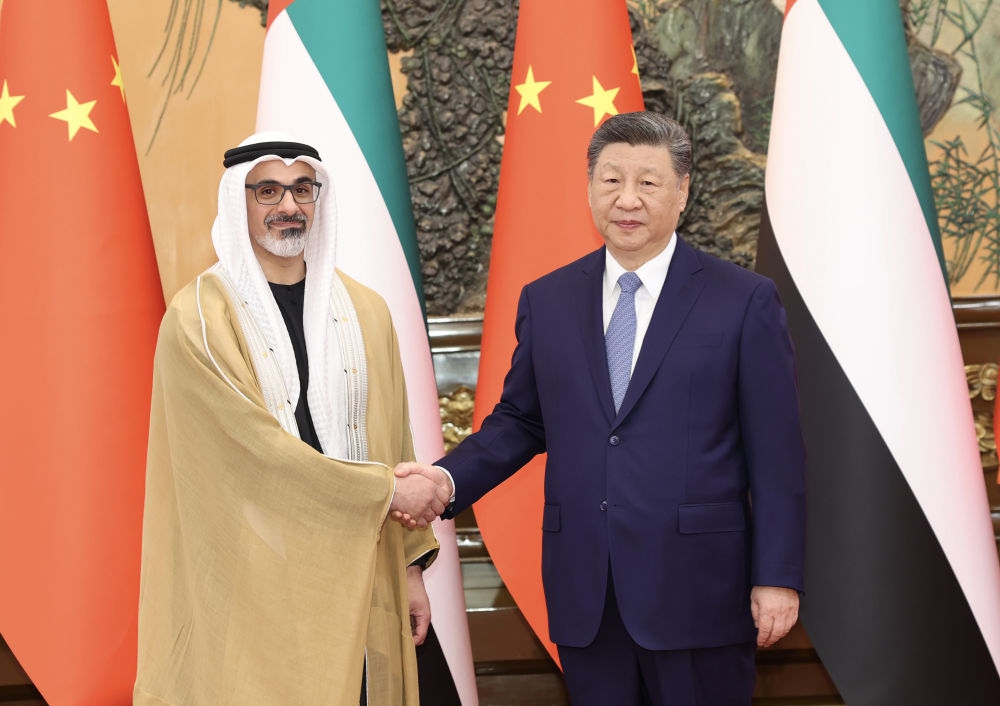
Chinese President Xi Jinping meets with Sheikh Khaled bin Mohamed bin Zayed Al Nahyan, Crown Prince of Abu Dhabi, United Arab Emirates, at the Great Hall of the People in Beijing, capital of China, April 14, 2026. (Xinhua/Huang Jingwen)
Chinese President Xi Jinping met with Sheikh Khaled bin Mohamed bin Zayed Al Nahyan, Crown Prince of Abu Dhabi, United Arab Emirates (UAE), in Beijing on Tuesday. Xi said the UAE is China's comprehensive strategic partner, and that China has always attached great importance to developing relations with the UAE, according to the Xinhua News Agency.
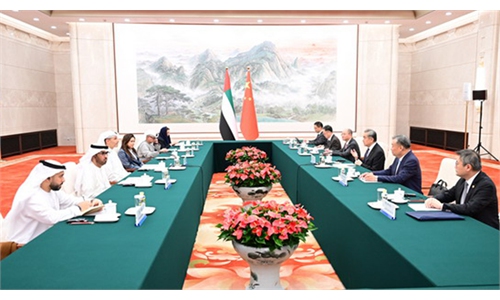
Chinese experts noted that the Crown Prince's visit to China aims to enhance bilateral ties and boost China-UAE cooperation. They also noted that the meeting, which took place at a profoundly precarious moment for the Middle East, with tensions spiraling following the launch of a joint US-Israeli military operation against Iran, could provide a constructive set of principles for addressing current regional challenges.
Four-point proposal
During their meetings, the two sides exchanged views on the current situation in the Middle East and the Gulf region. Xi emphasized China's position on promoting peace and talks, and reaffirmed that China will continue to play a constructive role in this regard, according to Xinhua.
Xi put forward a four-point proposal on promoting peace and stability in the Middle East.
Xi called for adherence to the principle of peaceful coexistence. It is imperative to promote the building of a common, comprehensive, cooperative and sustainable security architecture for the Middle East and the Gulf region, he noted, Xinhua reported.
He urged adherence to the principle of national sovereignty. He said the sovereignty, security and territorial integrity of countries in the Middle East and the Gulf region should be fully respected, and the safety of personnel, facilities and institutions of all countries should be effectively safeguarded.
On adherence to the principle of international rule of law, Xi said the authority of international rule of law should be upheld to prevent the world from falling back into the law of the jungle, according to Xinhua.
He said development and security should be coordinated. All parties should work together to create a favorable environment for the development of countries in the Middle East and the Gulf region.
China's proposal regarding the Middle East situation is rooted in China's international vision and the Global Security Initiative, reflecting the country's consistent stance of promoting peace and dialogue in response to the current regional crisis, Zhu Yongbiao, a Middle East affairs expert with Lanzhou University, told the Global Times on Tuesday.
Ding Long, a professor at the Middle East Studies Institute of Shanghai International Studies University, told the Global Times on Tuesday that "From the joint US-Israeli military operation against Iran, it is clear that there are no winners in this conflict, which has severely impacted regional economic development and people's livelihoods." He stressed that peaceful coexistence - particularly among Israel, Gulf countries and Iran - is essential.
Ding added that adherence to national sovereignty is another key lesson from the current crisis. Resorting to military means to undermine sovereignty has led to serious consequences and further deterioration of the Gulf situation. Political and diplomatic solutions, rather than force, are the only viable way forward, he said.
He also stressed that international rule of law must be respected, warning against a "might makes right" approach, noting that even major powers cannot guarantee benefits through the use of force.
According to Xinhua, during his meeting with the Chinese President, Sheikh Khaled said the UAE appreciates China's responsible and constructive role in international affairs and its active efforts to seek political solutions to the current crisis in the Middle East.
The UAE is committed to maintaining close communication and coordination with China to promote a ceasefire among the parties concerned, restore regional peace and stability at an early date, safeguard international shipping security, and prevent further impact on the global economy and energy security, he said.
The meeting has also drawn attention from international media. In a report covering visits to China by leaders from Spain, Vietnam and UAE, Al Jazeera noted that "China has presented itself as the opposite of Washington - a reliable, stable and predictable partner. For many states, that message really appeals."
Arab Times, a Kuwait-based English-language newspaper, said the proposal emphasizes regional peaceful coexistence, respect for national sovereignty, and stronger coordination between development and security policies across the region, while noting that the initiative comes amid ongoing geopolitical tensions in the Middle East with major powers increasingly engaging in diplomatic efforts to stabilize the region.
Firstpost, an India-based outlet, highlighted the timing of the visit, noting that after the 21-hours long Islamabad talks failed to deliver a long-lasting ceasefire, a number of global leaders are travelling to Beijing, in attempts to bring peace and stability in the Gulf.
Zhu noted that different countries hold divergent views on resolving the conflict, including some Gulf states, with certain actors advocating military solutions that risk further escalation. However, China has once again articulated its position and proposals at this critical moment, injecting momentum into peace efforts and helping ease tensions.
Enhancing China-UAE relations
Through joint efforts of both sides, China-UAE relations have maintained healthy and stable development, and witnessed deepened political mutual trust, growing practical cooperation and rich people-to-people exchanges, Xi said, according to Xinhua.
He called on both sides to strengthen the alignment of development strategies, and tap the potential for mutually beneficial cooperation in energy, investment, trade, science and technology and other fields.
Reuters noted that the visit by the crown prince of the largest of the UAE's seven emirates underscores a long-term commitment to expand a growing economic corridor with China, building on momentum generated by the 2024 visit of Sheikh Khaled's father.
Beyond discussing regional issues, a key objective of Sheikh Khaled's visit is to deepen practical cooperation with China across multiple sectors, Ding said. "China has long been the UAE's largest trading partner, with bilateral trade exceeding $100 billion last year, and there remains significant potential in areas such as new energy and artificial intelligence."
He added that UAE sovereign wealth funds have made substantial investments in China, while Chinese enterprises and expatriates are actively engaged in the UAE, underscoring the importance and vitality of bilateral ties.
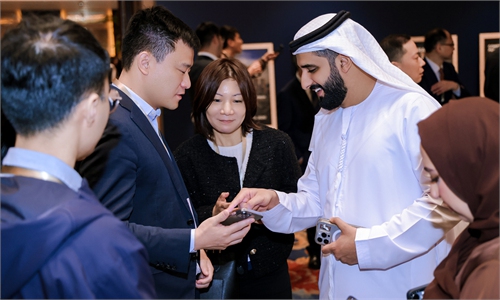
At the same time, economic cooperation has continued to expand. During the UAE-China Business Promotion Conference held in Beijing on Monday, co-organized by the UAE Embassy in China and the China Chamber of Commerce for Import and Export of Machinery and Electronic Products, the two countries signed 24 Memorandums of Understanding, according to the UAE Embassy.
At the conference, Chief Cargo Officer of Etihad Airways Stanislas Brun told the Global Times that while the current landscape of international trade is fraught with uncertainty, China stands out as a market characterized by "certainty and predictability."
Logistics constitutes a vital component of international trade and is highly susceptible to geopolitical fluctuations. Thus, Etihad Airways seeks to strengthen its logistical ties with China to enhance this sense of "certainty."
Mamoon Sbeih, chief international business development officer and Chairman of MENA in Apco, an advisory and advocacy communications consultancy firm, told the Global Times on site that China is one of the most important markets in the world, which is growing fast and remains stable. "It [China as a market] predicts clear stability, therefore, I see no other alternative to it."
"Anybody who understands economics will want to build relationship with China," he said.
RELATED ARTICLES