ARTS / CULTURE & LEISURE
SBTI personality test offers youth fun, but beware the trap of labels
By Published: Apr 14, 2026 10:54 PM

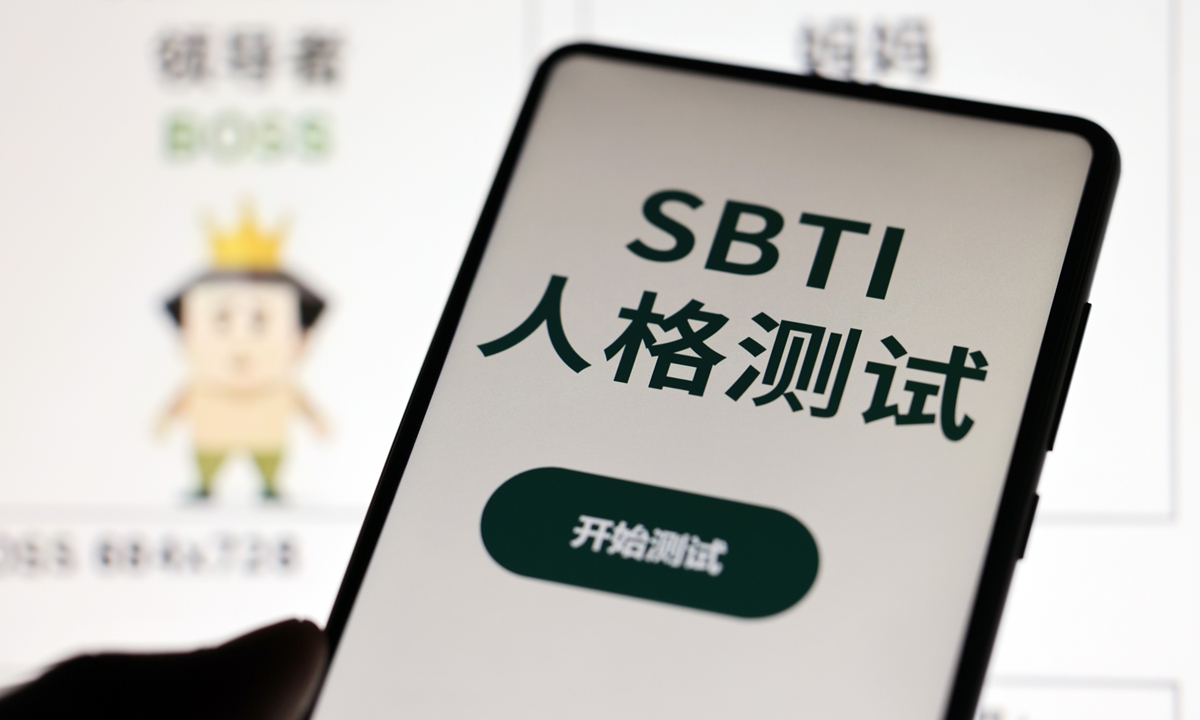
The Silly Big Personality Test (SBTI) Photo: VCG
In recent days, an online personality quiz - called the Silly Big Personality Test (SBTI) - crashed into the spotlight on Chinese social media. Created as a tongue-in-cheek parody of the globally popular Myers-Briggs Type Indicator (MBTI), SBTI can give you some meme-fueled labels, including "Boss," "Poor," "Monk" and "ATM-er," after answering a series of multiple-choice questions. Lots of young netizens compared, shared, and poked fun at their new "personalities," posting these tags across various social media platforms.That SBTI went viral is more than just another story of a trending test. It is being seen by experts as a glimpse into how today's youth use humor and self-mockery as social currency, yet also a reminder of the pitfalls of letting internet labels define our real selves.
Unlike the original MBTI test - grounded (if controversially) in psychological theory and marketed as a tool for self-discovery and self-improvement - the questions in the SBTI test lack strict logic. Some, for example, simply say "There is no question here, just pick randomly," or "I am a gloomy mouse, a crawling cockroach." The test results are like an encyclopedia of online memes, and due to their randomness, users may get different personality labels each time.
Why can a simple, entertainment-oriented quiz resonate with so many people? Zhao Wei, an associate researcher at the Jiangsu Provincial Academy of Social Sciences, said the core reason is that it touches on an age-old and fundamental question deep in people's hearts: how to understand oneself and how to understand others. This exploration of the self, and the extension of self-awareness for understanding others, is a topic that every generation is eager to explore and pays constant attention to. Once a test taps into this core need, it easily arouses people's curiosity, according to the Guangming Daily.
The SBTI test is like drawing a portrait of a person, capturing just a moment or an aspect of the self. "This kind of personality test is not scientific or rigorous. It is more about fun and self-mockery, making it an easy outlet for young people's emotions. At the same time, its social nature allows users to share their results on diverse social platforms, helping them find emotional resonance with others," Ding Daoshi, a veteran analyst in the internet sector, told the Global Times on Tuesday.
Ding also noted that these humorous tags can become social currency. When friends share their results and in-jokes about "Boss" or "Monk," they are forming a new common language. On crowded social platforms, SBTI makes everyone feel part of the same inside joke. In a sense, it rewrites the logic of youth socializing: the meme is the message, and participation is more important than the result itself. Taking the test becomes a playful ticket to belonging.
However, the SBTI trend is not all harmless fun. Beneath the waves of laughs and memes, an important risk lurks - the trap of self-labeling. It is human nature to seek identity and recognition, and personality tags, however playful, can be surprisingly sticky. For some, the label of "Poor" or "ATM-er" becomes more than a joke; it starts to color how they see themselves and how others see them.
This is not a new phenomenon. Even more scientific tools like MBTI have been criticized for boxing people into simplistic categories. But meme-based quizzes can be even more seductive: They dress up stereotypes as humor and encourage users to perform their label for likes and retweets, according to Ding.
Pei Shuangyi, director of the psychological rehabilitation department of Zhejiang Zhongshan Hospital, also cautioned that people should not become overly attached to negative labels, and should avoid internalizing them as part of their self-identity. If someone keeps saying "I'm useless" every day, over time, the effect of self-suggestion may truly make them feel negative, powerless, and unmotivated, the China Youth Daily reported.
The author is a reporter with the Global Times. life@globaltimes.com.cn
RELATED ARTICLES