GT Voice: Trade by foreign-invested firms shows why anti-globalization doesn’t work
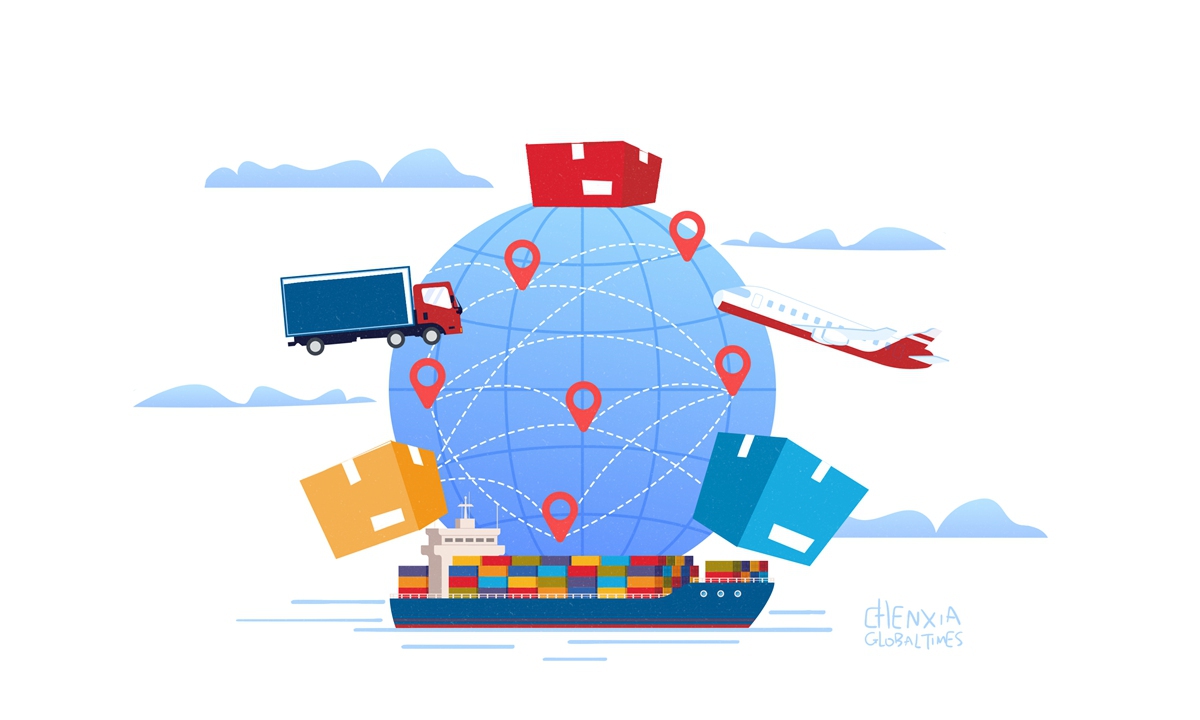
Illustration: Chen Xia/GT
Figures released by China's General Administration of Customs on Tuesday showed that foreign-invested enterprises' total trade grew 16.1 percent year-on-year in the first quarter, according to the Xinhua News Agency. It was the eighth consecutive quarter of growth, a noteworthy achievement in an increasingly uncertain global trade environment. The figure highlights how globalization continues to deliver substantial benefits for foreign-invested businesses in China, enabling them to sustain growth despite the complexities facing global trade.In recent years, a narrative has gained traction in some Western countries, framing China as a major beneficiary of globalization while portraying the West as having been left at a disadvantage. This view has fueled anti-globalization sentiment and provided a flawed basis for trade protectionism. However, this narrative does not reflect the broader realities of global trade, which reveal a more complex and mutually beneficial dynamic.
Globalization has created an interconnected system in which various parties stand to gain in different ways, with one example being foreign-invested enterprises in China. Decades ago, many Western companies, recognizing the comparative advantages offered by different markets, began making strategic investments abroad, helping to shape the global supply chains we see today. These multinational corporations were among the earliest proponents of globalization, and their investments played an important role in the development of today's integrated economic landscape. Even now, these companies continue to derive tangible benefits from their global strategies.
In China, while private enterprises continue to expand and their share of foreign trade steadily grows, foreign-invested enterprises remain an important part of the trade landscape. In the first quarter, the import and export value of foreign-invested enterprises increased by 16.1 percent, slightly surpassing the 15 percent growth seen in China's overall goods trade. This suggests that foreign-invested companies have shared in the opportunities arising from China's foreign trade development.
These opportunities can be viewed from two perspectives. First, when foreign-invested enterprises increase imports, it is often driven by factors such as expanding production capacities in China, which raises demand for equipment and raw materials, or by growing domestic consumption, which boosts the need for intermediate goods and finished products. These trends suggest that foreign-invested companies have a relatively stable medium-term outlook for the Chinese market, reflecting their confidence in the country's economic prospects.
Second, when foreign-invested enterprises increase exports, it highlights their ability to take advantage of China's industrial strengths to enhance international competitiveness. China is reportedly the only country in the world to have all the categories listed in the UN industrial classification, a unique advantage that, alongside other factors, continues to enhance China's attractiveness to foreign investment.
Amid global trade uncertainty, China's economic stability offers clear advantages for multinational companies. The growth in imports and exports highlights one facet of these advantages, which arise from the combined effects of economic globalization and China's commitment to high levels of economic openness.
China's continued push for high-level opening-up has created a fair, transparent, and predictable business environment for foreign-invested enterprises. This process benefits all parties, as it generates opportunities for businesses, including foreign firms.
At the same time, as China offers opportunities to foreign investment, a growing number of Chinese companies are expanding internationally. Globalization, in this context, is a two-way process - active and evolving - resulting in the formation of increasingly complex global supply networks.
In this light, the rhetoric sometimes heard in the West, claiming that globalization has disadvantaged Western economies, appears increasingly outdated. Such arguments continue to reflect a zero-sum mentality, where one side's gain is seen as another's loss.
In reality, global supply chains are now deeply interwoven - exports from one country often include goods produced by foreign-invested companies, while imports may include products from domestic firms operating abroad. This interconnectedness is a hallmark of globalization's continued expansion, one that is unlikely to be reversed.
What drives this increasingly integrated global network forward is the spontaneous power of the market, or more precisely, businesses "voting with their feet." The growth in imports and exports by foreign-invested companies is a direct manifestation of this dynamic.
RELATED ARTICLES