Illustration: Chen Xia/GT
With German Chancellor Friedrich Merz set to kick off his first official visit to Beijing since taking office, new trade data showing China has overtaken the US as Germany's largest trading partner has come into sharp focus.Bilateral trade between China and Germany reached 251.8 billion euros ($296.6 billion) in 2025, up 2.1 percent year-on-year, with China surpassing the US to once again become Germany's most important trading partner, as it did from 2016 to 2023, Germany's Federal Statistical Office said in a press release on Friday.
Amid rising protectionism and geopolitical turbulence in the world, the figures underscore the resilience of economic ties between the two nations while serving as a testament to the enduring power of pragmatic cooperation. While Germany-US trade dropped by 5 percent amid tariff disputes, China-Germany trade countered global headwinds with steady growth.
This contrast tells how the two countries have withstood outside pressure and steadily advanced their trade relations at a time of sluggish global economic recovery and multiple shocks to global industrial and supply chains.
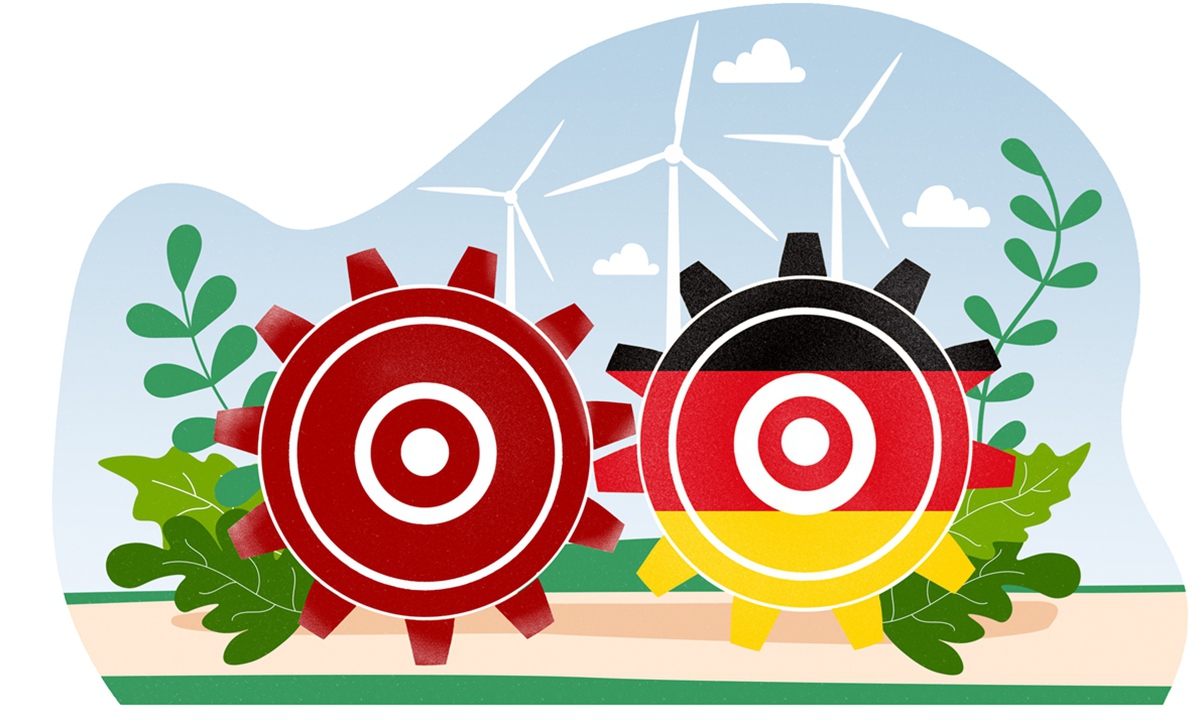
The complementary strengths of the two major economies lie behind this resilience. Germany possesses world-leading capabilities in high-end manufacturing, precision technology, and industrial design, while China offers a super-sized market, a complete industrial system, and very efficient, stable supply chains. With mutual benefits in areas such as intelligent manufacturing, green development, and digital transformation, their long-standing, market-driven collaboration has become a globally recognizable pattern.
The more complex the external environment becomes, the more this complementary advantage reveals the irreplaceable value, serving as a crucial pillar for both economies to weather risks and move forward. This mutually beneficial partnership is further validated by the actual choices of many market players.
Despite occasional political noise about "de-risking," companies competing in the real economy continue to demonstrate rational consideration for profits and innovation. Against the backdrop of US tariff pressure on German exports, this situation has prompted German companies to place greater emphasis on cooperation with China.
Data from the German Economic Institute (IW) showed that investments in China rose to more than 7 billion euros between January and November last year, up 55.5 percent from 4.5 billion euros in 2024, according to Reuters.
Concrete corporate cases illustrate this momentum.
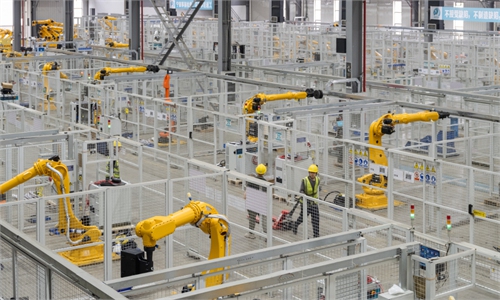
In August 2025, Bosch Automotive Products (Suzhou) Co, a subsidiary of Bosch Group, launched an intelligent driving control innovation project in the Suzhou Industrial Park, with a planned investment of 10 billion yuan ($1.45 billion) during the next five years.
And, in November, Volkswagen Group China Technology Co completed the core expansion of its research and development (R&D) center in Hefei, capital of East China's Anhui Province, establishing it as Volkswagen's first and largest integrated R&D base outside Germany with full-process vehicle development and validation capabilities.
This pace of continuous expansion underscores a fundamental reality: for German industry, China, with its stable and transparent business environment and comprehensive, efficient supply chains, has become indispensable. For German businesses, the market opportunities in China are real, abundant, and sustainable. The message is clear: decoupling from China means decoupling from growth opportunities and disconnecting from future development.
It points to a broader and more significant trend. For an economy as reliant on exports and high-end manufacturing as Germany's, China has moved from being a mere sales market to a vital pillar supporting industrial competitiveness.
Amid contracting global demand and sluggish European growth, weakening economic linkages with China is inconceivable from the long-term standpoint of national interest. The only realistic path forward is to reinforce and expand this win-win partnership.
From Merz's Spring Festival speech to his upcoming visit to Beijing, a string of pragmatic moves signals his administration's willingness to deepen cooperation.
This readiness is not Germany's alone, but reflects a wider European shift. Since the start of 2026, leaders from Ireland, Finland, and the UK have visited China, revealing a clear hedging mindset within Europe. Countries are demonstrating through their actions that, while facing uncertain trade policies and industrial shocks in the world, seeking pragmatic cooperation with China is a realistic path to mitigate risks, stabilize expectations, and protect their true interests.
RELATED ARTICLES