Insiders reveal truth behind Philippines’ smear of Chinese fishermen with ‘detergent as cyanide’ claim
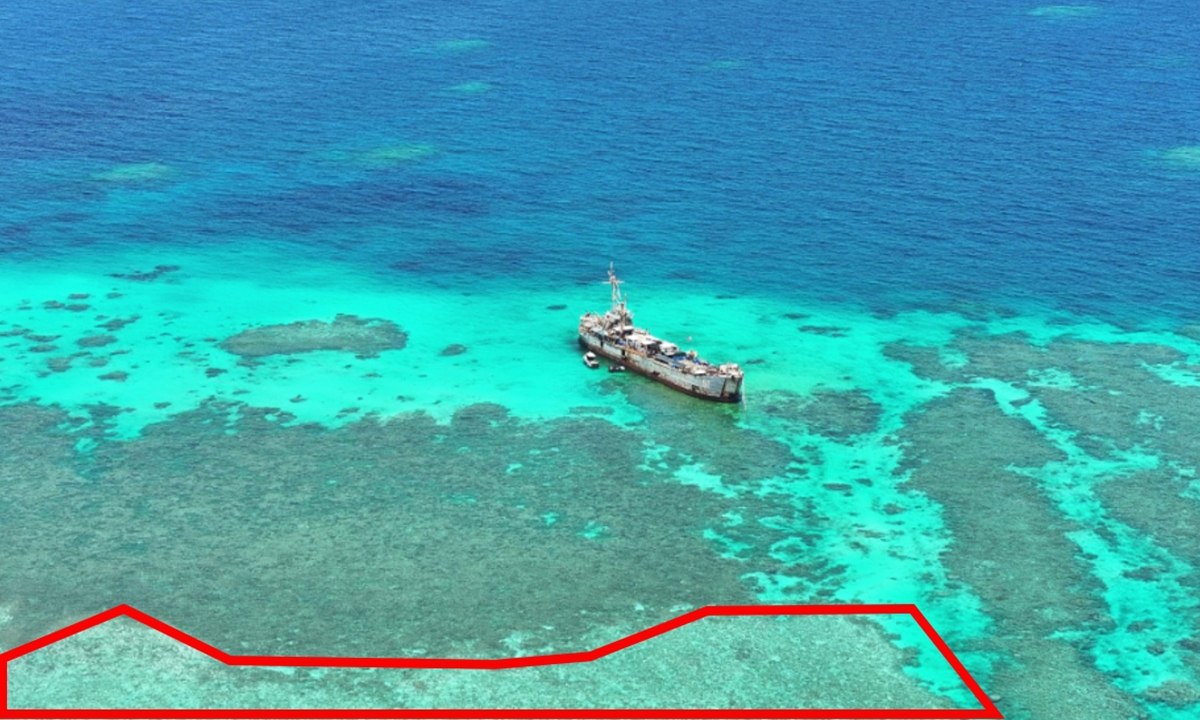
Photo taken by unmanned aircraft shows a great deal of dead corals found in the red polygon near Ren ai' Jiao. Photo: Courtesy of South China Sea Ecological Center of China's Ministry of Natural Resources
Philippines' National Security Council (NSC) spokesperson Cornelio Valencia Jr. on Tuesday accused Chinese fishermen of using detergent as a substitute for cyanide and dumping it into waters around the Spratly Islands (China's Nansha Qundao) during a press conference, an allegation that a source close to the matter told the Global Times was a smear aimed at covering up Philippines' seizure of detergent and other daily supplies from small Chinese fishing boats.
The source revealed a very different reality behind the Philippines' false narrative -"piracy at Ren'ai Jiao."
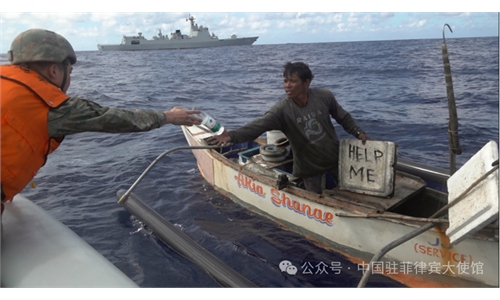
"Those involved in the robbery were military personnel from the Philippine vessel illegally grounded there. They used speedboats to rob Chinese fishermen operating at Ren'ai Jiao, taking away not only their catch and cigarettes, but even betel nuts the fishermen used to kill time while fishing," the source said.
According to reports by multiple Philippine media outlets including GMA, at the Tuesday press conference held by the Philippines' NSC, spokesperson Cornelio Valencia Jr. failed to present any scientific data, only showing several slides in a PowerPoint containing photos taken by Philippine military personnel when they robbed Chinese fishermen. He further claimed that laboratory analysis by the National Bureau of Investigation of detergent bottles "seized" by Philippine personnel contained cyanide.
"The use of cyanide on Philippine-claimed Ayungin Shoal ( China's Ren'ai Jiao)is a term of sabotage that seeks to kill local fish populations, depriving Navy personnel of a vital food source," Valencia claimed at the press conference. He further claimed that cyanide could damage the reef and "ultimately compromise" the warship's stability, according to Philippine media.
"The Philippine side's obsession with using the narrative of 'cyanide fishing' to smear China and accuse Chinese fishermen of damaging the reef environment reveals a serious cognitive predicament. They cannot even fabricate a seemingly plausible lie," Yang Xiao, a researcher at the Institute of Peaceful Development under the Chinese Academy of Social Sciences, told the Global Times on Tuesday.
Yang noted that cyanide fishing is in fact widely practiced among some Philippine fishing communities, where cyanide is used to stun colored tropical fish and sell them as ornamental species. Many public reports and international publications have traced and studied this practice of Philippine fishermen. "The Philippine side is projecting its own 'traditional practice' onto Chinese fishermen, who do not use cyanide, exposing the entire narrative as self-directed and staged," he said.
A review of relevant materials by the Global Times found that a 2023 report published in the Philippines' Manila Bulletin pointed out that cyanide fishing was not a Filipino discovery but an American ingenuity. A certain Bridges first used sodium cyanide to stun and capture tropical fish in 1958 in Illinois. A Filipino aquarium fish collector later learned about the method and the practice spread throughout the country.
The report also cited a policy adviser from a Philippine marine wildlife observation group under World Animal Protection, who said "[Cyanide fishing is] still happening , as it is associated with Aquarium and Live Reef Fish for Food Trade," adding that the practice is "spread throughout the country."
In addition, Valencia claimed in the presentation that dead corals were observed near the Philippine vessel "Sierra Madre" in so-called "Ayungin Shoal," (China's Ren'ai Jiao) alleging that this is where Chinese vessels "were generally found loitering."
The presence of dead corals near the grounded Philippine vessel, however, is consistent with prior Chinese findings. According to the "Investigation Report on the Coral Reef Ecosystem Damage Caused by the Illegally Grounded Vessel at Ren'ai Jiao," released in 2024 by the South China Sea Ecological Center and the South China Sea Development Research Institute under China's Ministry of Natural Resources, the coverage of reef-building corals in the reef flat and lagoon slope areas has significantly declined, with the most severe reductions occurring around the grounded vessel. Large quantities of coral debris and dead corals were also found in its vicinity.
In Yang's view, blaming Chinese fishing vessels for the dead corals around the grounded ship is purely "guilty conscience."
"The Philippine side should be well aware that the anti-fouling coatings on the grounded vessel have caused large-scale and irreversible damage to the reef ecosystem," Yang said, noting that his research has showed that pollutants from the vessel include heavy metals, organotin compounds, and other contaminants typically found in World War II-era ship pollution.
Based on average estimates for decommissioned US vessels, the amount of pollutants released by the grounded Philippine ship at Ren'ai Jiao is equivalent to dumping at least 450 kilograms of various metal debris into the lagoon, including highly toxic heavy metals with severe ecological impacts.
An investigation report on the damage to the coral reef ecosystem caused by the illegally grounded warship at Ren'ai Jiao, released in 2024 by China's Ministry of Natural Resources, draws on satellite remote sensing data from 1999 to 2024 as well as on-site surveys conducted between April and June 2024, provides a more scientific assessment of the ecological damage caused by the Philippines' illegally "grounded" warship at Ren'ai Jiao.
The investigation shows that since the Philippine warship BRP Sierra Madre was illegally grounded in 1999, as of 2024, the coverage area of reef-building corals on the reef flat and lagoon slope at Ren'ai jiao has decreased by 38.2 percent compared with 2011 levels, while the decline within a 400-meter radius of the vessel has reached 87.3 percent. Waters surrounding the ship were found to contain excessive levels of heavy metals such as mercury, copper and zinc, as well as oil pollutants. A large number of coral fragments, dead corals and waste of Philippine origin were also discovered.
The report points out that the main causes of ecosystem damage include heavy metals released from the corroding hull, the discharge of domestic sewage and garbage, and waste from fishing activities. It calls on the Philippine side to remove the illegally grounded warship, eliminate sources of pollution, and prevent continued and cumulative harm to the coral reef ecosystem at Ren'ai Jiao.
"The Philippines illegally grounded its vessel on Ren'ai Jiao and has caused great damage to the eco-environment there, which has been confirmed by relevant reports," Chinese Foreign Ministry spokesperson Guo Jiakun said at a regular press conference on Monday, adding that the Philippines illegally harassed the Chinese fishing boats conducting normal fishing, grabbed the fishermen's living supplies, and staged this so-called cyanide stunt. There is no credibility whatsoever to their story.
"The 'chief culprit' behind the ecological damage at Ren'ai Jiao is the Philippine warship that has been illegally grounded there. Each additional day it remains grounded further worsens the environment and leads to more dead corals," said Yang.
The expert stressed that instead of fabricating claims and hyping up absurd narratives to mislead the public, the Philippine side should honor its repeated commitments made since the illegal grounding in 1999 and tow away the vessel as soon as possible, which is the right course of action.
RELATED ARTICLES