IN-DEPTH / IN-DEPTH
Witnesses of China-US ping-pong diplomacy share memorable moments 55 years ago, highlight enduring legacy of people-to-people friendship
A small ball, a lasting bond
By in Shanghai Published: Apr 15, 2026 08:59 PM

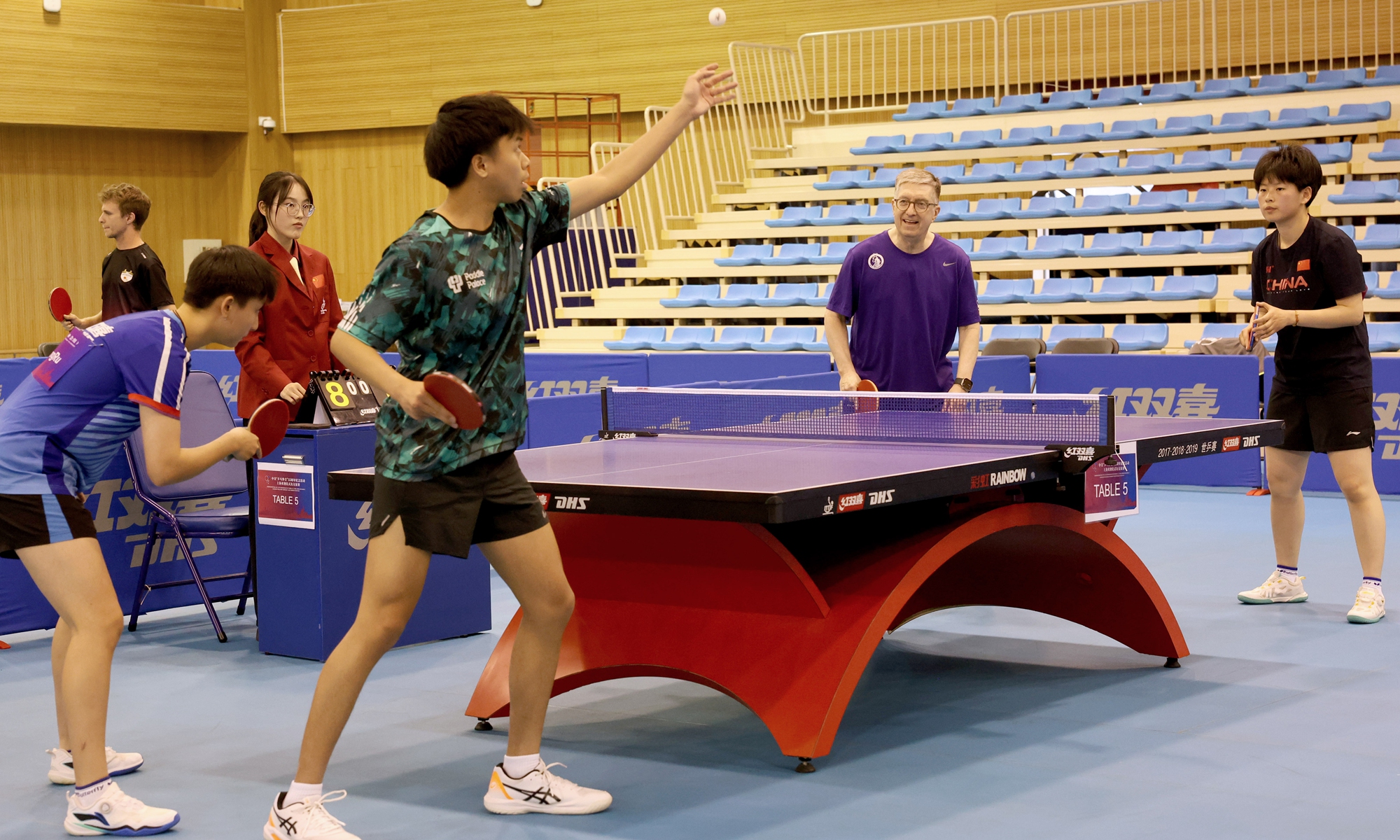
Chinese and US table tennis players and enthusiasts compete in a friendly match at Shanghai University of Sport on April 13, 2026. Photo: Chen Xia/GT
Editor's Note:
Chinese President Xi Jinping often quotes an ancient saying on many diplomatic occasions: "No mountain or ocean can separate those who share the same aspirations." This powerful message underscores the force of friendship and cooperation in bridging hearts across nations, cultures and civilizations. Inspired by President Xi's vision, people-to-people exchanges between China and the world have been flourishing.
People from diverse backgrounds and fields, united by common goals and dreams, traverse mountains and oceans to connect with each other. Through letters, face-to-face dialogues and vibrant cultural events, they are collectively weaving a magnificent tapestry of building a community with a shared future for humanity.
The Global Times presents "Intertwined Destinies, Shared Paths," a series spotlighting the touching stories written by these "friendship ambassadors." They are scholars pushing the boundaries of research, diplomats advocating for deeper cooperation on the global stage, artists igniting imaginations with their creations and ordinary people extending heartfelt love beyond national borders driven by their genuine sincerity.
Their stories illuminate the spark of cultural exchanges, the driving force of technological innovation, the bountiful harvest of economic cooperation and the enduring warmth of human connection - all contributing to a more peaceful, prosperous and open world. This is the 11th installment of the series.
The crisp crack of ping-pong balls echoed through the hall - a heartbeat, the steady metronome of passing time.
In a spacious arena, 81-year-old Dell Sweeris was all concentration, his paddle slicing through the air as he traded rallies with a young Chinese student. After several lively exchanges they shook hands, and the silver-haired man exchanged a few simple English words about the points they'd just played.
"He is very high-level," Dell recalled later in a quiet lounge off the main hall. "I think he was surprised that an old man could return balls, like I did, and then I could smash some to him," he told the Global Times with a smile. Beside him, his wife Connie Sweeris chuckled kindly.
The young Chinese player across the table might not have known that the elderly couple once stood among US' top table-tennis athletes. Moreover, they were living witnesses to one of the most remarkable diplomatic breakthroughs of the 20th century: the China-US "ping-pong diplomacy."
In the spring of 1971, an accidental encounter between US and Chinese table tennis players on a bus set off a butterfly effect that cracked the ice of 22 years of official isolation between the two countries. This year, in April, the Sweerises joined a delegation of former players, ping-pong enthusiasts and friends from both nations who gathered in China to commemorate that historic milestone.
Fifty-five years ago, Chinese and American elder statesmen, with exceptional political wisdom and strategic foresight, reopened the door for friendly exchanges between our two peoples, and created the remarkable story of "a small ball moving the globe," wrote Chinese President Xi Jinping in a congratulatory letter sent to the event commemorating the 55th anniversary of China-US ping-pong diplomacy and the launch of the China-US youth sports exchange events on April 10, according to the website of Chinese Ministry of Foreign Affairs.
Today, young Chinese and Americans meet together to renew this bond and launch a series of sports exchange events that will contribute meaningfully to the cause of China-US friendship, Xi noted in the letter.
One of the exchange events was a table-tennis friendly match held Monday at Shanghai University of Sport, where the Sweerises were invited to hit the ceremonial opening serve. Under the watchful eyes of dozens of onlookers, they traded a few rallies with Chinese players.
For the couple, that split second when paddle met ball seemed to turn back the clock - the warm image of friendship from 55 years ago coming vividly back to life.
Deeply etched in memories
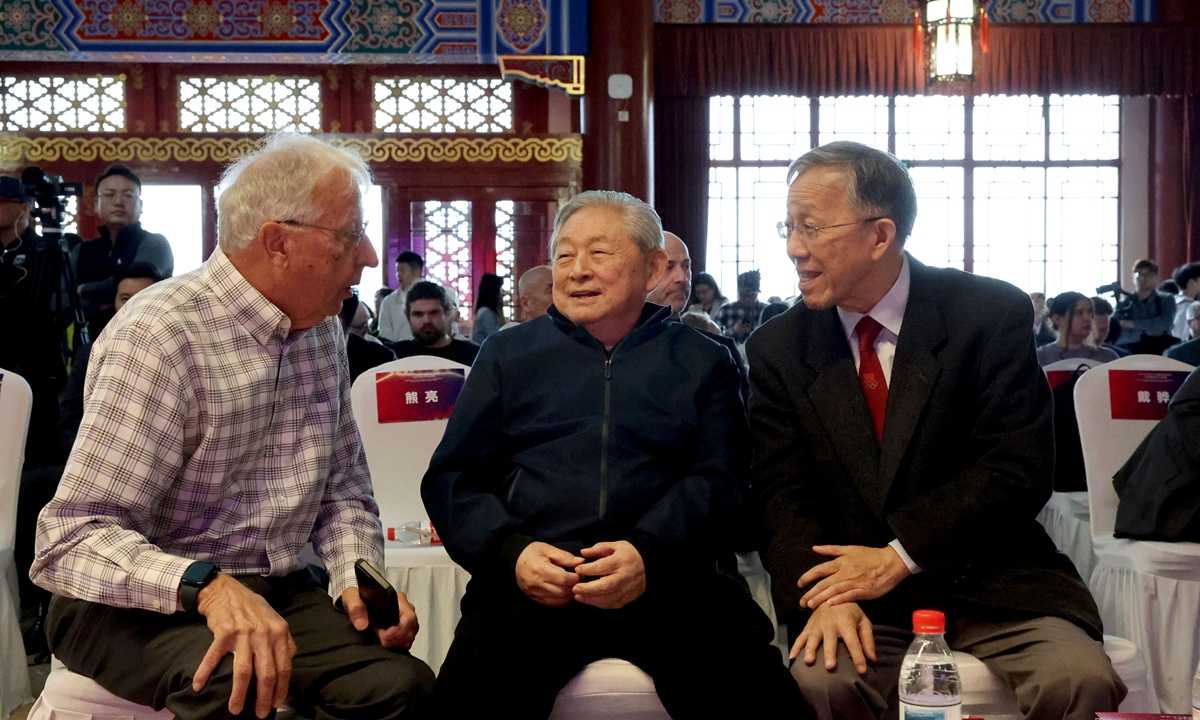
Former US table tennis player Dell Sweeris (left), honorary president of the International Table Tennis Federation Xu Yinsheng (middle), and former US table tennis player Yao Zhenxu have a chat at a commemoration marking the 55th anniversary of the ping-pong diplomacy in Shanghai on April 13, 2026. Photo: Chen Xia/GT
In April 1971, 23-year-old Connie Sweeris - a member of the US table tennis team and the American women's champion - traveled to China with 14 teammates for a week-long visit. They toured famous sights and met with then Chinese premier Zhou Enlai.Before she left, Connie Sweeris admitted she had been anxious and unsure what a "communist country" would actually be like. But the moment she set foot on Chinese soil, those worries melted away as the warmth of the hospitality made her feel genuinely welcomed.
"Premier Zhou asked Graham Steenhoven, then president of the United States Table Tennis Association, if he had any criticism about the trip so far and he said yes. The whole audience fell silent, and we thought, no, what is he going to say? He said: 'you feed us too much' and then the whole audience laughed," Connie Sweeris recalled.
The Chinese table tennis team paid a return visit to the US the following year. Dell Sweeris, also a US team member at that time, helped host them, and played with some of the world champions, like Zhuang Zedong and Zheng Minzhi.
The origin of these unprecedented visits went back to the 31st World Table Tennis Championships in Nagoya, Japan, in 1971. By chance, US player Glenn Cowan boarded the wrong bus and found himself on the Chinese team's coach. Zhuang stepped forward, struck up a conversation and gave Cowan a gift.
That dramatic "wrong bus" moment unexpectedly cracked open the long-shuttered door between the two countries: days later, China formally invited the US table tennis team to visit; that July, then US national security advisor Henry Kissinger made his secret trip to China; in February 1972, former US president Richard Nixon made his historic visit to China, and the Shanghai Communique was released, officially launching the normalization of China-US relations. From then on, "ping-pong diplomacy" was enshrined in the annals of world diplomacy.
Yao Zhenxu, a former table tennis player who witnessed ping-pong diplomacy firsthand from the Chinese side, shared some vivid memories with the Global Times on the sidelines of Monday's friendly match. When the US table-tennis team visited Shanghai in 1971, Yao played a friendly game with Cowan, and afterwards showed him around the city. In one residential neighborhood, Cowan casually pointed to an apartment on the fifth floor and said he wanted to see it.
The two then ran up the stairs and knocked on the door - a family was eating dinner, and the room was full of the aroma of red-braised pork. Cowan asked if could he have a piece, and when the family said yes, he actually ate one.
"We were all so young then. But decades later these little things are still deeply etched in our memories," Yao told the Global Times, smiling.
A lasting legacy
A brief visit set in motion a friendship that has now run for more than half a century. Eyewitnesses such as the Sweerises and Yao have not to let that chapter fade into memory, instead, they have kept building grass-roots China-US goodwill with steadfast, personal effort.
Over the decades, the Sweerises have crossed the Pacific multiple times, taking part in commemorations of ping-pong diplomacy and leaving footprints in cities across China. During this year's 55th-anniversary events, before traveling on to Shanghai, they stopped in Beijing and reconnected with old friends there. When Connie Sweeris bumped into her longtime friend, former Chinese table-tennis champion Zheng, at Peking University, she was overcome with emotion. "We warmly embraced each other," she told the Global Times.
The old friends struck up a conversation which quickly turned to children and grandchildren, and to whether they still play ping-pong. They even staged a lighthearted exhibition match for fun. They were enjoying playing and just trying to "keep the ball on the table," Dell Sweeris said. For them, victory or defeat has long since become beside the point; what matters is the reunion, and the quiet, wordless understanding that bridges time and distance.
Ping-pong diplomacy does more than enrich the lives of a handful of athletes. It also reshapes the trajectories of countless people involved.
Jan Carol Berris is one of them. In 1971, when she first heard that the US table-tennis team had been invited to China, she was working at the US Consulate in Hong Kong. Her initial reaction was disbelief. When the invitation was confirmed, her life became tightly entwined with US-China relations: two former professors of hers asked whether she was willing to leave her government post for a year, to help prepare the reception for the Chinese team coming to the US. She expected a temporary hiatus, but, "Fifty-five years later, I'm still there," said Berris, who is now vice president of the National Committee on US-China Relations.
From that point on, Berris became one of the most energetic promoters of people-to-people exchanges between the two countries, visiting China more than 170 times over the decades. To her, the core value of these exchanges is the chance to meet one another as vibrant individuals. "It's a chance for us to humanize the other side," she told the Global Times.
Over the past 55 years, the ping-pong diplomacy has long transcended the realm of sports to become a lasting legacy in the history of our relations, said Ji Yongjun, vice secretary-general of the Chinese People's Association for Friendship with Foreign Countries. "May we use ping pong as a medium to connect with sincerity" and to promote "people-to-people exchanges, so that we can build a consensus of cooperation," Ji said at a commemorative event being held in Shanghai on Monday.
Planting seeds
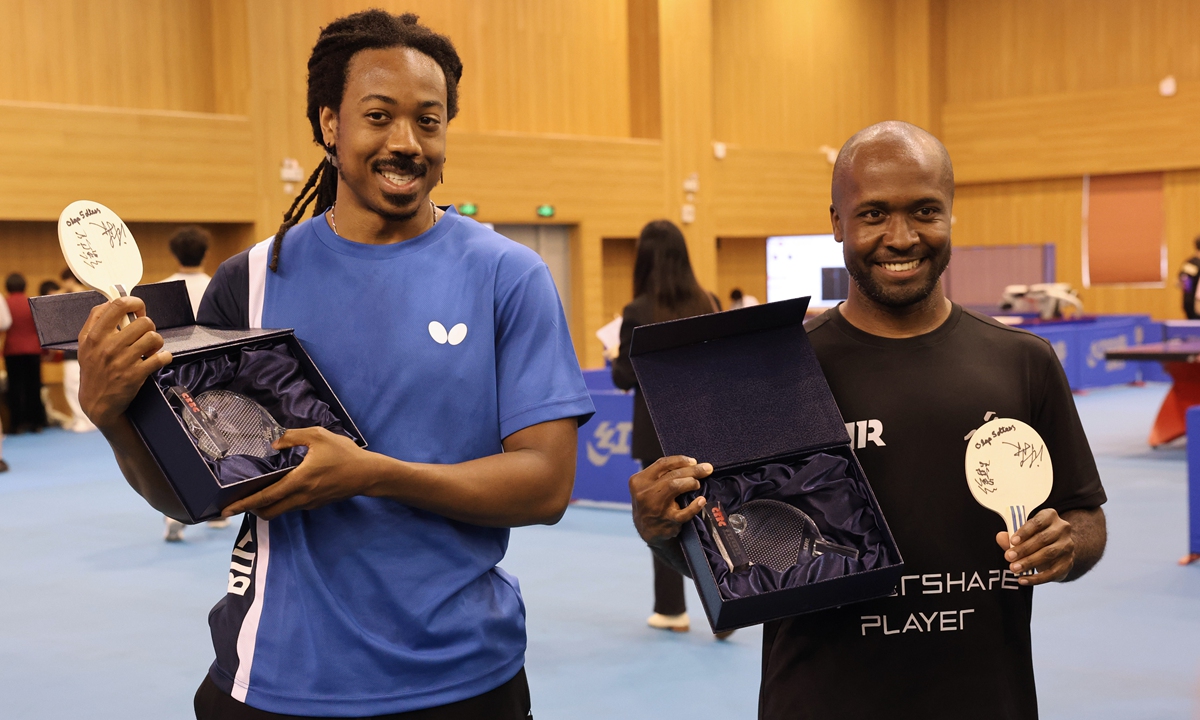
Two winners of a friendly ping-pong match pose for a photo at Shanghai University of Sport on April 13, 2026. Photo: Chen Xia/GT
When the friendly match at the table tennis gym at Shanghai University of Sport took place, after the Sweerises delivered the ceremonial opening serve, the atmosphere in the room lifted instantly. This was no cutthroat contest, instead, what filled the air was an exchange filled with warmth and excitement.Among the players was Jeffrey Lehman, an avid table tennis enthusiast and vice-chancellor of NYU (New York University) Shanghai, who walked away with a third-place prize. After receiving his award, he happily shared a special anecdote.
In 1972, when he was an 11th grader, his father took him to the University of Maryland to watch an exhibition match by the visiting Chinese table tennis team. The next day, word spread like wildfire: a member of the Chinese team had set up a table at a nearby shopping mall and was willing to play anyone. Encouraged by his friends, Lehman raced over.
"I had the chance to play a few points against a member of the Chinese women's team," Lehman told the Global Times. "It was an amazing experience."
Now, standing in the gym filled with young Americans and Chinese playing together, Lehman said the scene filled him with happiness. "The sense of openness, curiosity and eagerness to keep on learning, is quite inspiring."
Once, the story of "a small ball moving the globe" helped the two countries break through decades of ice. Today, that same little ping-pong ball has been passed like a relay baton into the hands of the new generations, planting seeds of friendship in their hearts.
Alejandro Lopez from Los Angeles was visiting China for the first time. At Monday's friendly match, he lost in the very first round, but that did nothing to dampen his excitement. "It's not about winning or losing. It's just about meeting people and making friends." Lopez told the Global Times.
In the same match, Chinese student Han Zhaojie teamed up with a US partner for a mixed doubles game. Han felt he and his new teammate clicked right away-their coordination was smooth, their communication easy and natural.
Han echoed Lopez. "Winning or losing doesn't really matter. What matters more is the exchange between us," he told the Global Times. "Just like our Chinese predecessors said: friendship first, competition second."
RELATED ARTICLES