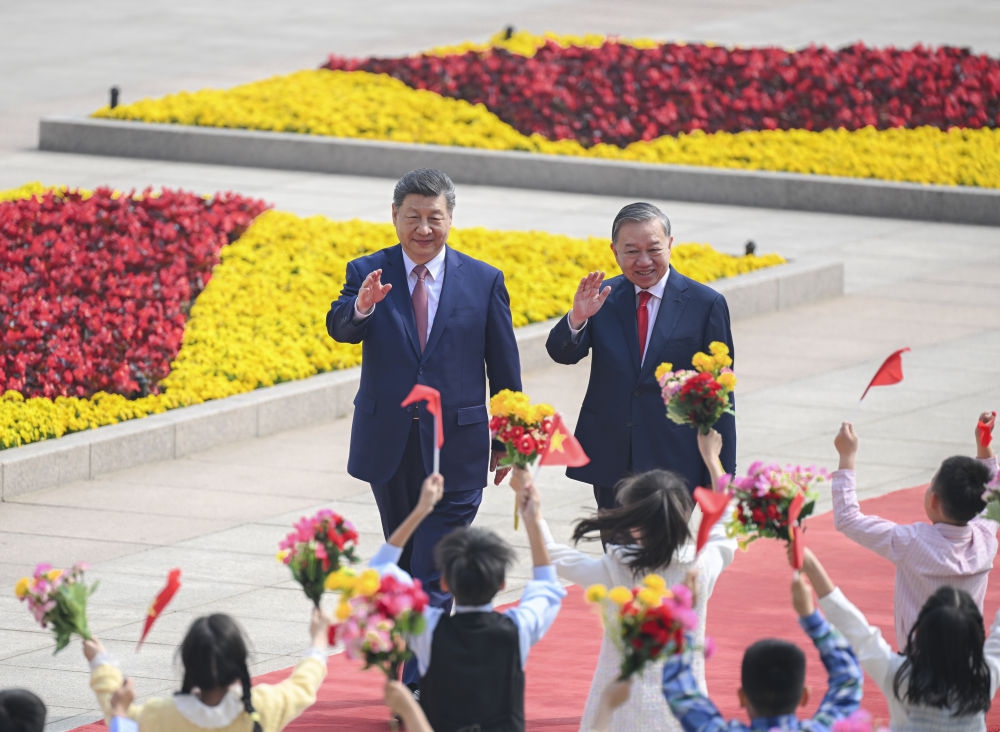
General Secretary of the Communist Party of China Central Committee and Chinese President Xi Jinping holds a welcome ceremony for General Secretary of the Communist Party of Vietnam Central Committee and Vietnamese President To Lam prior to their talks in Beijing on April 15, 2026. Photo: Xinhua
China and Vietnam should uphold the principles of peace, development, cooperation and mutual benefit, and work together to oppose unilateralism and protectionism, General Secretary of the Communist Party of China (CPC) Central Committee and Chinese President Xi Jinping said on Wednesday, according to the Xinhua News Agency.
Both sides should safeguard the global free trade system and keep the industrial and supply chains stable and unimpeded, he said.
Xi made the remarks when holding talks with General Secretary of the Communist Party of Vietnam Central Committee and Vietnamese President To Lam, who is on a state visit to China.
This marks the first foreign trip Lam made since being elected president of Vietnam earlier this month. The trip also comes a year after Xi's historic visit to the Southeast Asian country.
Chinese experts said that with deep mutual trust between the two parties and the two countries, China-Vietnam relations have witnessed stable and sound development, and the latest visit is expected to bring the relationship to a higher level, facilitating synergy between development strategies and pragmatic cooperation.
Sustained cooperation
China will advance high-quality comprehensive strategic cooperation with Vietnam, and accelerate the building of a higher-level China-Vietnam community with a shared future that carries strategic significance, Xi said on Wednesday.
He said the leadership of the communist party is the most essential feature and the greatest strength of socialism, and defending the socialist system and the ruling position of the communist party is the greatest common strategic interest of the CPC and the CPV.
Xi said the two sides must maintain a high degree of strategic vigilance and strong strategic resolve, always remain confident in their path and system, and ensure that all reform will not change the direction of the path or the nature of the system.
The two sides should implement the new round of cooperation plan between the CPC and the CPV, and conduct in-depth exchanges and mutual learning on theories and experiences in party and state governance, and make good use of the China-Vietnam "3+3" strategic dialogue on diplomacy, defense and public security, he said.
Xi said both countries should work together in their modernization drive, accelerate the alignment of development strategies and prioritize infrastructure connectivity.
Xi also called on both sides to strengthen cooperation in emerging fields such as artificial intelligence, semiconductors, and the Internet of Things, adding that more high-quality Vietnamese products are welcome to enter the Chinese market.
For his part, Lam said Vietnam will firmly regard the development of relations with China as an objective necessity, a strategic choice and a top priority, and said that his country will continue to support the one-China policy and stands ready to strengthen strategic communication and high-level strategic coordination with China, Xinhua reported.
Vietnam will upgrade the level of cooperation in economy, trade, investment, railways and other infrastructure, as well as tourism, and step up cooperation in education, training, science and technology, people-to-people exchanges, and sub-national cooperation, Lam said, according to the report.
Xi and To Lam jointly attended a signing ceremony of cooperation documents in Beijing on Wednesday, per Xinhua. The documents covered areas including inter-party exchanges, public security, justice, economy, industrial and supply chain cooperation, customs cooperation, science and technology, people's livelihoods, human resources development, media, and sub-national cooperation.
Through the high-level engagement, China-Vietnam political mutual trust has been further deepened, strategic coordination strengthened, pragmatic cooperation delivered tangible outcomes, and people-to-people bonds extended and consolidated, Xu Liping, director of the Center for Southeast Asian Studies at the Chinese Academy of Social Sciences, told the Global Times.
The two sides have deepened exchanges on state governance and highlighted political guidance by the leaders for the development of relations between the two parties and two countries, Xu added.
Gu Xiaosong, dean of the ASEAN Research Institute at Hainan Tropical Ocean University, told the Global Times that great potential exists for further cooperation in economic, trade and people-to-people cultural fields.
Vietnam has retained its position as China's largest trading partner in ASEAN for 10 consecutive years and ranked as China's fourth-largest globally in 2024 and 2025, according to VNA.
While bilateral trade volume is already considerable, there is room for Vietnam to increase exports of its light industrial products, agricultural products and other goods to China, Gu said.
To Lam's visit to China also comes at a crucial moment as this year marks the beginning of China's 15th Five-Year Plan period (2026-30), and the conclusion of the 14th National Congress of the Communist Party of Vietnam, Xu said, and this opens ways for alignment and coordination of development strategies.
Flurry of visits
Alongside To Lam's trip to China, a flurry of diplomatic exchanges has been taking place in Beijing in recent days, featuring high-level visitors from Thailand, Spain, the United Arab Emirates and Russia, with President of the Republic of Mozambique Daniel Francisco Chapo also set to pay a state visit starting Thursday.
Observers, when analyzing this diplomatic peak, also referred to the opening weeks of 2026, when China witnessed a surge in diplomatic interactions, spanning China's neighboring regions, Europe, North America and the Global South, which attracted widespread global attention.
Engagement covering different regions around the world underscores China's global influence, said Wang Dong, executive director of the Institute for Global Cooperation and Understanding at Peking University.
Major media outlets in the Middle East including Al Jazeera and Al Arabiya English also highlighted the busy diplomatic traffic in Beijing this week, noting that China is welcoming a string of leaders from countries impacted by the Middle East war, as well as its economic fallout.
Reuters on Wednesday listed the visits of Western leaders this year who are seeking to elevate ties with China. The report said that in recent years, China has pushed for the building of what it says should be an equal and orderly multipolar world where every country has a say and major powers shoulder more responsibilities.
Such dynamics reflect that in a turbulent world, China serves as a pillar of stability and certainty, Wang Dong told the Global Times on Wednesday, adding that countries around the globe place higher expectations on China's leading role on the international stage.
Amid mounting global economic pressure, Wang Dong noted that with China launching its 15th Five-Year Plan, its vast market, integrated industrial chains and high-tech advances are expected to offer enormous opportunities to other countries around the world.
Over the past five years, China's economy has grown at an average annual rate of 5.4 percent, accounting for around 30 percent of global growth, greater than the contribution of the Group of Seven combined, Chinese Foreign Minister Wang Yi said at a press conference on the sidelines of the session of the national legislature in March, Xinhua reported.
Wang Dong said that China's foreign policy of openness, inclusiveness and opposition to ideological or bloc confrontation, coupled with its commitment to equality and mutual benefit, has made it a partner of choice and a great opportunity for other countries.
RELATED ARTICLES