Illustration: Chen Xia/Global Times
Li Chenggang, China international trade representative with the Ministry of Commerce (MOFCOM) and vice minister of commerce, met with US carmaker Ford's Chief Policy Officer Steven Croley in Beijing on Monday, and the two sides exchanged views on China-US economic and trade relations and Ford's development in China, according to the MOFCOM on Wednesday.Li said that the Chinese and US auto industries are highly complementary, with broad scope for cooperation, and it is hoped that Ford would continue to deepen its presence in the Chinese market and strengthen exchanges and cooperation with Chinese companies to provide more competitive products for the Chinese and global markets.
For his part, Croley said that Ford has been operating in China for many years and attaches great importance to the Chinese market and industrial and supply chains. It stands ready to explore new business development opportunities with its partners and hopes that the economic and trade relations between the US and China will maintain stable development, Croley added, according to the MOFCOM.
Business cooperation plays a crucial role for the stable development of China-US ties, and these remarks from the Ford's senior executive show both the company's wishes to continue development in the Chinese market as well as its expectation for stable relations between the world's two biggest economies.
Yet, the rapid rise of China's auto industry has sparked a wide range of reactions internationally, revealing a complex mix of feelings toward Chinese electric vehicles (EVs). Even within Ford, there are differing views. Ford's CEO Jim Farley reportedly made rather unfair remarks regarding Chinese carmakers. He claimed that the US should not let Chinese cars "into our country," according to Bloomberg.
Obviously, such claims are not conducive to cooperation. As Chinese officials have repeatedly pointed out, cooperation between China and the US are complementary and mutually beneficial in nature. Cooperation can benefit both sides, while protectionism leads nowhere.
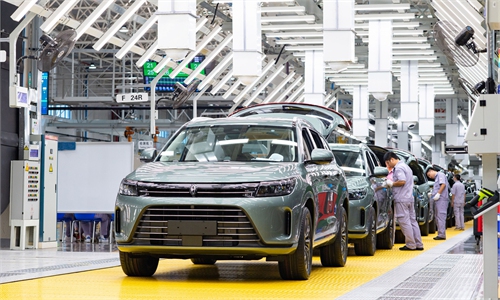
The auto sector is a vital pillar of manufacturing, and the rise of EVs has injected new vitality into this traditional sector, drawing global attention. In the face of industrial change and new competition, there are naturally some anxieties. However, looking at the broader industrial shift and the global market, opportunity outweighs competition.
China has consistently embraced an open, cooperative and inclusive attitude, providing vast space for all market players. Many multinational companies have deepened their presence in China, making full use of its enormous consumer market, complete industrial chain and vibrant research and development (R&D) ecosystem to achieve a win‑win situation for their own growth and that of China's auto industry.
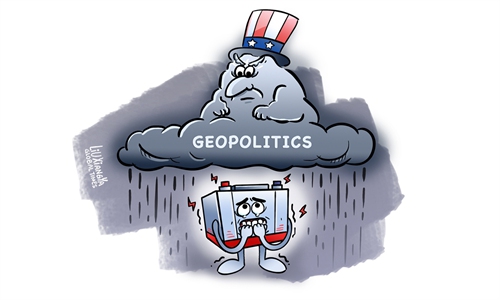
There is no denying that protectionist voices linger in some quarters of the international auto sector. However, recent positive developments have shown that cooperation is an inevitable choice at the commercial, industrial chain and practical development levels, and trade protectionism will not block the trend of industrial development. This is because the development of the EV industry is inseparable from technological innovation, industrial chain coordination and market sharing, all of which require countries and businesses to break down barriers and deepen cooperation.
In fact, many global players are seeing greater potential for cooperation. For example, on Monday, Spanish Prime Minister Pedro Sanchez visited Chinese tech firm Xiaomi in Beijing and experienced one of the firm's cars, the Xiaomi YU7. In February, German Chancellor Friedrich Merz took the new Mercedes-Benz S-Class for a test ride in Beijing, and highlighted the close cooperation between German manufacturers and Chinese technology.
China has always adhered to a high level of opening-up, providing a fair, transparent and predictable development environment for global automakers. The Chinese market has the world's most complete automobile industrial chain, the largest production and sales scale of new-energy vehicles, and the most dynamic technological innovation ecosystem. This is not only China's advantage, but also represents vast opportunities for all businesses investing in China. From Volkswagen, BMW and Mercedes-Benz to Tesla and Ford, all companies willing to cooperate sincerely and integrate deeply have reaped substantial returns in the Chinese market.
It is hoped that those who are still influenced by trade protectionist voices or inclined to protectionism can see the vitality of the EV industry's development, and work to promote win-win cooperation for all businesses, no matter where they are from. After all, in the ongoing industrial transformation, the earlier one can embrace fair competition, the more opportunities one can seize.
RELATED ARTICLES