Debuts shine at major consumer expo as businesses tap market opportunities
By Yin Yeping and in Haikou Published: Apr 16, 2026 07:46 PM

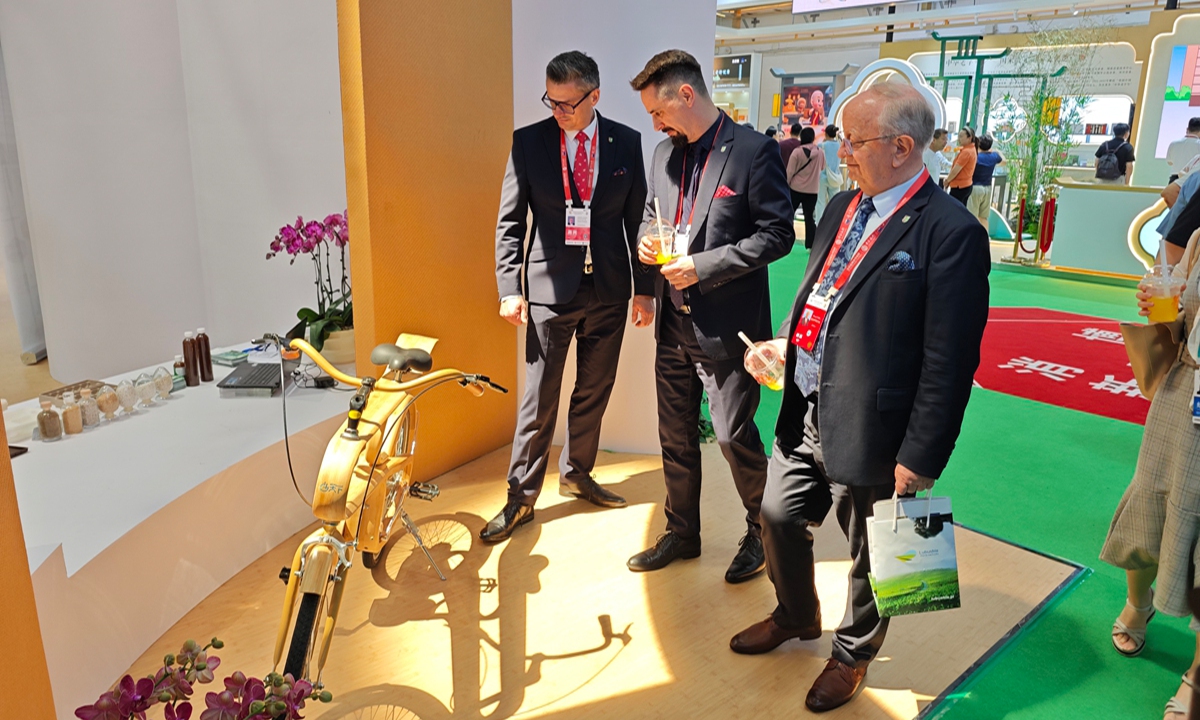
Foreign visitors look at a China made bicycle on display at the Sixth China International Consumer Products Expo (CICPE) in Haikou, South China’s Hainan Province, on April 15, 2026. Photo: Yin Yeping/GT
From trendy toys to artificial intelligence (AI) glasses, and from massaging armchairs to DIY cosmetic machines, a wide range of products is on display at the Sixth China International Consumer Products Expo (CICPE) in Haikou, South China's Hainan Province. Many of them are being unveiled for the first time, making debut exhibitions and product launches a defining highlight of the event.
More than 200 new products have been or will be launched at this year's expo, which runs from Monday to Saturday, double the number from last year, the Global Times learned from the event organizers.
It's the first time that Liang Yong, a sales representative from Piececool, a brand based in Dongguan, South China's Guangdong Province, is participating in the expo. The company's products mainly focus on traditional Chinese styles and intangible cultural heritage.
Liang said that when it comes to the trendy toys, most people think of plastic models, cloth dolls or wooden toys, while metal models are relatively rare as they are often perceived as expensive. What the company is doing is to make metal puzzles more affordable, he said.
The company's sales are mainly concentrated in the domestic market, with monthly online sales reaching 2 million yuan ($291,488), Liang added.
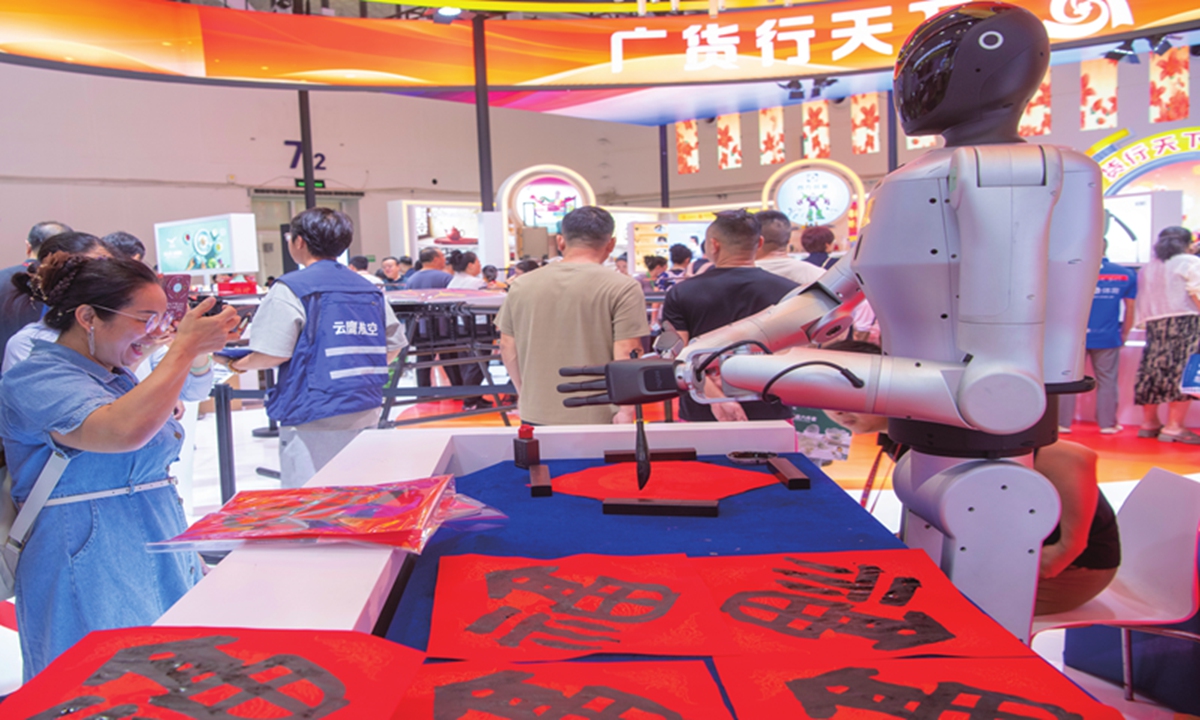
Visitors watch a robot writing calligraphy at the Sixth China International Consumer Products Expo in Haikou, South China's Hainan Province, on April 16, 2026. Photo: VCG
Also at the expo, Bloomage Biotech showcased its second-generation personalized skincare workstation for the first time, which compresses a 3,000-square-meter pharmaceutical-grade production facility into a unit roughly the size of a refrigerator.The system connects to an AI miniprogram that analyzes consumers' skin conditions and generates customized formulas, with the unit containing more than 100 formulations designed to address a wide range of skin concerns, Liu Chang, a company representative, told the Global Times at the booth.
"In about 10 minutes, we can produce a personalized serum. It's freshly made, and consumers can take it directly," Liu said, noting that the device features an upgraded robotic arm that is more precise and quieter, while the production time has been reduced from about 15 minutes to just around 10 minutes per product.
It is also the first time that Rokid has set up an independent exhibition at the CICPE. This technology company from Hangzhou, East China's Zhejiang Province, the country's innovation hub, launched its new AI glasses at the event.
According to the company, it is the first time it has publicly demonstrated AI glasses with a subtitle function for hearing-impaired users, enabling real-time speech to text during conversations and phone calls, with text displayed directly in the user's field of view.
Powered by a built-in Qualcomm AR1 chip, the glasses also support photo and video capture, smart teleprompting, real-time translation across 89 languages, live navigation, and AI-powered Q&A.
In one corner of the exhibition hall, visitors were sprawled across rows of massage chairs, some even dozing off. OSIM, the product developer, is a Singapore-based company that has participated in all six editions of the CICPE, unveiling new products each year, and this time was no exception.
At this year's expo, it launched a new massage chair that engages multiple senses, including touch, smell sight, and sound, with an AI assistant. Users do not need to speak, as the chair uses AI facial recognition to assess their physical condition. Combined with data such as heart rates, breathing frequency, and stress levels, it can tailor a more suitable massage program, Kathy Zhou, assistant manager of Branding and Strategic Marketing at OSIM China, told the Global Times.
The chair offers three massage styles: Chinese, Thai and Japanese. It also features built-in audio for a more immersive experience, while a scent diffuser releases aromas such as lavender to help users relax and sleep better.
Asked why the company returns to the expo every year, Zhou said that as a multinational company, it values not only strong economic growth but also policy stability, which is crucial for long-term investment. "In this regard, China remains a highly attractive market for us," she said.
RELATED ARTICLES