China’s industrial momentum shifts toward new drivers as high-tech manufacturing powers growth
Robust growth underscores rising economic resilience despite external uncertainties: official
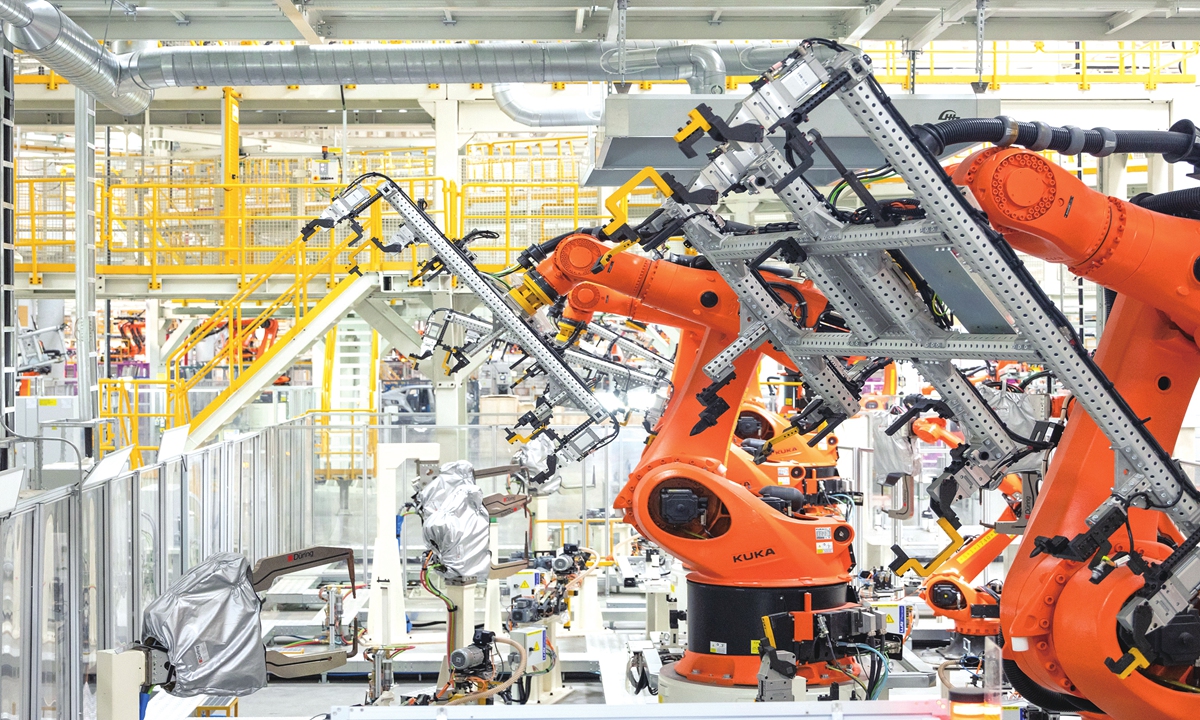
Industrial robot arms operate at the vehicle body workshop of Volkswagen's smart manufacturing base in Hefei, East China's Anhui Province. Photo: Courtesy of Volkswagen
China's industrial growth in the first quarter showed a clear shift toward new growth drivers, with equipment manufacturing and high-tech manufacturing posting robust expansion, while high-tech sectors accounted for more than half of total industrial profit growth, the National Bureau of Statistics (NBS) announced on Thursday.
Chinese analysts said that the trend highlights a continued pattern of relatively fast growth, structural upgrading and strengthening new drivers in industrial production, underscoring the economy's strong vitality despite a complex external environment.
The NBS data showed that the value added of high-tech manufacturing rose 12.5 percent year-on-year in the first quarter, outpacing the value added of industrial enterprises above designated size by 6.4 percentage points.
Although high-tech manufacturing accounts for less than 20 percent of total industrial output, it contributed 32.6 percent to overall industrial growth. Data for January and February showed that high-tech manufacturing accounted for 51.8 percent of total industrial profits, according to the NBS.
Notably, value-added in integrated circuit manufacturing jumped 49.4 percent, while that of biopharmaceutical manufacturing rose 14.8 percent, pointing to an accelerated shift in both production and supply structures toward the mid-to-high end of the value chain.
China's high-tech manufacturing sector has become increasingly technology-intensive, with some segments moving from catching up to keeping pace and even taking the lead, reflecting notable progress, Mao Shengyong, deputy head of the NBS, said at a press conference on Thursday.
"Emerging growth drivers are increasingly underpinning overall economic expansion," he added.
The latest gains reflect years of sustained efforts under China's innovation-driven development strategy, with increased investment and coordinated breakthroughs in technological and industrial innovation driving tangible progress and industrial upgrading, the official noted.
The strong performance of China's industrial sector, particularly high-tech manufacturing, underscores the economy's growing resilience, as innovation is increasingly taking a leading role in driving growth, Su Jian, a professor at Peking University's School of Economics and director of its National Center for Economic Research, told the Global Times on Thursday.
Su said that key growth momentum is coming from technology-driven upgrading and the cultivation of new quality productive forces, with traditional industries upgrading alongside the expansion of emerging sectors, effectively supporting high-quality development.
With overall investment growth picking up in the first quarter, investment in emerging sectors also showed solid momentum.
Investment in high-tech manufacturing rose 5.2 percent year-on-year, including a 19 percent increase in aerospace equipment manufacturing and a 6.6 percent rise in electronic and communication equipment manufacturing, official data showed.
Innovation is playing a stronger role in China's industrial development. "Emerging sectors such as the low-altitude economy, along with industries of the future including embodied intelligence and 6G, are accelerating and becoming new engines of investment growth," Mao said.
At the same time, producer services are moving toward greater specialization and higher value-added segments of the value chain. Investment in high-tech services rose 12.3 percent year-on-year in the first quarter, indicating continued a rapid expansion in emerging areas, NBS data showed.
Su said that innovation-driven industries will be a key driver of China's growth this year, underpinning structural upgrading and quality improvement. "With both domestic demand and global markets providing support, and industrial and supply chains becoming more resilient, the economy is well-positioned to sustain its growth momentum," he added.
China is stepping up coordinated efforts across the innovation chain to advance key technologies and frontier sectors, accelerating the commercialization of breakthroughs in areas such as aerospace, quantum technology and biopharmaceuticals, Mao said.
This trend was reflected in strong growth in high value-added segments, with aerospace equipment manufacturing up 17.7 percent and aircraft manufacturing rising 27.3 percent.
China has also made steady progress in scaling up artificial intelligence (AI), with the value added of digital product manufacturing rising 11.2 percent year-on-year in the first quarter. AI-related sectors outperformed, with electronic materials manufacturing up 32.5 percent and integrated circuit manufacturing rising 49.4 percent, according to the NBS.
The spillover effects of AI are extending upstream to sectors such as chemicals and power generation, which provide raw materials and energy, with its role as a growth driver becoming increasingly evident, Mao noted.
These gains came alongside strong industrial performance and improving corporate profitability. In January and February, profits of industrial enterprises above designated size rose 15.2 percent year-on-year, accelerating by 14.6 percentage points from last year's full-year pace.
Profits in high-tech manufacturing surged by nearly 60 percent, significantly boosting overall corporate performance and strengthening expectations and confidence.
Mao highlighted the resilience of China's industrial sector despite escalating geopolitical tensions, volatility in global energy markets and rising input costs.
"Backed by a vast domestic market, a complete industrial system and strong supporting capacity, China's industrial and supply chains have remained secure and stable, helping to cushion external shocks and support overall economic stability," he added.
The official also pointed to lingering external uncertainties and noted that some enterprises continue to face practical challenges, including profitability pressures, while pledging stronger policy support to help businesses address difficulties and achieve better development.
China on Thursday reported better-than-expected economic growth for the first quarter, with GDP expanding 5.0 percent year-on-year, reaching the upper end of its full-year target range of 4.5-5 percent and ranking among the fastest-growing major economies.
RELATED ARTICLES