Green farm machinery reflects China’s broader shift toward high-efficiency growth
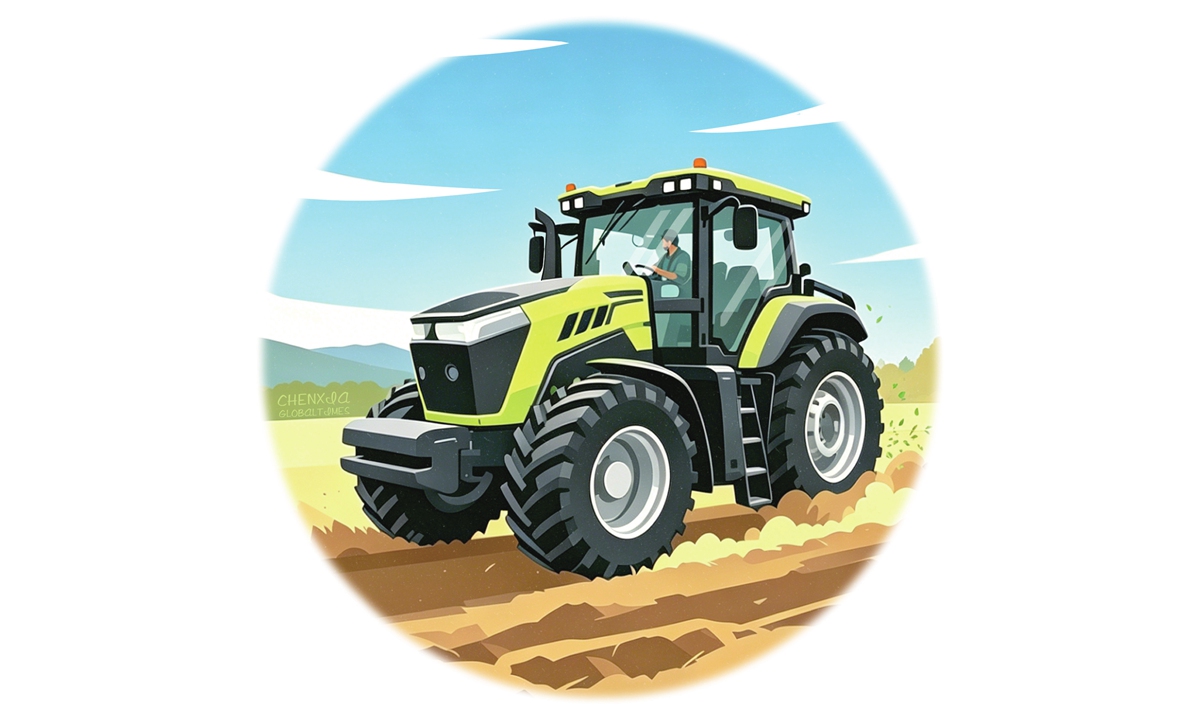
Illustration: Chen Xia/GT
Zoomlion Agriculture Machinery Co recently delivered a batch of DQ3004 hybrid tractors to customers in Aksu in Northwest China's Xinjiang Uygur Autonomous Region, where the equipment was quickly put into use for spring plowing, the Economic Daily reported on Thursday, showing that new-energy agricultural machinery is gaining popularity in China.Why has green agricultural machinery become increasingly popular? Beyond its environmental benefits, it helps farmers produce more at lower cost. Fuel costs for agricultural machinery operations account for about 30 percent of total agricultural production costs. Hybrid tractors, which can help save energy costs and work efficiently, are increasingly used in large-scale agriculture production. As a major cotton-growing area, Aksu has strong demand for this kind of efficient farming equipment.
Behind this ongoing trend, a technology-driven shift is taking place in China's agricultural production and broader economy, where, on the one hand, efficiency gains and technological upgrading are becoming more important drivers of growth, and, on the other hand, the green transition is increasingly aligned with high-quality economic growth goals.
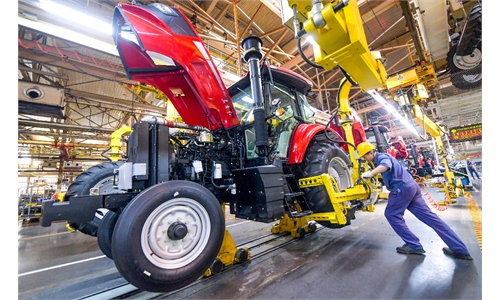
First, as technologies are driving industrial upgrading and adding more value in China's manufacturing sector, the benefits are reaching wider traditional sectors through equipment and machinery manufacturing.
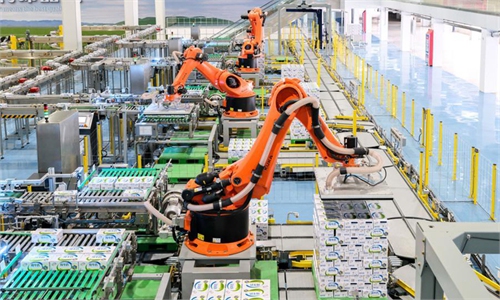
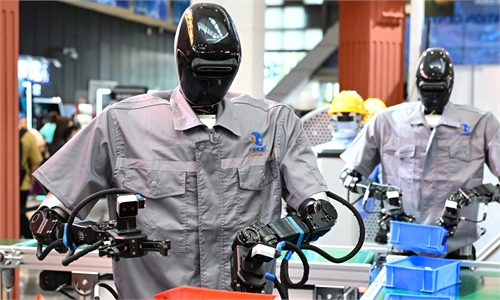
China's manufacturing sector is accelerating its shift toward high-end, intelligent, and green development, with the equipment manufacturing industry becoming a key driver of industrial growth. According to the National Bureau of Statistics, the value-added output of the equipment manufacturing sector continued to grow faster in the first quarter than overall industrial production. High-tech equipment such as industrial robots, 3D printing devices, and smart agricultural machinery maintained relatively strong growth momentum, with some segments recording double-digit increases.
This industrial upgrading is not confined to factories, but is also being reflected in traditional sectors such as agriculture. The use of green and smart agricultural machinery to support farming development is a typical example of how China's high-tech manufacturing is adding new momentum to traditional industries. As artificial intelligence (AI) is further integrated into agricultural machinery, some long-standing problems faced by farmers are being solved in a more efficient and lower-cost way.
For example, AI-powered inter-row weeding robots can operate in hilly and mountainous areas. Using AI and computer vision, they can accurately identify and remove weeds, greatly reducing the need for herbicides. This not only helps reduce environmental pollution, but also improves agricultural production efficiency.
As of the end of 2025, there were more than 300,000 agricultural drones in service in China, with annual operating coverage surpassing 460 million mu (30.67 million hectares), according to the Science and Technology Daily.
Second, the green transition is increasingly aligning with the goal of high-quality economic growth. The core logic is that clean energy technologies have achieved lower costs and higher efficiency, meaning that sustainability is no longer a trade-off between environmental protection and economic performance, but a win-win outcome.
The cost of using clean energy has fallen notably, with prices for electricity and hydrogen energy becoming more stable and gradually declining. Compared with fossil fuels, overall operating costs are lower in many cases. From a business perspective, adopting green and clean energy equipment is no longer just about meeting environmental requirements, but has become a rational choice to directly reduce costs, improve productivity, and enhance competitiveness. This also means that green development is no longer an additional burden, but a source of tangible economic benefits.
China has built the world's largest and most complete clean energy industrial chain, with solar and wind power achieving globally competitive electricity costs. Instead of relying solely on grid expansion to absorb power, more regions are exploring local conversion models. By linking renewable energy with hydrogen, chemicals, and advanced manufacturing, green electricity is injecting more power into wider range of industries.
For example, in Ejin Horo Banner of Ordos City in North China's Inner Mongolia Autonomous Region, agricultural and livestock farming has been integrated with photovoltaic power generation. Traditional cattle sheds there have been upgraded with solar power systems, generating more than 20 million kilowatt-hours of clean electricity annually, saving more than 6,000 tons of standard coal each year, and reducing electricity costs for farming and animal husbandry by 30 to 50 percent, according to China National Radio.
The rise of green and smart agricultural machinery reflects a shift in how growth is generated in China's farming sector and the broader economy. As manufacturing innovation spreads, agriculture is becoming more technology-intensive, where efficiency and sustainability reinforce each other. High-quality economic development is therefore moving from scale expansion toward productivity-led, green upgrading in practice.
The author is a reporter with the Global Times. bizopinion@globaltimes.com.cn
RELATED ARTICLES