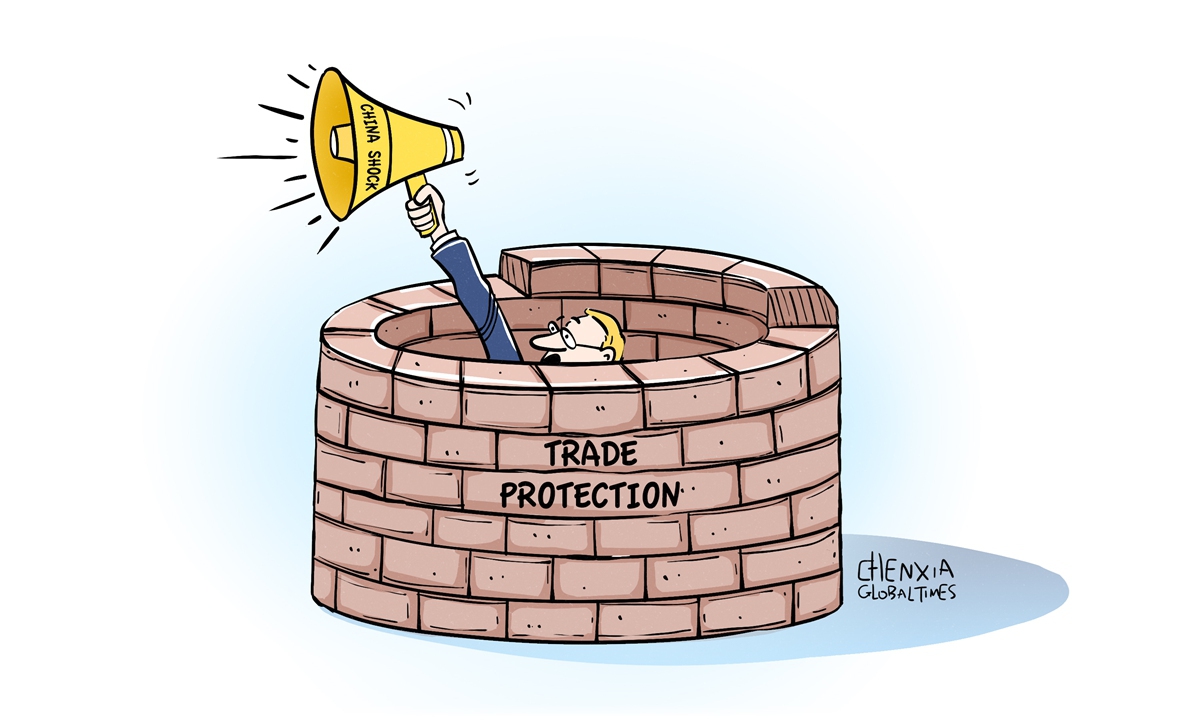
Illustration: Chen Xia/GT
It has been a while since some in the West began peddling the "China Shock 2.0" narrative, which reflects nothing but anxiety and unease over China's high-tech advancements.The latest example is a Tuesday article from the Financial Times, headlined "China shock 2.0: the flood of high-tech goods that will change the world," which distorted the accomplishments of China's high-tech sector into a so-called "assault on high-end manufacturing."
The "China Shock 2.0" narrative is essentially an attempt to smear China's development through one-sided narratives. It ignores the very nature of global industrial collaboration and turns a blind eye to the opportunities that China's economic growth has brought to the rest of the world.
There is no denying that China's high-tech industries have achieved remarkable progress in recent years, with exports continuing to rise. In the first quarter of this year, China's exports grew 11.9 percent year-on-year, with mechanical and electrical products accounting for more than 60 percent of the total, customs data showed.
Yet, a crucial fact is often overlooked: intermediate goods make up a large share of China's high-tech exports. In other words, what China exports in large quantities is not finished consumer goods, but components, semi-finished products, and modules. Data showed that, as of 2024, China had been the world's largest exporter of intermediate goods for 12 consecutive years.
These goods enter various countries and regions, where local businesses assemble, process, and integrate them into finished products for consumers. This is the normal state of global industrial division and collaboration. By supplying these intermediate goods, China helps stabilize the industrial chains of importing countries, reduces local manufacturers' procurement costs, and supports downstream production and employment.
In May 2025, The Wall Street Journal published an article headlined "The Real Story of the 'China Shock'," which noted that "One study found that a 1 percentage point increase in imports from China led to about a 1.9 percent drop in consumer prices in the US ... US businesses also reaped advantages. Manufacturers who use imported parts or materials benefited from cheaper inputs, making them more competitive globally."
At the same time, China encourages its companies to invest overseas, and companies themselves opt to do so for their development. This process further promotes the coordinated development of global industrial chains. It is misleading to simply refer to such supply chain relations deeply embedded in the global division of labor as a "shock."
Moreover, China is not only a major exporter but also a major importer. As its industrial upgrading and technological progress accelerates, China's demand for high-end components, precision instruments, advanced materials, and other key parts is growing. In the first quarter of 2026, China's imports rose by 19.6 percent. Among these, imports of mechanical and electrical products increased by 21.7 percent. A large portion of these imported products are also intermediate goods, providing a vast market space for high-tech suppliers around the world.
Many foreign companies, attracted by the sheer scale of the Chinese market, continue to increase their investments in China and deeply participate in the upgrading of its industrial chains. The very market and opportunities arising from China's high-tech progress further expose the so-called "shock" rhetoric as being fundamentally biased and unfounded.
Furthermore, the "China Shock 2.0" rhetoric ignores the important solutions that China's high-tech development provides to the world, thereby highlighting the prejudice and absurdity of certain anti-China discourse. At a time when conflicts in the Middle East have triggered global concerns over energy security, China's new-energy products offer quality alternatives for countries seeking energy-security solutions. What Western rhetoric calls "China's excess capacity" is in fact a valuable resource for addressing the global green transition and energy crisis.
In this sense, the "China Shock 2.0" claim is untenable because it is built from the very beginning on a false premise - misinterpreting mutually beneficial collaboration in global industrial chains as a zero-sum game, and maliciously framing the positive spillovers of China's high-tech development as a "shock" to others.
But the truth is that China's high-tech industries don't just export - they also import. They don't just compete - they also cooperate. They are changing the world, but the world is also changing them. This has never been about a one-way shock; it's about two-way engagement and co-evolution.
Anyone who stubbornly views Chinese manufacturing as a threat is not only misunderstanding how the global economy works but also risks missing the chance to benefit from the historic process.
RELATED ARTICLES