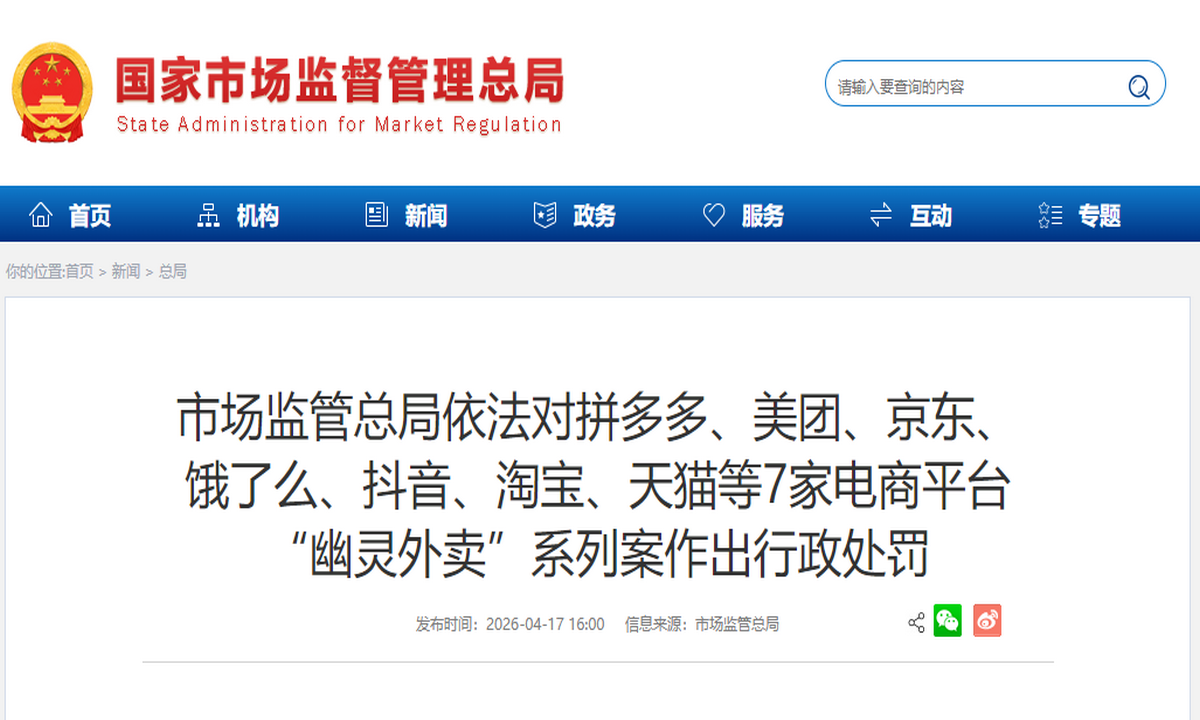
Screenshot of State Administration for Market Regulation
China's top market regulator said Friday that it has imposed a total fine of 3.597 billion yuan ($526million) on seven major e-commerce platforms for their involvement in a string of food delivery "ghost shop" cases and food safety violations, the Xinhua News Agency reported.
China's State Administration for Market Regulation (SAMR) announced on Friday that it has imposed administrative penalties on seven e-commerce platforms including PDD, Meituan, JD.com, Ele.me, ByteDance's Douyin, Alibaba's Taobao and Tmall.com 3.597 billion yuan for involvement in "ghost delivery" violations involving food delivery and ordered them to rectify their illegal practices.
"Ghost delivery " refer to food delivery activities conducted by "ghost shops" —businesses that falsify credentials or operate without food business licenses — whose presence on e-commerce platforms is enabled by the platforms' failure to fulfill their statutory duty to verify qualifications.
The market regulator also suspended new cake shop listings on these platforms for three to nine months, and imposing a total of 3.597 billion yuan in fines and confiscated illegal gains. Additionally, the legal representatives and food safety directors of the seven platforms were fined a combined total of 19.6874 million yuan, according to Xinhua.
According to Xinhua, this is the heaviest fine levied against platforms since the Food Safety Law was amended in 2015, directly targeting platforms' tolerance of illegal "ghost shops" operations. It also sends a clear signal that oversight of online food safety will be tightened: safeguarding the people's "safety on the tip of the tongue" means the digital space is not a "lawless" zone, and platforms cannot simply profit without "guarding the gate."
According to the SAMR's statement, administrative penalties were imposed on seven e-commerce platforms — Shanghai Xunmeng Information Technology Co (PDD), Beijing Sankuai Technology Co (Meituan), Beijing Jingdong 360 Degree E-commerce Co (JD.com), Shanghai Lazhas Information Technology Co (formerly Ele.me, now Taobao Flash Purchase), Beijing Douyin Technology Co (Douyin), Zhejiang Taobao Network Co (Taobao), and Zhejiang Tmall Network Co (Tmall) — in accordance with the country's food safety law and e-commerce law.
Investigations revealed that the seven e-commerce platforms failed to strictly review food business operator licenses for merchants accessing their platforms and failed to fulfill their statutory obligations to examine qualifications, the SAMR said, adding that these platforms signed cooperation agreements with order-transfer platforms, knowing or should have known that order-transfer practices infringed upon consumers' legitimate rights and interests, yet failed to take necessary measures.
The legal representatives and food safety directors of the seven platform enterprises, who bear responsibility for food safety management, failed to fully perform their relevant duties. These actions seriously violated the relevant provisions of Chinese laws, the SAMR said in its statement.
The SAMR ordered all seven platforms to remove the relevant "ghost shops" that had not undergone proper review and terminate their catering order-transfer partnerships with related order-transfer platforms.
Industry observers believe that the exposed "ghost shop" cases represent a landmark moment for improving online food safety regulation, carrying significant exemplary significance. The penalties serve not only as a powerful deterrent against illegal activities but also as a stern warning to platform enterprises for their failure to fulfill responsibilities. It has also sounded an alarm bell for the entire industry. All seven penalized platforms possess the attributes of "food business platforms," making them legally liable when problems arise, Liu Dingding, a Beijing‑based internet analyst, told the Global Times on Friday.
Platform economy has become a crucial engine driving economic development, and "ordering takeout" has become a daily dining option for the general public, especially young people. However, the online catering market features complex business models, lengthy supply chains, and high concealment, posing enormous regulatory challenges, Liu said, adding that the regulators' strict enforcement paves the way for the industry's long-term healthy development.
China's market regulator is moving to tighten controls on the online food delivery industry. The SAMR issued new rules, effective June 1, covering restaurants and other food providers using delivery platforms. The new regulations aim to prevent substandard merchants from accessing platforms in the first place, tighten control across the entire supply chain, and steer the industry toward standardized, orderly development, said the Xinhua report.
Global Times