China’s SPC releases typical cases punishing food safety violations on World Consumer Rights Day

Latest news
China's Supreme People's Court (SPC) on Sunday released a set of typical cases on consumer rights protection, focusing on areas such as food and drug consumption on this year's World Consumer Rights Day, in a bid to effectively safeguard consumers' legitimate rights and interests through high-quality judicial action, and guide businesses to operate with integrity and in compliance with the law.
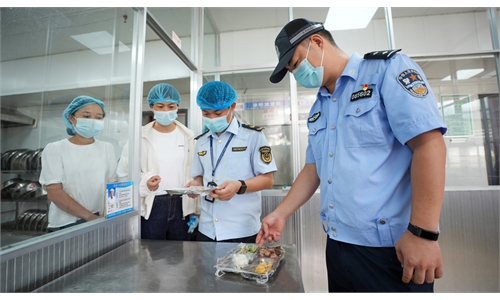
According to the SPC, food consumption is the most basic form of consumption, and food safety, being vital to public health and lives, remains a top priority for the court, which pledges to enforce the four "strictest" measures to ensure food safety and safeguard the public's "safety on the tip of the tongue" through the rule of law.
In one case released by the court, a consumer surnamed Yu sued an online seller, surnamed Zhang, after purchasing a weight-loss product for more than 2,000 yuan ($290) that was later found to contain Sibutramine, a substance banned in food products because it has been reported to cause severe cardiovascular diseases. Yu discovered the weight-loss product manufacturer listed on the packaging had its business license revoked more than a decade earlier and reported the case to the police. Zhang was subsequently investigated in a separate case on suspicion of producing and selling toxic or harmful food. Yu asked the court to order Zhang to pay tenfold punitive damages, arguing the product failed to meet food safety standards.
The court supported the consumer's claim and ordered punitive damages of more than 20,000 yuan, equal to ten times the purchase price. The ruling demonstrates the judiciary's "zero-tolerance" stance toward violations of food safety laws and serves as a strong deterrent to illegal activities, according to a statement from the SPC.
Zhang Yongjian, director of the Research Center for Development and Regulation of Food and Drug Industry under the Chinese Academy of Social Sciences, said that with the rapid growth of online sales, including online sales of food, regulators have identified emerging problems and risks. Thus, the authorities have issued rules requiring e-commerce platforms and livestream sellers to take legal responsibility for food safety, clarifying their management duties. Ensuring accountability benefits both consumers and online sellers, Zhang said.
The SPC said that it has always regarded creating a safe, fair and trustworthy legal environment for consumption as an important responsibility. It adapts to new consumer expectations and evolving requirements for rights protection, focusing on areas such as online consumption, consumption in emerging sectors and food and drug consumption, and has issued judicial rules in a timely manner to promote standardized and orderly development.
Notably, China's Supreme People's Procuratorate, together with the China Consumers Association, released typical public-interest litigation cases on consumer rights protection, focusing on food and drug safety and the rights of key groups such as the elderly, to enhance the precision of judicial protection.
According to Zhang Xueqiao, deputy prosecutor general of the Supreme People's Procuratorate (SPP), the prosecutorial authorities nationwide will continue to focus on prominent consumer rights protection issues raised by the public and on obstacles encountered in the consumption process.
They will continue the second season of the procuratorial public interest litigation supervision campaign related to food and drug safety, with greater emphasis on turning case outcomes into effective governance and on using legal means to promote upstream and systematic management, aiming to establish a consumer rights protection system with clear responsibilities, strong oversight, and efficient coordination, thereby continuously enhancing the public's sense of gain, happiness, and security, Zhang said.
RELATED ARTICLES