Chinese Commerce Minister Wang Wentao, Italy’s Tajani co-chair 16th China-Italy joint economic committee meeting to deepen trade ties
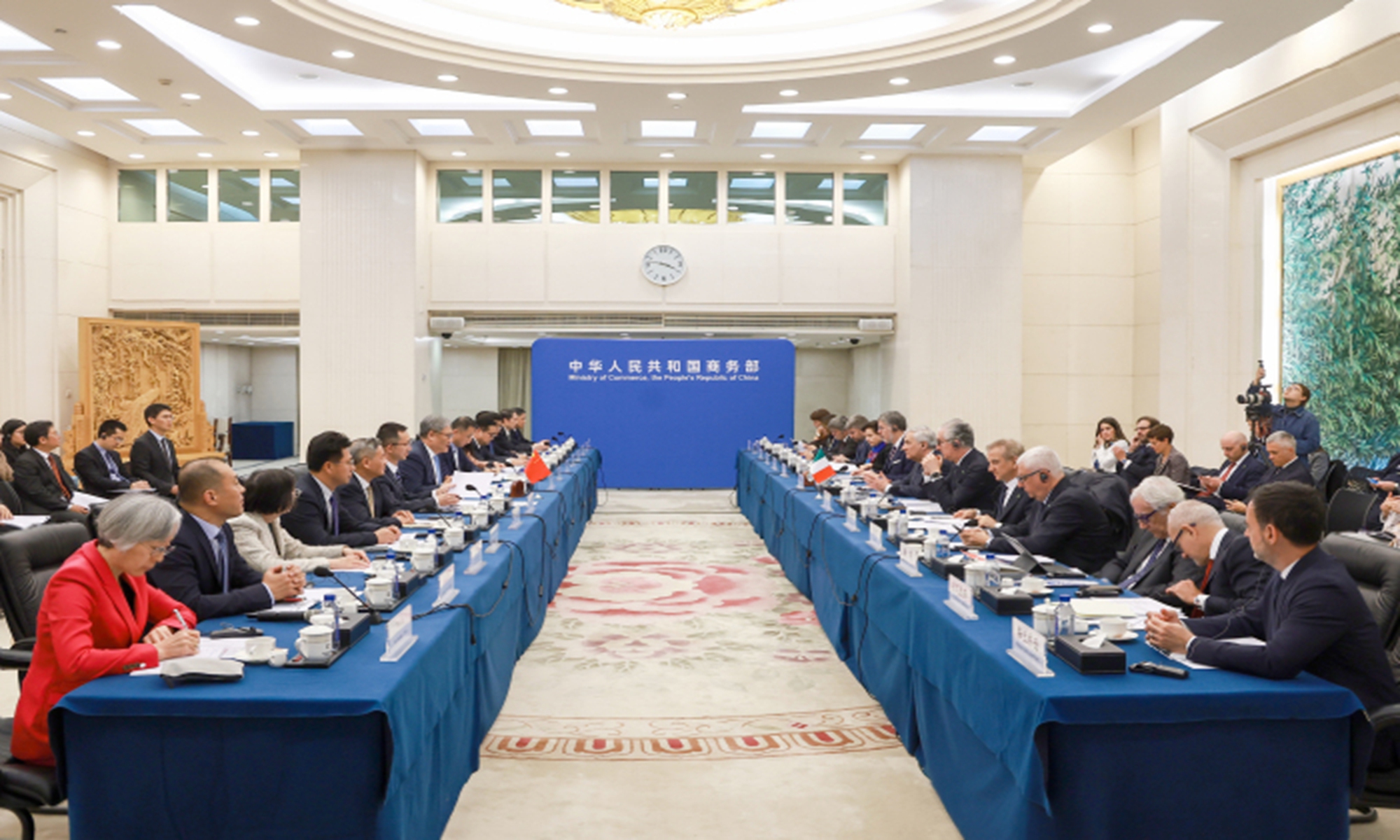
Chinese Commerce Minister Wang Wentao and Italian Deputy Prime Minister and Foreign Minister Antonio Tajani co-chair the 16th meeting of the China-Italy Joint Economic Committee in Beijing on April 17, 2026. Photo: screenshot of MOFCOM's website
Chinese Commerce Minister Wang Wentao and Italian deputy prime minister and Minister of Foreign Affairs and International Cooperation Antonio Tajani co-chaired the 16th meeting of the China-Italy joint economic committee in Beijing on Friday, where they held in-depth discussions on strengthening bilateral and China-EU economic and trade ties, according to the Ministry of Commerce (MOFCOM)'s website.
Wang said that under the strategic guidance of the two countries' leaders, China-Italy economic and trade cooperation has maintained steady and sound growth, with bilateral trade exceeding $70 billion for five consecutive years, growing momentum in services trade and steady two-way investment. China is willing to work with Italy to tap further cooperation potential and expand collaboration in areas such as e-commerce, agri-food, healthcare and industrial parks, to take bilateral ties to a new level, he said.
Wang said China and the EU are important economic and trade partners and should strengthen dialogue and communication to properly manage differences and frictions. As a key EU member, Italy is expected to play a constructive role in promoting the sound and stable development of China-EU economic ties.
Tajani said Italy attaches great importance to cooperation with China and is willing to work with the Chinese side to continue implementing the 2024-2027 action plan to strengthen their comprehensive strategic partnership, enhance exchanges and cooperation in intellectual property, and deepen collaboration in areas such as agri-food, tourism and sports. Italy welcomes Chinese companies to invest and will foster a favorable business environment.
He reaffirmed Italy's firm support for a WTO-centered, rules-based multilateral trading system, opposition to protectionism and willingness to play an active role within the EU in promoting dialogue and consultation to resolve China-EU trade frictions.
During the meeting, the two sides signed a China-Italy e-commerce action plan. Afterward, Wang and Tajani co-chaired a business roundtable of the China-Italy Entrepreneurs Committee. More than 150 business representatives from both countries attended.
Dreame Technology (Suzhou) Co co-president Lei Ming was invited to attend and spoke as one of five Chinese company representatives, according to Securities Daily. He said Italy, the cradle of the Renaissance, is also globally recognized as a hub for high-end manufacturing and design.
Zhou Yong, chairman of Jiangsu Soho Holdings Group Co, also speaking on behalf of Chinese enterprises, said that the group is expanding economic and trade cooperation by importing advanced Italian equipment such as offset printing machines into China, while helping high-end textile and apparel products enter the Italian market. It also operates regular China-Europe freight train services between Suzhou and Milan to facilitate trade and mutual benefit. In 2025, the group's imports and exports with Italy rose 12 percent year-on-year, maintaining steady and positive growth, according to the company's WeChat account.
Zhou Mi, a senior researcher at the Chinese Academy of International Trade and Economic Cooperation, told the Global Times that Italy holds a unique position in Europe and was among China's earliest cooperation partners. Despite evolving circumstances, Italy remains a key bridge in China-EU cooperation. Beyond its own economic and industrial needs, strengthening trade ties with Italy still offers significant room for expansion. He noted that China-Italy cooperation should explore new growth areas and maintain the overall stability of bilateral economic ties.
Zhou added that amid geopolitical pressures, China-Italy cooperation is gaining new, short-term opportunities, particularly in stabilizing supply chains and reducing costs. Collaboration in agri-food and infrastructure could help ease supply disruptions, improve logistics efficiency and strengthen resilience, while adjustments in Europe's e-commerce policies may also open up room for new cooperation.
RELATED ARTICLES