Iran flips Hormuz from open to closed within 24 hours; Chinese expert says both sides building leverage for future negotiations as standoff persists
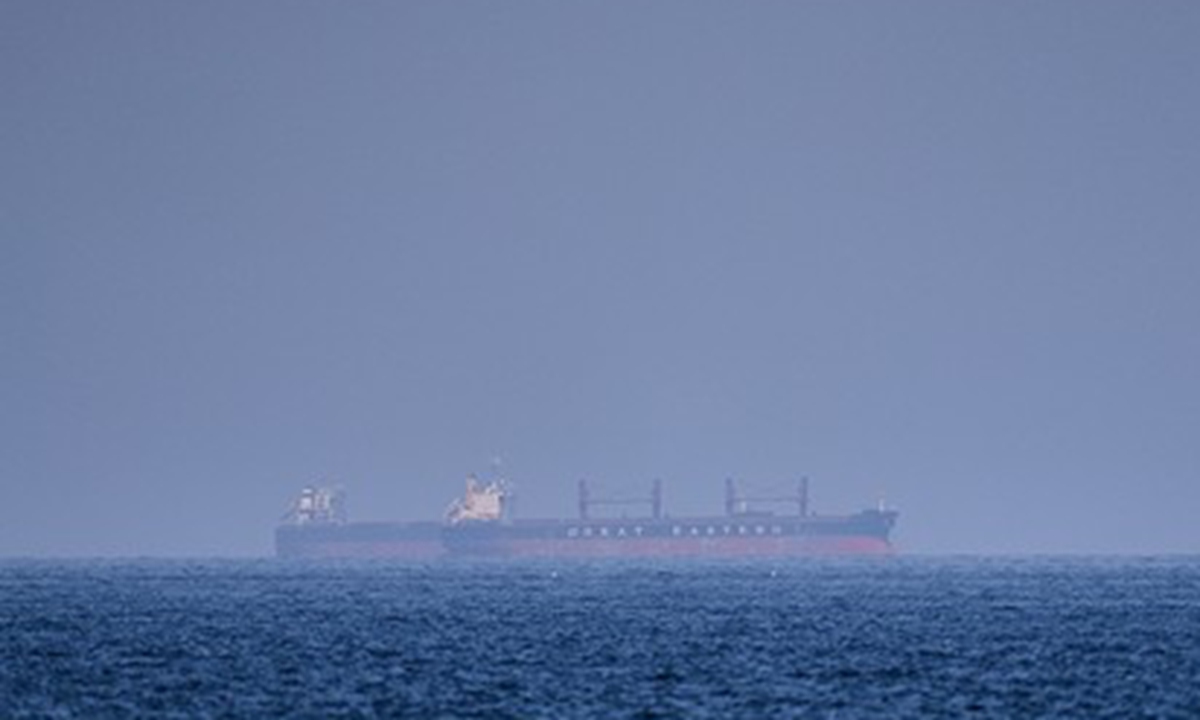
A bulk carrier anchors in the Strait of Hormuz on April 18, 2026. Photo: VCG
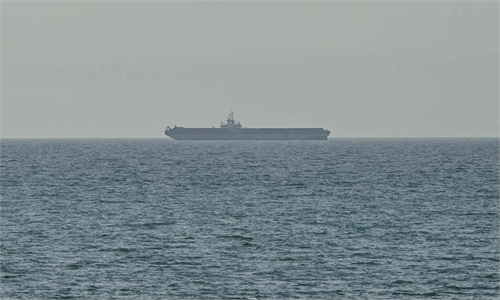
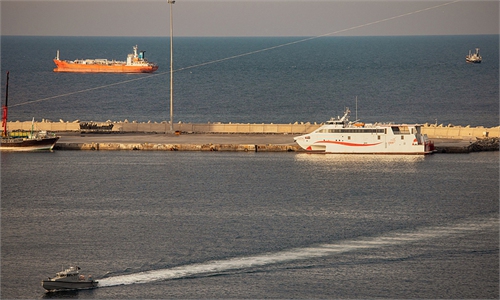
In a volatile and dizzying 24-hour reversal, Iran's Islamic Revolutionary Guard Corps (IRGC) Navy has announced, again, to close the Strait of Hormuz. In a statement via Telegram on Saturday evening, the IRGC warned that any vessel attempting to navigate the vital global chokepoint will be treated as a military target until Washington lifts its naval blockade on Iranian ports. The sudden escalation prompted an immediate pushback from US President Donald Trump, who declared that the US would not be "blackmailed" and insisted the American maritime siege will "remain in full force."
The policy shift suggests a rapid strategic recalculation in Tehran, which had declared the waterway "completely open" to commercial shipping just a day prior. According to Chinese analysts, the brief reopening yielded little tangible benefits for Iran. Instead, it served primarily to artificially depress global oil prices and temporarily buoy US stock markets a narrative the Trump administration eagerly amplified. Experts point out that Tehran's initial gesture was strictly conditional; with Washington consistently failing to honor any reciprocal commitments, the Islamic Republic has opted to re-close the key waterway.
Volatile situation
Iran and the United States on Sunday accused each other of ceasefire breach, Xinhua reported.
Iranian Foreign Ministry spokesman Esmaeil Baghaei said the US so-called "blockade" of Iran's ports and coastlines violated the ceasefire, calling it "unlawful and criminal."
Meanwhile, U.S. President Donald Trump has accused Iran of committing a "serious violation" of the ceasefire, according to Jonathan Karl, ABC News' chief Washington correspondent, who wrote on X on Sunday that Trump told him so.
The IRGC said in the statement on Saturday evening that "We warn that no vessel of any kind should move from its anchorage in the Persian Gulf and the Sea of Oman. Approaching the Strait of Hormuz will be considered cooperation with the enemy, and the offending vessel will be targeted."
The renewed blockade came after Iran reversed its position citing "repeated breaches of trust" by the US in relation to the ceasefire, according to CNN. "In violation of the ceasefire agreement, the American enemy did not lift the naval blockade on Iranian vessels and ports. Therefore, starting this evening, the Strait of Hormuz will be closed until this blockade is lifted," the IRGC said, as quoted by CNN.
Iranian Foreign Ministry spokesman Esmaeil Baghaei wrote on his X account on Saturday that "'unconditional transit passage' in Hormuz? That fiction sailed the moment US/Israeli aggression brought US military assets into the strait's backyard."
As Iran's top negotiator, Mohammad Bagher Ghalibaf said on Saturday that the recent talks with the US had made progress but gaps remained over nuclear issues and the Strait of Hormuz. Trump, for his part, claimed that "very good conversations" are happening with Tehran but suggested frustration with Tehran's approach. He said Tehran could not "blackmail" Washington by shutting the waterway and said the ceasefire could be terminated if no agreement is reached before its expiry on Wednesday. He added that the US naval blockade would "remain in full force," per Al Jazeera.
Trump was also reported convened a meeting in the White House situation room on Friday to discuss the escalating crisis around the Strait of Hormuz and ongoing negotiations with Iran, reported Axios, with a senior US official said that "If a breakthrough is not reached soon, the war could reopen within days."
Meanwhile, Iran's Supreme Leader Mojtaba Khamenei said the country's navy stood ready to inflict "new bitter defeats" on its adversaries.
Tensions escalated further as reports emerged that Iranian forces had opened fire on multiple commercial vessels near the strait. According to Reuters, at least two ships reported being targeted, while the United Kingdom Maritime Trade Operations said it received a report of an incident about 20 nautical miles northeast of Oman. The captain of a tanker said it had been approached by IRGC gunboats that fired on the vessel.
Two Indian-flagged ships attempting to cross the Strait of Hormuz were also attacked. India's foreign ministry summoned the Iranian Ambassador and urged Tehran to ensure safe passage for India-bound vessels, Reuters reported.
The latest developments underscore how quickly the situation has deteriorated from tentative diplomatic signaling into a volatile military standoff. Tehran appears unwilling to be swayed by what it sees as Washington's use of media narratives to claim success, particularly after the US president highlighted the reopening without acknowledging its conditions - moves that benefited US markets but not Iran, Li Haidong, a professor at China Foreign Affairs University, told the Global Times on Sunday.
"Iran appears to have concluded that President Trump's use of media and public messaging as a pressure tactic brought it no tangible benefit, and Iran refused to be misled by it. As a result, Iran was further provoked, and the decision to close the strait can be seen as a reaction driven by that frustration," Li said. "Looking ahead, similar cycles of escalation and reversal are likely to persist, as negotiations between the two sides remain unresolved and fundamentally deadlocked."
According to Business Insider, after the move, ship-tracking data showed that only a limited number of vessels passed through the Strait of Hormuz, while others turned away.
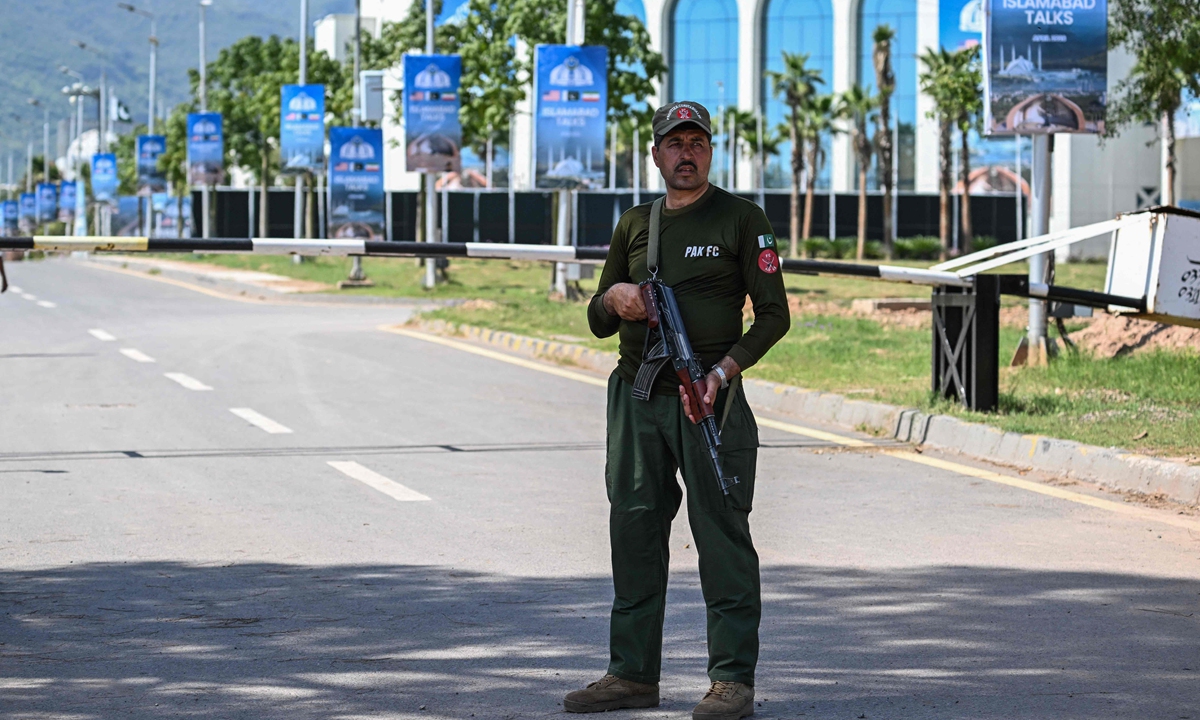
A security personnel stands guard near the Serena Hotel in Islamabad on April 19, 2026. A second round of US-Iran talks is reportedly to be held in Islamabad this coming week. Photo: VCG
Mixed messages
Al Jazeera reported Sunday, citing two Pakistani security sources, that negotiations between the US and Iran will likely be held before Friday, as "both the Serena and Marriott hotels in Islamabad are being cleared of guests with no new bookings allowed until Friday," and the Serena hotel was the venue for the first round of negotiations between the US and Iran on April 11.
President Trump also said US negotiators will be in Pakistan on Monday to hold a second round of talks with Iran, Xinhua reported.
Prior to the news, Iranian officials indicated on Saturday that no date had been set for the next round of negotiations with the US, adding that a framework of understanding must first be established, as reported by Reuters.
On a related front, tensions persisted though a 10-day ceasefire between Israel and Lebanon took effect at midnight between Thursday and Friday, announced by Trump. The Israeli military said it had struck militants approaching a designated "Yellow Line" in southern Lebanon, while Hezbollah leader Naim Qassem warned that any violations would be met with retaliation, according to Xinhua.
The fundamental issue between the US and Iran remains a deep lack of mutual trust, which leads to repeated swings and persistent uncertainty. It resembles a 'red light, green light' game - any slight movement can trigger an intense reaction, Ding Long, a professor at the Middle East Studies Institute of Shanghai International Studies University, told the Global Times on Sunday.
"Iran's decision to reopen the Strait of Hormuz was based on the ceasefire between Israel and Lebanon, but it later found the situation had not truly ended; once a day passed, it shut the passage again," Ding said.
The complexity of the situation and accumulated mistrust determined that there is no easy, quick way out of the muddle, analysts said.
The "mistrust" was reflected by Ghalibaf, who said Tehran has no trust in the US and that its armed forces remain on full combat readiness, as fighting may resume at any moment.
Iran's President Pezeshkian has also been quoted as saying that Trump has no justification to deprive Iran of its nuclear rights on Sunday, as Washington and Tehran continue to face disagreements over nuclear issues, per Reuters.
Li noted that while the current stalemate may persist for some time, it should not be mistaken for a genuine move toward ending the conflict. Both sides are likely to use this period to build leverage for future negotiations - strengthening military capabilities, sharpening information warfare strategies, and consolidating alliances in preparation for the next round of confrontation.
Ding, otherwise, said there is still some hope for progress in negotiations between the two countries, and a temporary de-escalation or ceasefire remains possible. However, a final agreement on core issues such as uranium enrichment will remain difficult.
RELATED ARTICLES