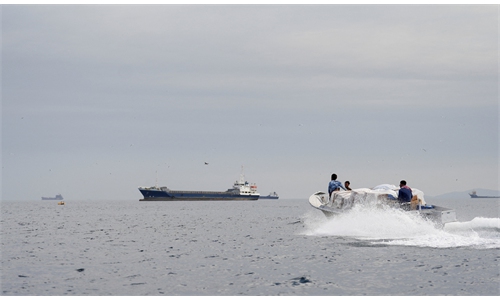
Strait of Hormuz faces volatility amid US President’s blockade order; Chinese FM notes root cause is military conflict, urges restraint
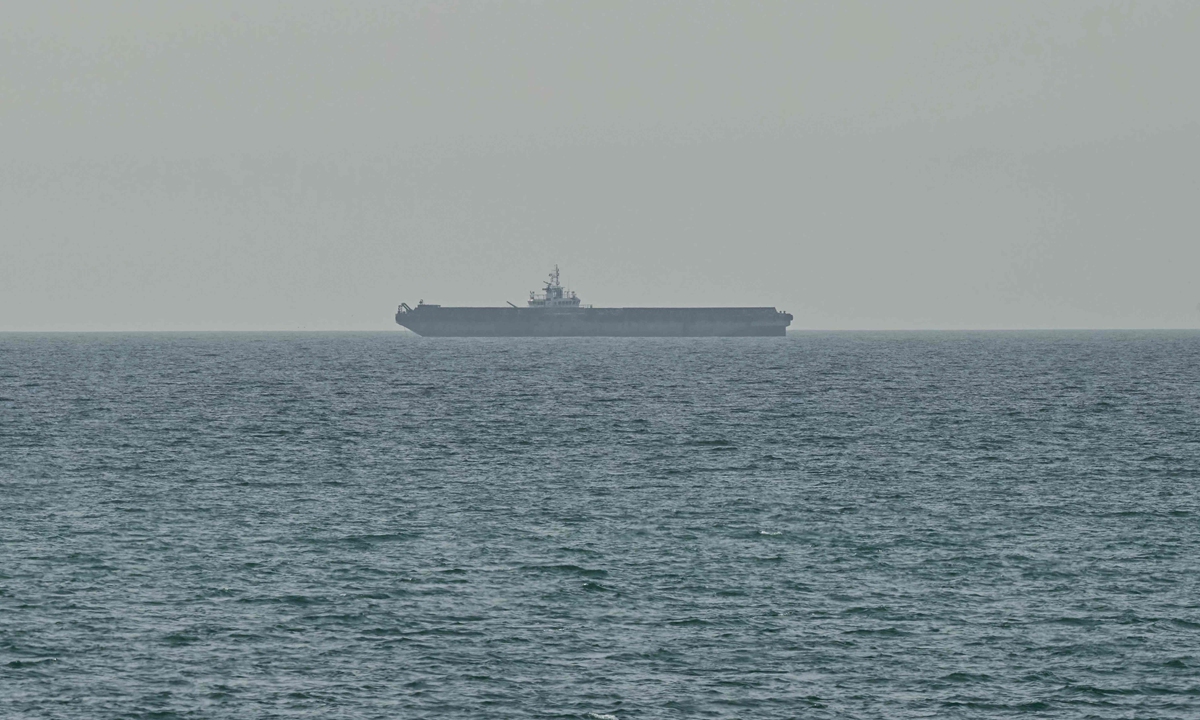
A ship is seen off the coast of Ras al-Khaimah, United Arab Emirates, the day after the failure of US-Iran peace talks on April 13, 2026. Photo: VCG
As the US blockade of Strait of Hormuz came into effect on Monday 10:00 A.M. ET., the US military said it will block all maritime traffic entering and exiting Iranian ports, according to Al Jazeera.The US president Donald Trump earlier on Monday announced on social media that the United States to Blockade Ships Entering or Exiting Iranian Ports on April 13 at 10:00 A.M. ET.
Situation surrounding the Strait of Hormuz once again faces volatility following US President Donald Trump ordered a naval blockade of the Strait of Hormuz on Sunday after peace negotiations between the US and Iran in Islamabad that lasted 21 hours collapsed on Sunday morning.
As tensions linger between the US and Iran over the strait, Netanyahu says ceasefire with Iran might end "within short time", Xinhua reported, citing Israeli media.
The root cause of the disruption at the Strait of Hormuz is the military conflict. To solve the issue, the conflict must stop as soon as possible. All parties need to remain calm and exercise restraint. China will continue playing a constructive role, Chinese Foreign Ministry spokesperson Guo Jiakun said on Monday when asked to comment on Trump's order of the blockade of the Strait of Hormuz and measures against countries having energy trade with Iran. In an interview he also called on China to buy oil from the US or Venezuela.
The Strait of Hormuz is an important international trade route for goods and energy. Keeping the area safe and stable and ensuring unimpeded passage serves the common interest of the international community, Guo added.
Guo also said that as to the purchase of oil, China stands ready to work with others to jointly safeguard global energy security and keep supply chains stable. However, to fundamentally resolve the issue, what needs to be done first and foremost is to restore peace and stability in the Gulf and Middle East region. Venezuela is a sovereign state and has full permanent sovereignty over all its natural resources and economic activities. It has the right to choose its own partners of cooperation. Other countries have no right to dictate to it.
The remarks came after Trump ordered a naval blockade of the Strait on Sunday, a move that CNBC described as "dimming hopes for a quick end to the conflict in the Middle East and escalating tensions with Iran that has already triggered the worst energy shock in history."
In a social media post, Trump said the US Navy "will begin the process of BLOCKADING any and all Ships trying to enter, or leave, the Strait of Hormuz", following the collapse of peace talks over the weekend. He also accused Iran of extortion, alleging that it had sought to charge tolls to tankers.
After Trump made the claim, a spokesperson for Iran's armed forces responded by saying that Iran would implement a "permanent mechanism" to control the Strait of Hormuz due to continued US threats, and warned that if the security of Iranian ports is threatened, "no port in the Persian Gulf and the Sea of Oman will remain safe," according to NBC news.
In the statement, Iran's unified armed forces command described the US blockade of Iranian ports as "illegal" and "constitute piracy", while warning that the security of ports in the Persian Gulf and the Sea of Oman is either for everyone or for no one, NBC news reported.
Secretary-General of the International Maritime Organization Arsenio Dominguez said on Monday that countries have no right to blockade international straits used for international transit. "From a legal perspective, in accordance with international law, there is no right to prohibit the right of innocent passage, nor to impede the freedom of navigation through international straits used for international transit," he said, according to Xinhua News Agency.
It is not surprising that Trump made latest order, as a blockade of the Strait of Hormuz could shift the consequences of a US-instigated conflict with Iran onto the rest of the world, Li Haidong, a professor at China Foreign Affairs University, told the Global Times.
Li added that any attempt to block areas surrounding the Strait would inevitably affect Iran's oil export and many oil-importing countries, including those in Europe and Southeast Asia, amplifying the global economic fallout.
At the same time, there are groundless smearing and malicious association attempting to hype China's role in the Iran war. In response to a question about reports claiming that "China is preparing to provide weapons to Iran" and that "China has supplied Iran with dual-use technologies and related components," Foreign Ministry spokesperson Guo said on Monday that China has always adopted a prudent and responsible approach to arms exports, implementing strict controls in accordance with its domestic export control laws and regulations as well as its international obligations. China opposes groundless smears and malicious associations, Guo said.
On Sunday, Trump also reportedly threatened 50 percent tariffs if China is found to be supplying Iran weapons. Guo, in response, said that China's position is very clear: tariff wars have no winners.
Some of US' allies continue to express distance from the conflict initiated by the US. British Prime Minister Keir Starmer said in an interview on Monday that the UK would not be dragged into the Iran war nor be involved in a blockade of the Strait of Hormuz. "We're not supporting the blockade," he said, adding that it was vital to get the Strait reopened, per Reuters.
Australian Prime Minister Anthony Albanese also called for the full reopening of the strait and the restoration of free navigation, while noting that the lack of progress in recent negotiations was "disappointing", according to the Guardian.
European responses reflect growing concern that the consequences of Washington's actions could be borne by the wider international community, Li said.
RELATED ARTICLES