ARTS / BOOKS
Reviving 1933 Great Wall defense through literature
By Published: Apr 19, 2026 10:08 PM

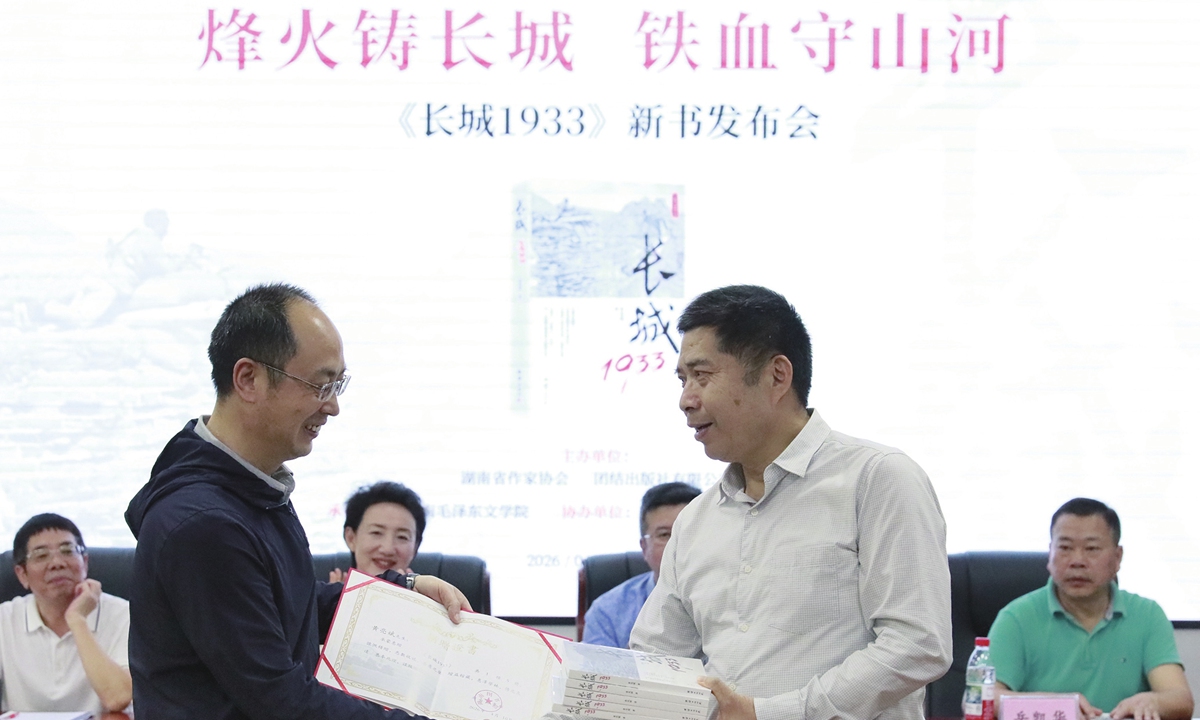
Chinese author Huang Liangbin (right) holds a launch event for his new book The Great Wall 1933 in Changsha, Central China's Hunan Province, on April 10, 2026. Photos on this page: Courtesy of Unity Press
Standing atop of the Gubeikou Great Wall in Beijing's Miyun district, where the wind howls through broken battlements and the earth still bears the faint scars of artillery fire, Chinese author Huang Liangbin closes his eyes and envisions the chaos of 1933.Ninety years after Chinese troops fought desperately to defend this ancient barrier against Japanese invaders during the War of Resistance against Japanese Aggression (1931-45), the Hunan-based writer has breathed new life into the pivotal Great Wall defense with his latest book, The Great Wall 1933, recently published to broad acclaim.
More than a historical recount, the work paints a portrait of soldiers from various armies and ordinary civilians uniting to repel foreign aggression, using the Great Wall as a spiritual symbol to explore the bond between a nation and its people, and weaving together historical depth, literary grace and profound insight into a compelling narrative.
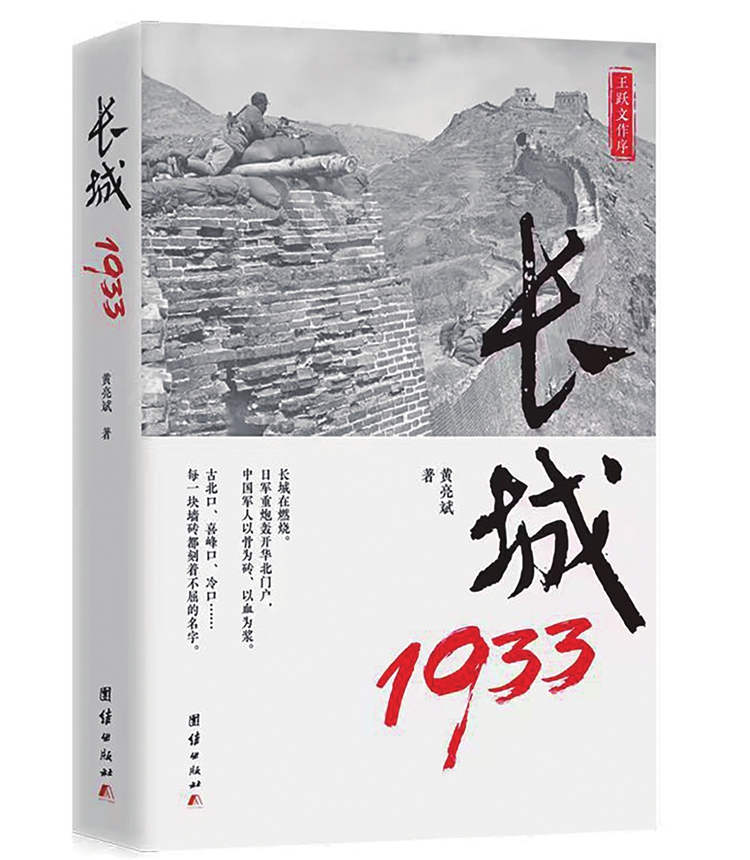
The book of The Great Wall 1933
Family ties
For Huang, the impetus to write The Great Wall 1933 was deeply rooted in his family's connection to the war, a legacy that has shaped his understanding of history since childhood.
Growing up in Central China's Hunan Province, he frequently heard stories of his late paternal uncle Huang Jie, a commander in the 17th Army who fought valiantly in the Great Wall defense, which is seen as an important part of the early War against Japanese Aggression.
"When I was in primary school, leaders from the united front work departments, some of whom were my paternal uncle's subordinates or colleagues, would often visit and recite poems he wrote on the battlefield,'" Huang recalled in an exclusive interview with the Global Times.
These verses, composed by Huang Jie during lulls in the fighting, left an indelible impression on the young Huang, planting the seed for his later literary endeavor.
His family's historical footprint extends beyond the Great Wall defense. Huang's genealogy records ancestors who followed Zuo Zongtang, better known as General Tso, on his western expedition to recover Xinjiang in the late Qing Dynasty (1644-1911).
"It is a great honor for our family to have witnessed such a magnificent feat in China's modern history," he said.
This lineage of patriotism, spanning generations, gave Huang a unique perspective as he set out to write, one that balances intimate family memories with the grand sweep of history.
In crafting the book, Huang emphasized impartiality, refusing to focus solely on his parental uncle's contributions.
"A family is part of a nation; without a nation, there can be no family," he quotes his great-uncle as writing in an inscription for the 17th Army.
"While I am proud of my great-uncle's bravery, I knew I must remain objective as a writer. He was just one commander among many, and the war was fought by soldiers from the Central Army, Northeast Army, Northwest Army, and Shanxi-Suiyuan Field Army, as well as countless civilians who offered their support."
To ensure authenticity, Huang pored over first-hand historical materials, including the diaries and biographies of generals Xu Tingyao, Huang Jie, Guan Linzheng and Zheng Dongguo, and made a pilgrimage to Gubeikou, where the desolation of the former battlefield and the once-thriving military towns submerged by the Miyun Reservoir deepened his resolve to preserve this forgotten history.
Timeless spirit
Though the 1933 Great Wall defense ultimately ended in a strategic retreat, Huang argues that its spiritual victory far outweighs its military setbacks.
As renowned writer Wang Yuewen commented on the book's story, the war embodied the Chinese nation's patriotism, unity, courage and perseverance in the face of aggression, serving as a milestone in national awakening and a textbook for patriotism.
"The war halted the Japanese advance and laid the groundwork for China's prolonged resistance against aggression," Huang said.
"Through dialogues between generals in the book, I explore the gains and losses of the campaign, highlighting the indomitable spirit of the Chinese military and the people," he added.
At the heart of the book is Huang's reflection on the true meaning of the Great Wall, a symbol that has long represented the bond between a nation and its people.
"A strong nation is defined by the unity of its people when the powerful respect the weak, workers are dignified, and all citizens stand together as one, a spiritual Great Wall is forged that no enemy can break."
This spirit, Huang said, remains as relevant today as it was in 1933.
"Peace is not to be taken for granted. The world is still turbulent, and Japanese militarism has not been fully eradicated," he warned, going on to express his hope that the book will awaken vigilance among contemporary readers, especially the younger generation, and remind them that today's peace was built on the blood and courage of those who fought in 1933.
As Huang noted, the national spirit of resistance depicted in The Great Wall 1933 is encapsulated in China's national anthem, March of the Volunteers, written by Tian Han, a fellow Hunan resident and contemporary of the war, against the backdrop of the Great Wall defense.
"The line 'Arise! ye who refuse to be bond slaves! With our very flesh and blood, let us build our new Great Wall' is a testament to the Chinese nation's resolve in the face of oppression," Huang said.
Through his book, Huang seeks to ensure that this resolve, and the sacrifices that sustained it, are never ever forgotten.
RELATED ARTICLES