ARTS / CULTURE & LEISURE
Exhibit features martyrs’ spirit through archaeological tech
To ensure sacrifice ‘remembered by more people’
By in Shanghai Published: Oct 20, 2025 10:46 PM

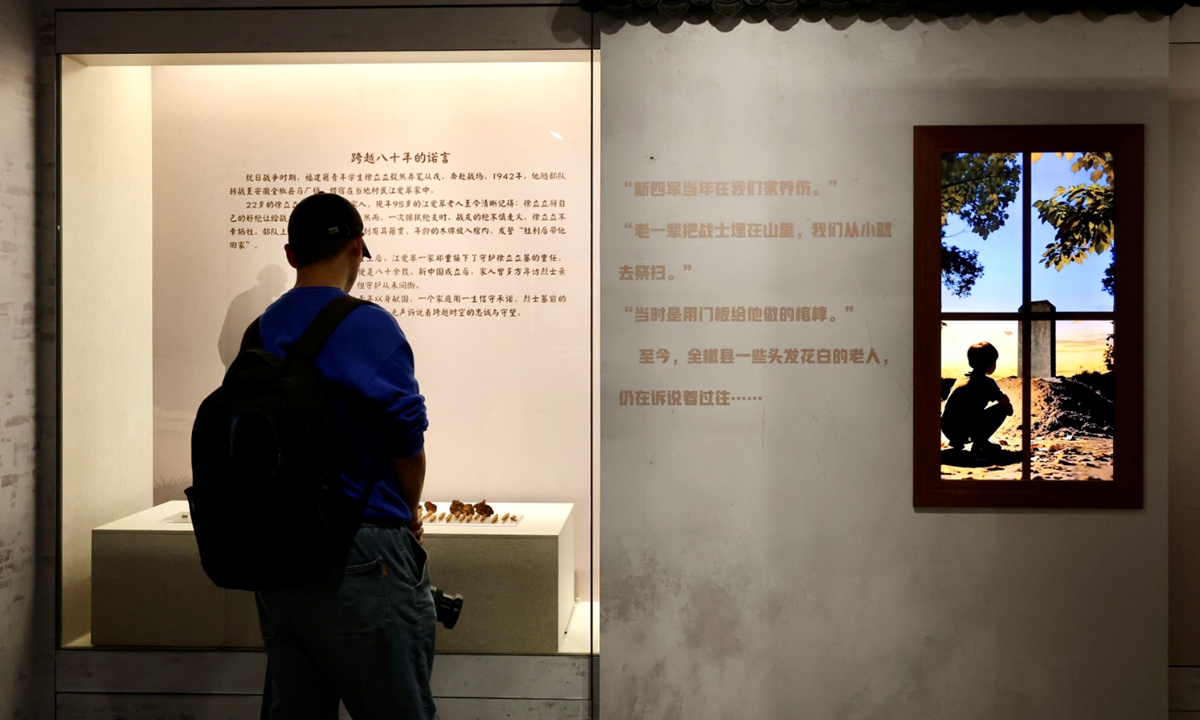
A visitor explores an exhibition commemorating the 80th anniversary of the victory in the Chinese People's War of Resistance against Japanese Aggression and the World Anti-Fascist War in Shanghai on October 20, 2025. Photo: Chen Xia/GT
On a wall of the exhibition hall, dozens of Chinese soldiers' portraits glow softly under the lights. In each image they wear old-style military uniforms, and their eyes are resolute and bright as if engaging visitors in a silent exchange about courage and loyalty.This is the first scene that those who enter the exhibition hall of a newly opened exhibition in Shanghai see. The portraits on the wall are not real photographs; instead, they have been reconstructed by archaeologists using modern technological methods from the remains of these previously unknown martyrs.
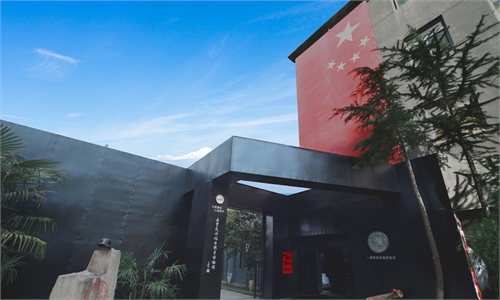
The exhibition, which commemorates the 80th anniversary of the victory in the Chinese People's War of Resistance against Japanese Aggression and the World Anti-Fascist War, opened on Monday at the Shanghai-based Memorial of the First National Congress of the Communist Party of China (CPC). It is being held to recreate the life trajectories of the heroic martyrs, and to interpret the profound essence and contemporary value of the great spirit forged during the war, the memorial's director Xue Feng said at the exhibition's opening ceremony on Monday.
A highlight of the exhibition is the display of technology-driven archaeological work, an effort dedicated to "making the once unknown martyrs become known," said Wen Shaoqing, a researcher at Fudan University's Laboratory of Molecular Archaeology, which contributed to the exhibition.
Many of the martyrs were very young when they fell fighting Japanese invaders - some not even at the age of 20, and most left no direct descendants, Wen said, adding that the martyrs sacrificed their lives for the country and its people during turbulent wartime years, yet their individual stories are not well known.
"What we are doing is trying to ensure that their sacrifice and patriotic devotion are remembered by more people," he told the Global Times on Monday.
Wen and his laboratory have been carrying out archaeological work related to Chinese revolutionary martyrs for years. He said that by using modern technical methods, such as DNA comparison, strontium isotope analysis, pathological examination and AI-based reconstruction, researchers can gather and present as much information as possible from a martyr's remains, such as appearance, family and relatives, dietary habits and the immediate cause of death.
At the exhibition hall, Wen pointed out a distinctive display: a 3D-printed model of the skeletal remains of a martyr labeled M10, whose remains were found in Nancun village, a former battlefield against Japanese invaders in North China's Shanxi Province. The model shows bullet holes in the sacrum, ribs, hip bones and shoulder blades. The femur bears signs of infection, along with a wound with smooth-edged traces consistent with an amputation.
"These marks indicate that all the bullets struck him from the front, and we can even reconstruct a posture suggesting he charged toward the enemy," Wen said. "It can be inferred that after he was wounded, he suffered severe infection, and without effective medical care available he had to undergo amputation."
The marks on the remains offer a stark, visceral picture of war's brutality, and vividly convey the martyr's courage - fighting to the death against Japanese invaders and protecting local civilians until his final moments, he added.
The exhibition features 362 items collected from historical sites from the War against Japanese Aggression, related memorial halls and research laboratories. It focuses on three battlefronts under the leadership of the CPC, including Nancun village, aiming to showcase the perseverance and sacrifice of ordinary soldiers during the war through individual perspectives, according to the curator Qu Yutong.
"We hope that by sharing the personal stories of these ordinary yet heroic soldiers, the exhibition can evoke emotional resonance among visitors, and reflect the pivotal role of the CPC as the mainstay in China's War against Japanese Aggression," Qu told the Global Times on Monday.
The exhibition is open to public for free. It is scheduled to run until December 21.
RELATED ARTICLES