Air China to resume direct flights from Beijing to Delhi as flight frequencies between two economies rise
By Published: Apr 20, 2026 01:10 PM

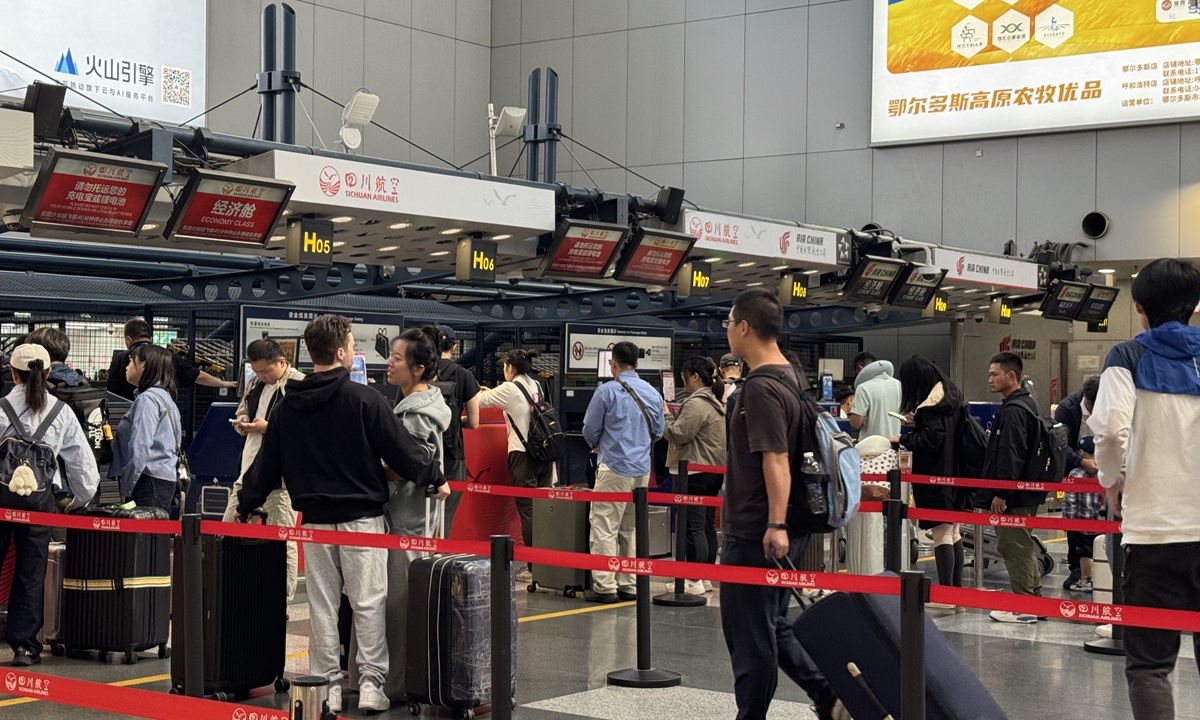
Passengers queue to check in at Beijing Capital International Airport on September 28, 2025. Photo: Tu Lei/ GT
Effective from Tuesday, Air China will resume its direct route between Beijing and Delhi, which marks the second route to India resumed by Chinese airlines this month.
According to information seen on the Air China app, the service will run three times a week on Tuesdays, Fridays, and Sundays, using an Airbus A330 aircraft. Economy class fares will start from 3,570 yuan ($523), with the flight departing at 3:15 pm and arriving in Delhi at 8:20 pm local time.
On April 18, China Eastern Airlines resumed its direct flight between Kunming, Southwest China's Yunnan Province and Kolkata, India.
This was the carrier's latest expansion of its China-India route network following the resumption of the Shanghai-Delhi route in November 2025.
China Eastern Airlines said that the route, with six weekly round-trip flights using Boeing 737 aircraft, will add more convenience to the China-India collaboration.
The more frequent flights by Chinese airlines come amid a similar push by Indian airlines. Indian airline IndiGo announced in March the launch of daily direct flights between Kolkata and Shanghai, which started on March 29.
Previously, IndiGo resumed the Kolkata-Guangzhou route and launched the Delhi-Guangzhou route. With the introduction of the Kolkata-Shanghai route, IndiGo said that it will continue to enrich travel options between China and India, effectively meeting the growing demand for economic, trade, and tourism exchanges between the world's two most populous nations.
According to the latest operational data for April, IndiGo has maintained an overall passenger load factor between 68 percent and 85 percent on multiple China-India routes. Popular routes such as Delhi-Guangzhou and Kolkata-Guangzhou have shown particularly outstanding performances, reflecting a stable and positive operational trend, according to information the company shared with the Global Times on Monday.
More airlines from both sides are increasing their services, which have positive significance for further consolidating the momentum of bilateral ties. It also reflects India's further pragmatic adjustments, including in its China policy, Qian Feng, director of the Research Department at Tsinghua University's National Strategy Institute, told the Global Times.
Qian added that this trend not only facilitates personnel exchanges between the two countries, but also represents more practical measures to reduce supply chain costs and support travel for technology companies and the manufacturing sector.
The frequent exchanges have come amid warming relations between China and India.
Last month, India approved relaxing restrictions on Chinese investments in selected sectors to help ease a capital squeeze and mark a reset of economic ties after six years of friction, Reuters reported on March 10.
Prime Minister Narendra Modi's cabinet approved changes to foreign direct investment rules that restricted investments from China and other land‑bordering countries, to allow investments in electronics, capital goods and solar cells, according to a statement.
On March 27, China's Minister of Commerce Wang Wentao met with Piyush Goyal, Minister of Commerce and Industry of India, according to a statement on the Ministry of Commerce's website.
Wang stated that the ministry stands ready to work with India's Ministry of Commerce and Industry, under the strategic guidance of the leaders of the two countries, to fully leverage the role of bilateral economic and trade cooperation as a ballast.
RELATED ARTICLES