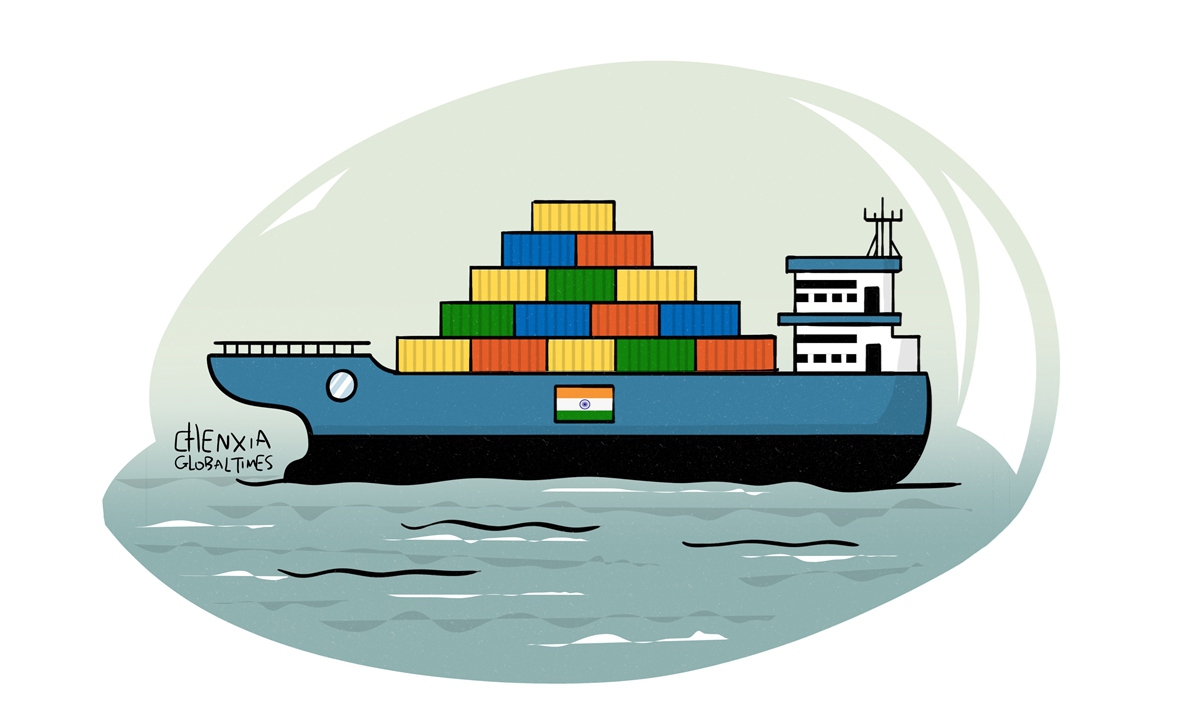
Illustration: Chen Xia/GT
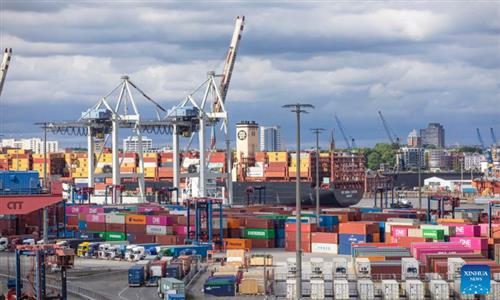
News that India's estimated trade deficit with China from April 2025 to February 2026 topped the $100 billion mark - with still a month left for the fiscal year - has reignited discussion in Indian media outlets about a "trade imbalance."India's commerce department has estimated that exports to China increased nearly 38 percent year-on-year to $17.5 billion during the period from April 2025 to February 2026, while imports rose more than 15 percent to reach almost $120 billion, leading to a trade deficit of $102 billion, The Times of India reported on Tuesday.
While these numbers naturally draw attention from Indian media amid claims of a "trade imbalance," an excessive focus on the deficit obscures the real opportunities embedded in them. Look closer: the nearly 38 percent growth in India's exports to China, more than doubling the growth rate of imports from China, is the true game-changer. This figure holds the key to understanding the real potential of India-China economic ties.
Despite the relatively small base of India's exports to China, the nearly 38 percent growth rate itself sends a significant signal. It demonstrates that the vast Chinese market is providing tangible growth momentum for Indian exports. More importantly, this fast-growth trend has not only persisted but also accelerated. The Hindustan Times reported in October that India's exports to China rose by about 22 percent year-on-year from April to September 2025. The jump in the growth rate from 22 percent to 38 percent within just a few months shows that Chinese opportunities are being rapidly unlocked for India, vivid proof of the vitality of bilateral trade cooperation.
Moreover, the support that India-China trade provides to the Indian economy should not be overlooked. Cost-effective goods from China not only enrich India's domestic consumer market but also play an irreplaceable role in reducing production costs and improving efficiency for Indian businesses. Undoubtedly, they provide a solid support for the development of Indian manufacturing.
Meanwhile, the steady increase in intermediate goods trade between the two countries indicates that the linkage within the industrial chains is strengthening, a trend conducive to enhancing the competitiveness of India's local industries.
At a time of rising global trade protectionism, how to identify and sustain high-growth areas - such as India's expanding exports to China - holds strategic significance for India, as it seeks to mitigate external risks and reduce trade uncertainty. The right path forward lies in in-depth industrial chain cooperation.
In a speech delivered in December 2025, Chinese Ambassador to India Xu Feihong noted that in the subsequent five years, China would continue to consolidate the foundation of the real economy, upgrade traditional industries such as chemicals and machinery, foster emerging industries such as new energy and new materials, and unlock a potential market of $1.4 trillion. This will make the pie of common interests bigger and deliver more benefits to the peoples of the two countries.
Xu also welcomed more premium Indian goods to enter China and more Indian companies to invest and do business in the country, sharing the dividends of China's opening-up. He expressed hope that the Indian side would provide a fair, transparent and non-discriminatory business environment for Chinese companies, further expanding mutually beneficial cooperation.
Notably, there have been some positive signals emerging from New Delhi. For example, India's Department for Promotion of Industry and International Trade on Monday eased foreign direct investment rules to allow overseas companies with Chinese shareholding of up to 10 percent to invest in India through the automatic route, though they are subject to sectoral limits and conditions, the Press Trust of India reported. The move reportedly followed years of complaints from domestic industry about restrictions on Chinese investments that had stalled new projects and plans.
At its core, sustained export growth hinges on industrial competitiveness. If India can attract more Chinese investment and foster technology partnerships, it will be well-positioned to manufacture higher-value-added products domestically. These goods could not only better satisfy domestic demand but also find their way back to China and to markets beyond. In the long run, the development of the industrial chain will further boost India's exports and help optimize India's export structure to China and further strengthen mutually beneficial trade.
China and India possess tremendous potential and broad prospects for economic cooperation. Their complementarity far outweighs their competitiveness. Only by continuously expanding the cake of shared interests can the potential for cooperation be transformed into momentum for development, allowing the fruits of win-win outcomes to better benefit the peoples of both countries. Conversely, biased views fixated on the current trade deficit will impede growth in mutually beneficial bilateral trade.
RELATED ARTICLES