HK IPO momentum accelerates into 2026, underpinned by hard tech, new economy: report
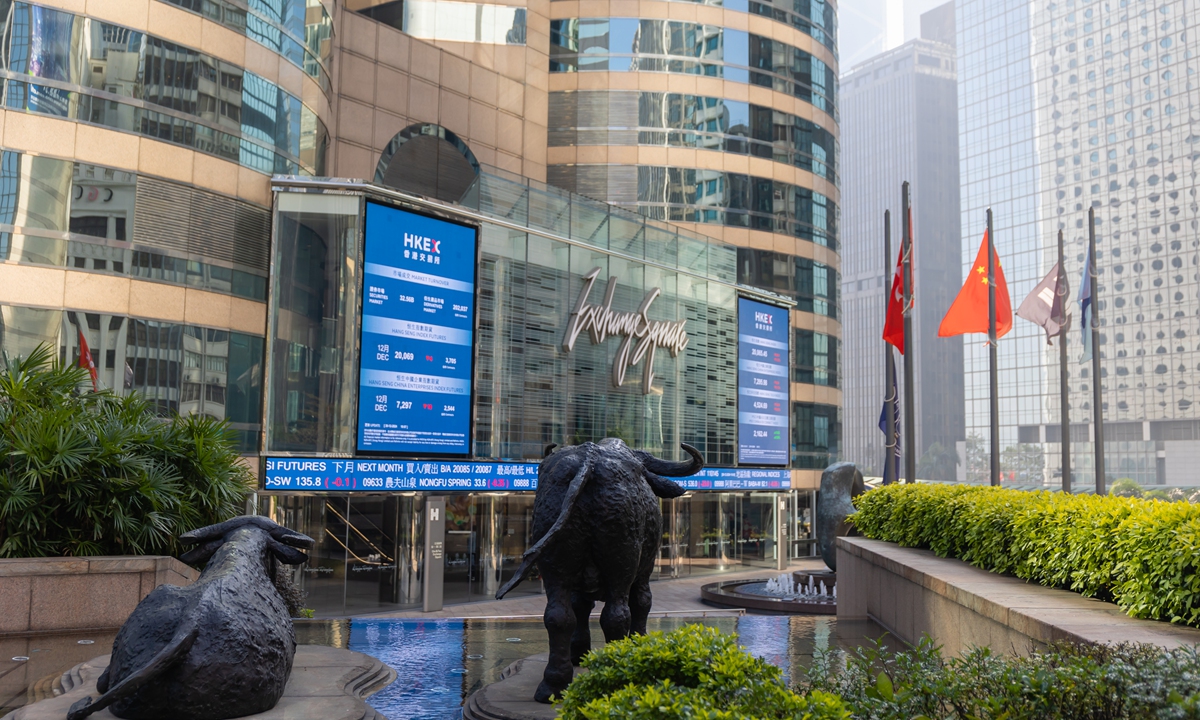
View of Hong Kong Exchanges and Clearing Ltd Photo: VCG
Manycore Tech, the first company of "Hangzhou Six Little Dragons" to list on Hong Kong, saw its stock surge 101.29 percent at close on Monday, with its marketing value reaching HK$63.652 billion ($8.13 billion).
On April 17, Manycore officially listed on the Hong Kong Exchanges and Clearing (HKEX). On its debut, the stock opened more than 170 percent higher. The performance of the tech company mirrors the vigorous development of the Hong Kong capital market since this year.
According to a statement sent to the Global Times on Monday, Goldman Sachs said that Hong Kong IPO momentum has accelerated into 2026, with 40 listings year to date, raising $14 billion, up 488 percent year-on-year, after reclaiming the top equity fund raising spot in 2025.
The resurgence is underpinned by a shift towards "Hard Tech" and "New Economy" (Biotech, New Consumption), alongside a significant rise in A-to-H listings. Investor appetite remains robust, reflected by strong demand for new offerings and resilient post-IPO performance, up 40 percent one month post listing. A long queue of around 400 active applications underscores high issuer confidence, said the statement.
"For the full year 2026, we project a total equity supply of $110 billion, comprising $60billion in new IPOs and $50 billion in post-IPO financing," Goldman Sachs noted.
Bonnie Y Chan, CEO of the HKEX, said on April 15 that Hong Kong's new share fundraising activities this year have already reached approximately 40 percent of last year's full-year total, according to Yahoo Finance.
The number of companies queuing for listing is at a record high, with more than 10 multinational corporations currently preparing to list in Hong Kong. Against the backdrop of international capital reassessing regional allocations and rising attention on Asian markets, the vibrancy of Hong Kong's IPO market continues to draw significant interest, Chan was quoted as saying in the report.
A report headlined "Hong Kong reasserts role as safe haven in global finance amid Middle East turmoil" published by the South China Morning Post on Monday also echoed the trend.
The report said that, with the conflict destabilizing the Middle East - at one point forcing the closure of the Dubai International Airport and sending stocks in the Gulf region plunging - Hong Kong has re-emerged due to its geographical location, a pegged exchange rate, free capital flows and support from China's economic strength.
"The Hong Kong market has been steadily trending upward thanks to its stability supported by the Chinese mainland, especially amid the increasing external uncertainties, while lobal capital accelerates its allocation into high-quality assets amid the weak dollar cycle," Wang Peng, an associate researcher at the Beijing Academy of Social Sciences, told the Global Times on Monday.
Wang noted the positive role that technology companies listing in Hong Kong can play in promoting its development, particularly the choice by Chinese mainland tech firms to pursue dual-listing between the two places.
"By listing premium assets concurrently in the two markets, companies can alleviate the pressure of market expansion in a single venue and stimulate greater vibrancy across the entire technology sector," Wang said.
Hong Kong has long been regarded as the gateway and platform for mainland enterprises to access international markets, Paul Chan, financial secretary of the Hong Kong Special Administrative Region (HKSAR) government, said during the Global Investment Summit, local media RTHK reported on April 15.
The outline of the 15th Five-Year Plan (2026-30) proposes supporting Hong Kong and Macao to better integrate into and serve the overall development of the country, and leverage their professional service advantages to assist enterprises in "going global."
The HKSAR government has established a dedicated task force, which assists mainland enterprises in expanding into overseas markets by providing support in areas such as risk management, while also creating new opportunities for Hong Kong, said Paul Chan.
With mainland industries shifting toward digitalization and greening, Hong Kong serves as the "first springboard" for these new quality productive forces to go global, Wang said, noting that as a super connector, the city is welcoming a historic opportunity for "new economy spillover" this year.
RELATED ARTICLES