Chinese nuclear industry giant partners with IAEA to boost cancer care in LMICs with nuclear tech
Spreading rays of hope
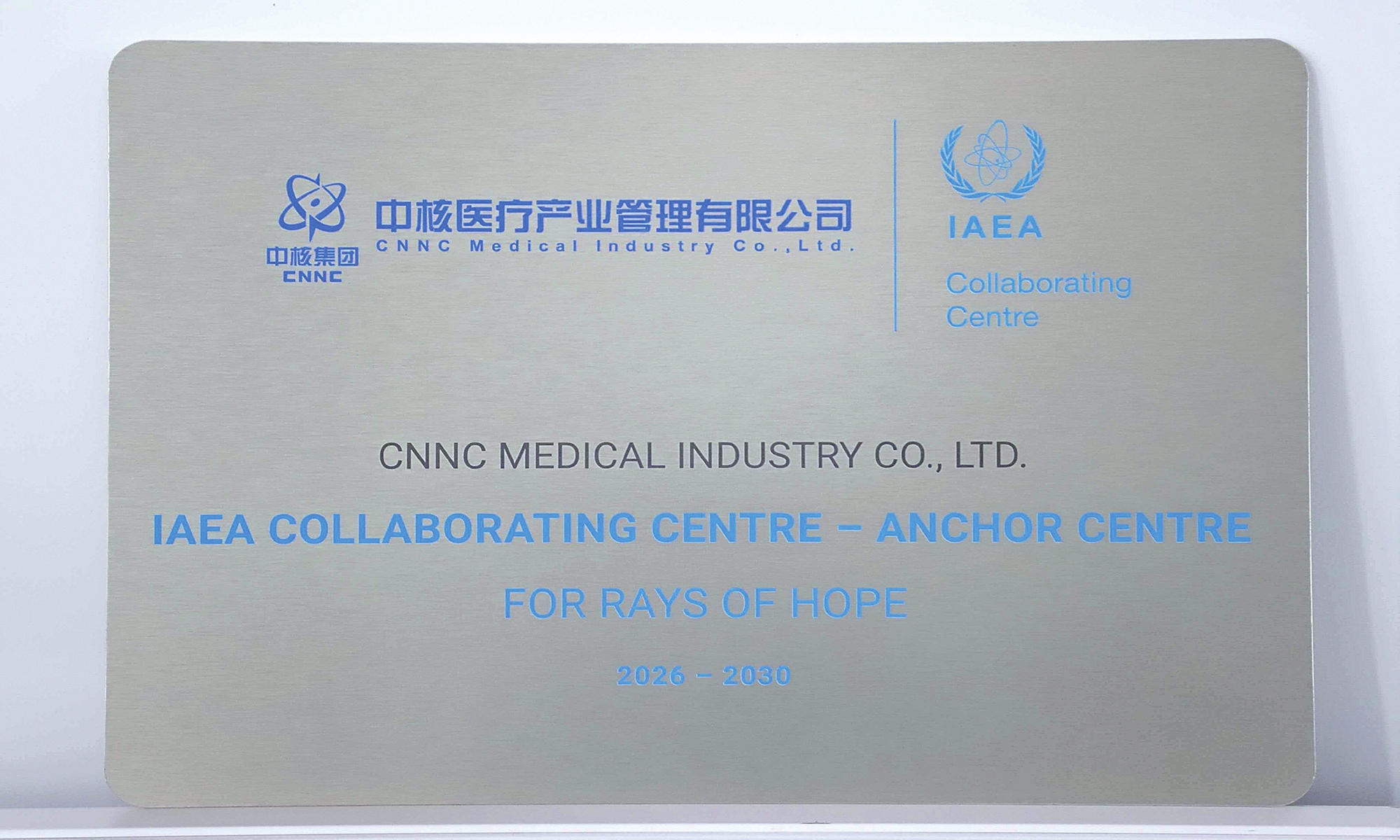
View of the plaque of IAEA Collaborating Centre - Anchor Centre for Rays of Hope awarded to CNNC Medical Industry Co., LTD Photo: CNNC
Stepping off the elevator on the seventh floor of China National Nuclear Corp. (CNNC) Medical Industry Co., LTD in Beijing, visitors are immediately greeted by a striking plaque that gleams under the soft lighting: "IAEA Collaboration Centre - Anchor Centre for Rays of Hope.""This plaque is deeply cherished," said Zhu Qiang, vice president of CNNC Medical Co., Ltd. (CNNC Medical) when talking about the story behind the awarding and the designation.
Less than a month ago, the International Atomic Energy Agency (IAEA) designated CNNC Medical as its Rays of Hope Anchor Centre, Zhu told the Global Times on Friday. This distinction places the Chinese enterprise among a group of only 20 institutions worldwide - regional hubs of excellence in radiology, nuclear medicine and radiotherapy - to help strengthen cancer care in low- and middle-income countries (LMICs) in various aspects, including training healthcare professionals, participating in IAEA Coordinated Research Projects, and providing mentorship to medical institutions in LMICs.
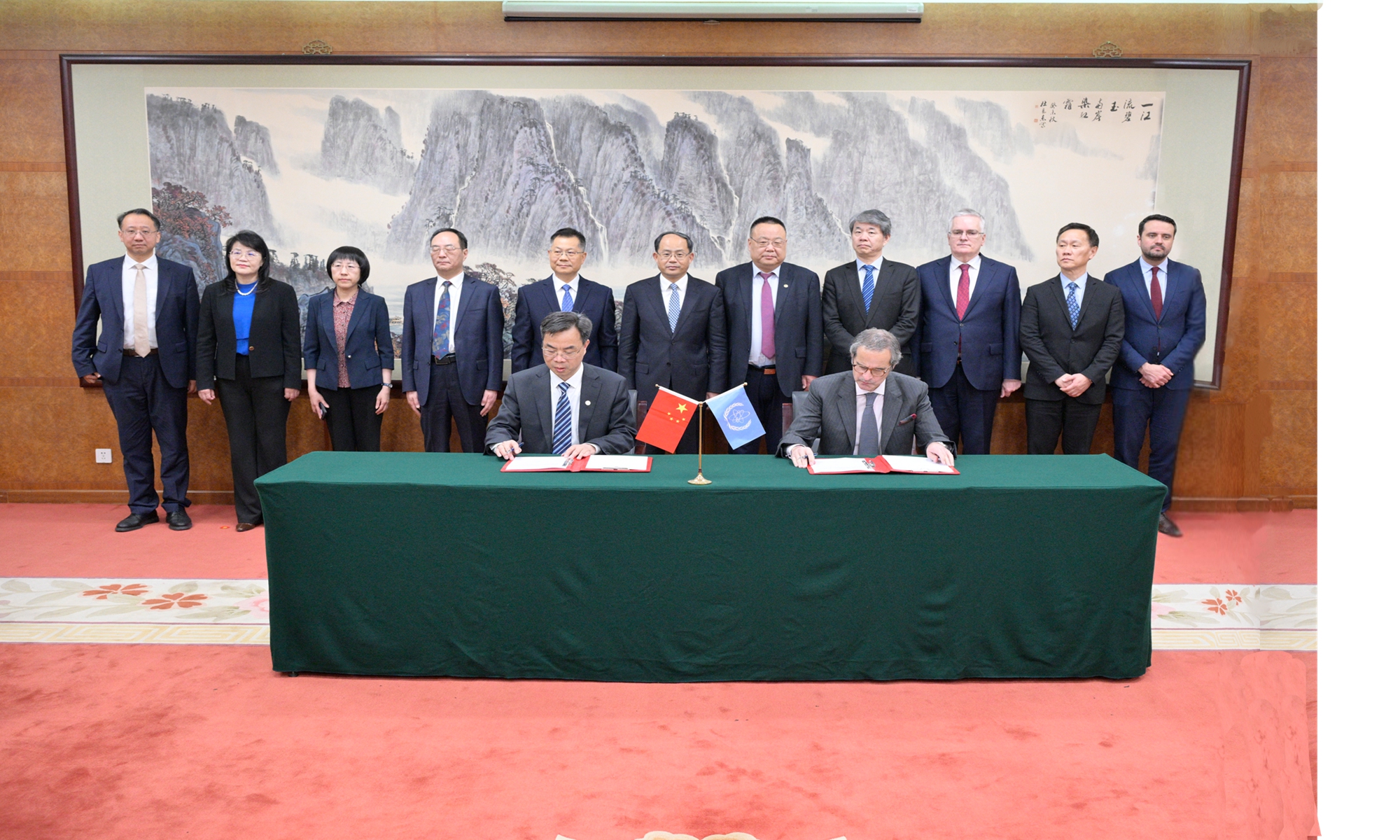
View of the plaque of IAEA Collaborating Centre - Anchor Centre for Rays of Hope awarded to CNNC Medical Industry Co., LTD Photo: CNNC
"This recognition marks not only a significant milestone in CNNC Medical's internationalization drive, but also a vivid testament to China's commitment to building a global community of health for all humankind through nuclear technology," he said.
This commitment has translated into tangible action since 2023. Under the cooperation framework between CNNC and IAEA, CNNC Medical has consecutively hosted international and regional training courses on radiotherapy and nuclear medicine for four consecutive years. To date, the company has provided professional training to over 70 medical professionals and researchers from 35 countries in the fields of nuclear medicine and healthcare.
"These pragmatic actions have earned high commendation from the IAEA and member states, and the trainees, serving as a model of implementing the 'Rays of Hope' initiative," Zhu said.
CNNC Medical now operates seven hospitals, featuring prominent departments such as nuclear medicine and radiotherapy. With these strengths, the company is equipped to assist LMICs by providing integrated solutions including medical equipment, technical guidance, clinical support, tele-diagnosis services and capacity building.
"As the leading enterprise of China's nuclear technology application industry chain, CNNC will fully leverage the Anchor Centre to deepen communications and cooperation with the IAEA and its more than 180 member states in the field of nuclear healthcare. Efforts will be made to drive China's nuclear medical industrial chain to go global and deliver sustained benefits to patients worldwide, empower global health using nuclear technology, and make new contributions to high-level opening up," Zhu said.
Rapid advancement
CNNC Medical Industry Co.'s recognition by the IAEA is underpinned by the rapid advancement of CNNC's nuclear technology applications. In this regard, the Research Institute of Physical and Chemical Engineering of Nuclear Industry (IPCE), another subsidiary of the centrally administered state-owned enterprise, is a representative.
The institute now possesses core technologies for stable isotope research and development (R&D) and production. It is the only supplier in China with integrated R&D and supply capabilities covering dozens of stable isotopes, including xenon, krypton, zinc, selenium, molybdenum, tellurium, tungsten, silicon, germanium, nickel and ytterbium.
"Currently, China's innovation in nuclear technology applications is flourishing across multiple fronts under the guidance of China Atomic Energy Authority (CAEA). The nation's developmental trajectory and strategic focus in this sector are largely aligned with global trends, with nuclear medicine and industrial manufacturing standing out as two prime examples," Cai Wei, Head of Stable Isotope Industry, IPCE, told the Global Times on Friday.
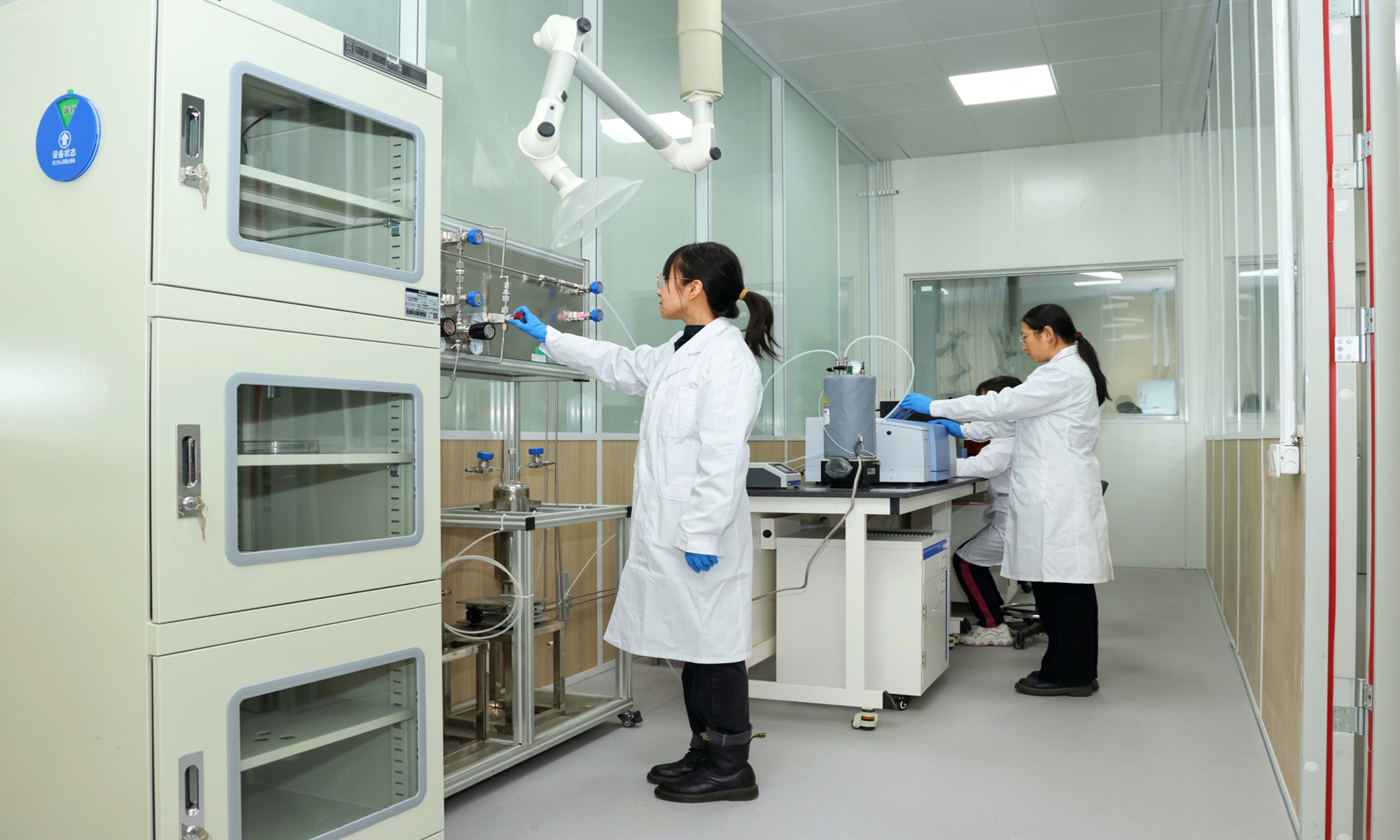
Researchers at the stable isotope R&D technology laboratory of the Research Institute of Physical and Chemical Engineering of Nuclear Industry (IPCE) in December 2023 Photo: IPCE
For example, CNNC successfully produced gram-scale quantities of nickel-64 isotopes with an abundance exceeding 99 percent for the first time in 2024 - a technology currently mastered by only a handful of countries. Through accelerator irradiation, the isotope can be converted into copper-64, a radioisotope that has demonstrated significant efficacy in providing early warnings and definitive diagnoses of cancer, Cai explained.In addition, the company is now pushing ahead with the application of stable isotopes such as boron, silicon, and germanium in semiconductor manufacturing to enhance chip immunity to interference, yield rate, and operational performance, Cai said.
Represented by the applications in healthcare and high-end manufacturing, China's nuclear technology application industry has achieved a series of landmark successes in recent years. Comprehensive breakthroughs have been realized in the independent R&D and industrialization of accelerators. High-intensity heavy-ion accelerator facility has been successfully commissioned with full beam trajectory penetration achieved. Furthermore, China has successfully developed its first commercial tandem accelerator and exported its first medical cyclotron.
"A series of achievements inject powerful new momentum into the high-quality development of the nuclear technology application industry," Guo Lili, secretary-general of the China Isotope and Radiation Association (CIRA), told the Global Times on Friday.
Along with nuclear technological breakthroughs, China's market scale of nuclear technology applications continues to rise. According to data from the CIRA, the total output value of the nuclear technology application industry reached 240 billion yuan ($35.2 billion) in 2022, maintained an annual compound growth rate of over 10 percent.
Moreover, the country aims to see the annual direct economic output value of the industry hit 400 billion yuan by 2026, according to an action plan released by the CAEA, the National Development and Reform Commission and other departments in 2024.
Int'l cooperation needed
Amid rapid technological and industrial shifts, the CIRA will host the 3rd International Nuclear Technology Application Conference (INTAC), which is going to be held in Beijing from April 21-23, attracting wide international participation including international organization such as the IAEA and the International Irradiation Association, as well as industry guests from countries including Russia, France, Belgium and the USA.
The conference provides an international forum to discuss the expansion of nuclear technologies and applications that support high-quality, sustainable economic and social development. The Global Times learned that the CIRA is going to announce Initiative to Jointly Build an Open, Inclusive, Universally Beneficial and Win-Win International Industrial Ecosystem for Nuclear Technology Applications at the conference.
"Given the complex and volatile international landscape, the global nuclear technology application industry faces severe challenges. Instability in industrial chains and supply chains, coupled with restrictions on key products, has created significant bottlenecks. Furthermore, the capital-intensive nature of projects, long investment cycles, and limited financing channels have constrained the implementation of international cooperation," Guo said.
Against this backdrop, China has established a comprehensive, full-industry-chain layout. With its expanding industrial scale and growing technical capabilities, China provides solid support for deepening international collaboration, she added.
As a vital component of new quality productive forces, the development of the nuclear technology application industry aligns seamlessly with the directives of the Fourth Plenary Session of the 20th Central Committee of the Communist Party of China regarding the building of a modern industrial system and the proposals for formulating the 15th Five-Year Plan (2026-2030) in promoting the growth of strategic emerging industries, the CNNC said at the 2nd International Nuclear Technology Application Industry Development Conference held in Nanning, South China's Guangxi Zhuang Autonomous Region in 2025.
"As the 'national team' and main force in nuclear technology applications, CNNC shoulders great responsibility and a glorious mission. We remain committed to the principles of openness, collaboration, and win-win cooperation, dedicated to translating our industrial strengths into shared momentum for the advancement of the entire industry chain," the company noted.
"We warmly welcome foreign medical institutions, experts, and scholars to visit CNNC Medical and our hospitals for academic exchanges. We encourage professionals to apply for our specialized training programs via the IAEA platform. Furthermore, we are committed to fostering cross-regional collaboration to advance global nuclear healthcare," Zhu said.
RELATED ARTICLES